
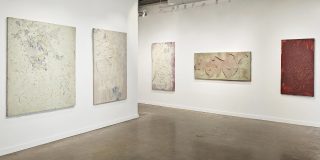
Contributed by Alex Grimley / In the 1972 documentary Painters Painting, Kenneth Noland is asked by director Emile de Antonio, “What does ‘color field painting’ mean?” The plainspoken artist thinks for a second before answering, “What they generally mean, I think, is that the painting is mostly generated by color, rather than, say, drawing or any other means.” Noland’s matter-of-fact response is indicative of his feeling about such terminology. Labels coined in the 1960s like “color field painting” and “post-painterly abstraction” – “a fairly awkward term,” he remarked – circumscribed his art, categorizing it alongside that of painters like Helen Frankenthaler and Jules Olitski, artists whose aims increasingly diverged from Noland’s. “Kenneth Noland: From Center to Edge,” currently on view at Hunter Dunbar Projects, is a concentrated presentation that illustrates the considerable range of the artist’s practice over four decades, from the 1960s to the early 2000s.

Noland’s mid-career work is particularly compelling. Like Ellsworth Kelly and Robert Mangold, Noland used shaped canvases to explore the spatial and tactile ambiguities inherent in radically asymmetrical paintings. Where Kelly tended toward bright monochromes and uninflected paint surfaces, relying largely on contour for pictorial interest, Noland’s colors are moodier and more dramatic, interacting with shape and sheen to heighten rather than resolve compositional tension. Mangold’s work has generally been closer to Noland’s, and several paintings in his most recent show at Pace, “Pentagons and Folded Space,” resonate with Noland’s highly irregular shaped canvases. For these two artists, shape serves less as a boundary than as a generative force, setting in motion spatial relationships that reverberate across the painting’s interior.
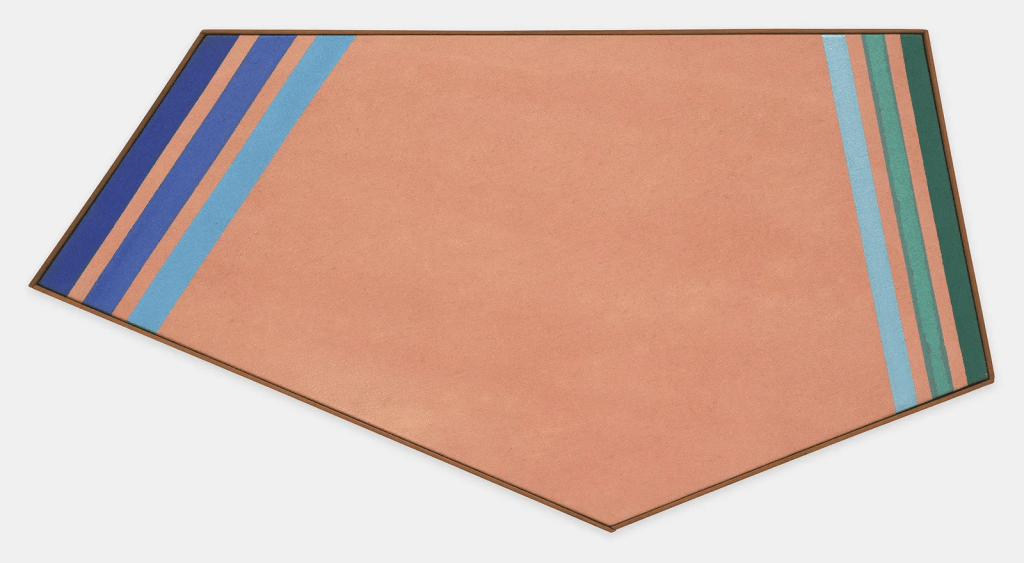
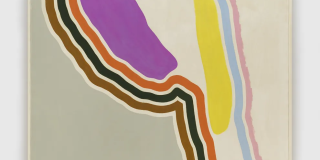
Slants (1976) is a standout in this regard: an erratically attenuated diamond, unpainted but for thin stripes along two sides, with a surface that seems torqued and warped. The bands of color that span two opposing edges charge the painting like a magnetic field, attracting the viewer’s attention and amplifying the picture’s visual speed along those edges while pushing the eye toward the expansive, unpainted center of the canvas. Despite its economy of incident, the painting’s visual dynamism is nearly inexhaustible; the shape does not settle into equilibrium. Up and Down (1978) produces a similar effect, with two sequences of cool-colored bands flanking the outer edges of a coral ground. Each sequence appears to reside upon its own plane, the two planes canted in opposite directions from the painting’s lower vertex. This painting’s spatial ambiguity is less emphatic, though, as its small size flattens its pictorial depth.
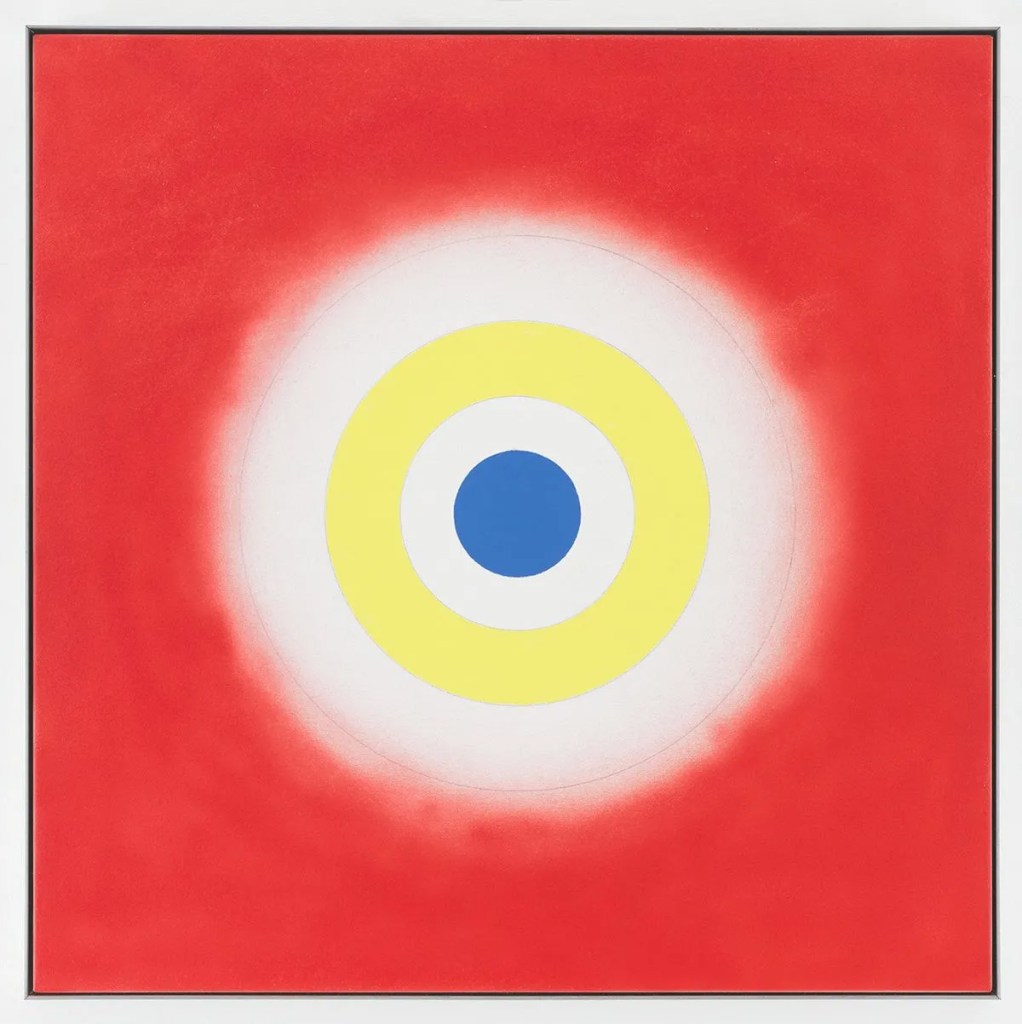
The show’s installation is sensitive to the nuances of Noland’s art, with works of similar tonalities grouped together. While the back gallery features a range of coolly toned pictures, several works in the front room foreground primary colors. This arrangement shows how the artist utilized similar color harmonies to different ends, as in Sea Purse (1962) and Mysteries: Costa del Sol (2001), two concentrically organized paintings built mostly around red, yellow, and blue. In the earlier painting, each color encloses the next, from the outermost yellow band inward. Together they hover weightless in the center of the raw canvas, with the innermost dark, pale circle reading like an absence rather than a presence. While the elements in Sea Purse appear flattened and layered, the circles in Mysteries: Costa del Sol seem to radiate outward from the dense blue core as if defining spherical volume. Ultimately, the exhibition functions less as a survey of periods than as a focused occasion for reconsidering Noland’s under-appreciated role in expanding the possibilities for abstract painting.
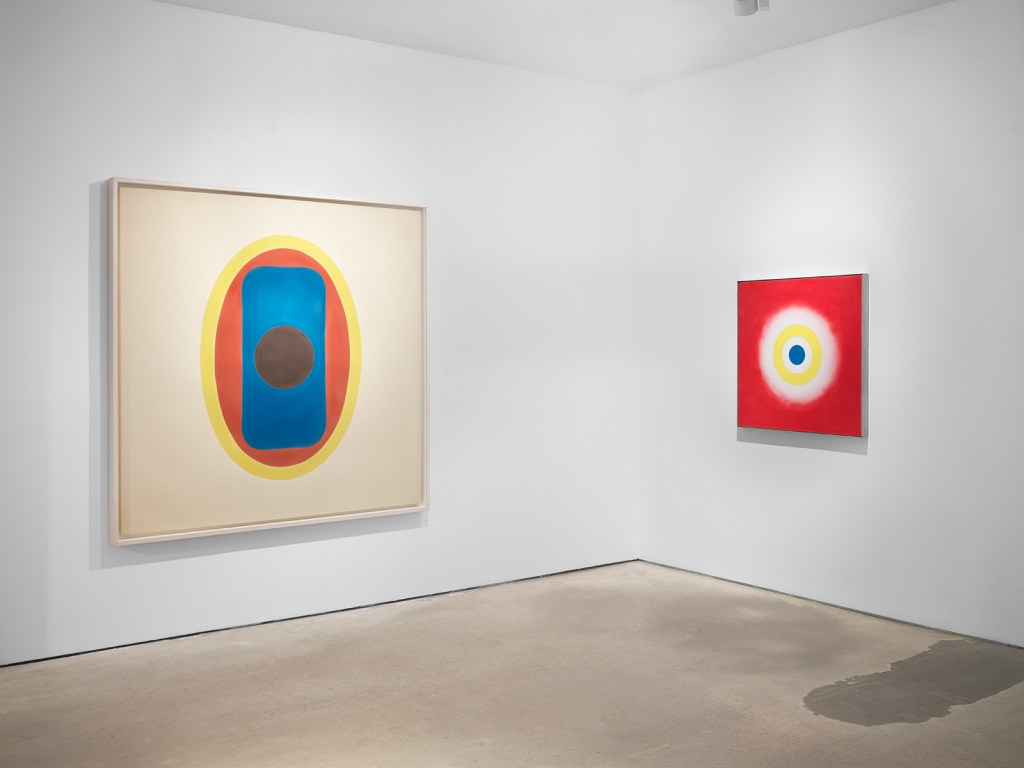
Left: Sea Purse, 1962. Right: Mysteries: Costa del Sol, 2001.
“Kenneth Noland: From Center to Edge,” Hunter Dunbar Projects, 524 West 24th Street, New York, NY. Through June 26, 2026.
About the author: Alex Grimley is an art historian specializing in postwar and contemporary art, particularly Color Field painting. His writing addresses intersections of visual art, criticism, and experimental music.





A strong review of art that is not easy to write about.