Tag: Alex Grimley

Solo Shows

Eric Aho: Between nature and abstraction

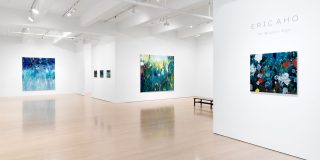
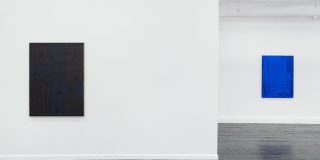
Contributed by Alex Grimley / Unique among the twenty-odd paintings in Eric Aho’s exhibition “The Meadow’s Edge,” on view at DC Moore, is a grass-green landscape. While many of the exhibited works feature a shallow foreground, this scene is bright and open, incorporating a meadow dotted with dandelions and stretching back to a remote tree line. The picture’s title, Meadow Near Lincolnville, Maine (1954), refers to the year that artists Alex Katz and Lois Dodd purchased a home in that town, and, as Aho remarks, “embarked on a new chapter of American painting.” Katz and Aho share a compelling interest in what seeing feels like. I first saw Katz’s manifested in Twilight at the High Museum in Atlanta. There he evokes the condition of seeing in near total darkness with a ten-foot-tall black expanse that gives way only near the very top of the canvas, to a faint patch of sky through tree cover. Without representing any recognizable landscape elements, the painting records the experience of looking up at the night sky.

Solo Shows

Sherron Francis: Between delicacy and force

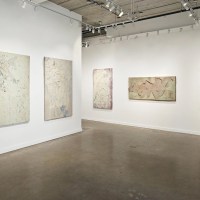
Contributed by Alex Grimley / One of the main currents of abstract painting in the 1970s – much discussed then, not so much now – was the resurgence of painterliness that followed the 1960s trend of hard-edge, geometric abstraction. The subject of the 1971 Art News Annual, for instance, was “Painterly Painting,” while the following year, art historian John Elderfield published an expansive two-part article in Art International titled “Painterliness Redefined,” which traced the emergent tendency primarily through the work and influence of Jules Olitski. At the end of the decade, exhibitions like the Brockton Art Museum’s “Aspects of the 70’s: Painterly Abstraction” offered a retrospective view of this development. “Sherron Francis: Beyond the Stain,” currently at Lincoln Glenn, brings this strain of post-Minimalist abstraction into focus through a particularly assured body of work from the late 1970s and early 1980s.

Solo Shows

Kenneth Noland: Generative force and visual dynamism

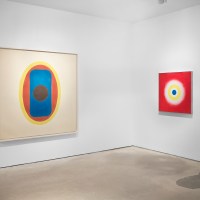
Contributed by Alex Grimley / In the 1972 documentary Painters Painting, Kenneth Noland is asked by director Emile de Antonio, “What does ‘color field painting’ mean?” The plainspoken artist thinks for a second before answering, “What they generally mean, I think, is that the painting is mostly generated by color, rather than, say, drawing or any other means.” Noland’s matter-of-fact response is indicative of his feeling about such terminology. Labels coined in the 1960s like “color field painting” and “post-painterly abstraction” – “a fairly awkward term,” he remarked – circumscribed his art, categorizing it alongside that of painters like Helen Frankenthaler and Jules Olitski, artists whose aims increasingly diverged from Noland’s. “Kenneth Noland: From Center to Edge,” currently on view at Hunter Dunbar Projects, is a concentrated presentation that illustrates the considerable range of the artist’s practice over four decades, from the 1960s to the early 2000s.