Contributed by Jonathan Stevenson / The painter Nora Griffin, nonpareil chronicler of New York City, grew up in Noho as her father George conjured, as she puts it, “a sweeter version of R. Crumb’s debased Zap comix” and helped pave her way as an artist. Fierman’s current show “Time Café,” named for the restaurant that anchored the neighborhood, galvanically pairs the two, complementing Nora’s shrewdly lyrical paintings with George’s quizzical drawings, flip-books, and avant-garde cartoons. The result is a deeply plumbed sampling of 1970s and ‘80s New York and what it wrought, poised between nostalgic commemoration and acknowledged perpetuity – a duality reflected in Nora’s 2026 portrait of her father circa 1976, one profile looking reflective and the other anticipatory. Ultimately, both artists understand that any desperation in extending sentimentality to the city is likely unwarranted because its susceptibility to discomfitingly rapid change – the “New York minute” – is largely a myth, its past firmly embedded and there to see. Their mission, undertaken exuberantly, is to record it in context.

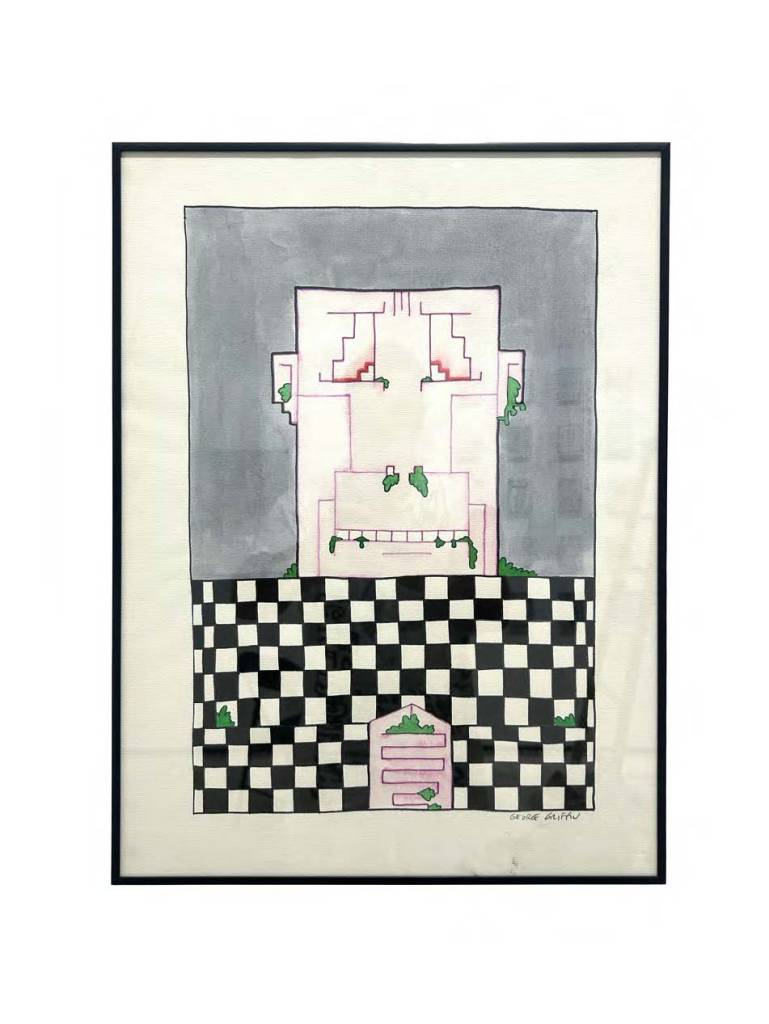
George’s 1972 drawing Solidarity, both sardonic and earnest, strikes a keynote of offhand confidence, presenting a building façade replete with inhabitants draped about the windows reaching into places not strictly their own and impinging – for the most part nourishingly or at least harmlessly – on one another’s lives, implicitly on an ongoing basis. Nearby, Nora depicts skyscrapers in paradoxically diminutive canvases. Empire State Building, Twin Towers, and Freedom Tower murmur the passage of nearly a century, the light in each dawn or dusk, echoing George’s wryly Oz-ish 1970s drawing City Country. If Hopper saw the city as an essentially horizontal phenomenon under modern siege, the Griffins have embraced its verticality as integral to an organic nature and expressive of undaunted potential.

Empire State Building, 2026
oil on canvas, 8 x 6 inches
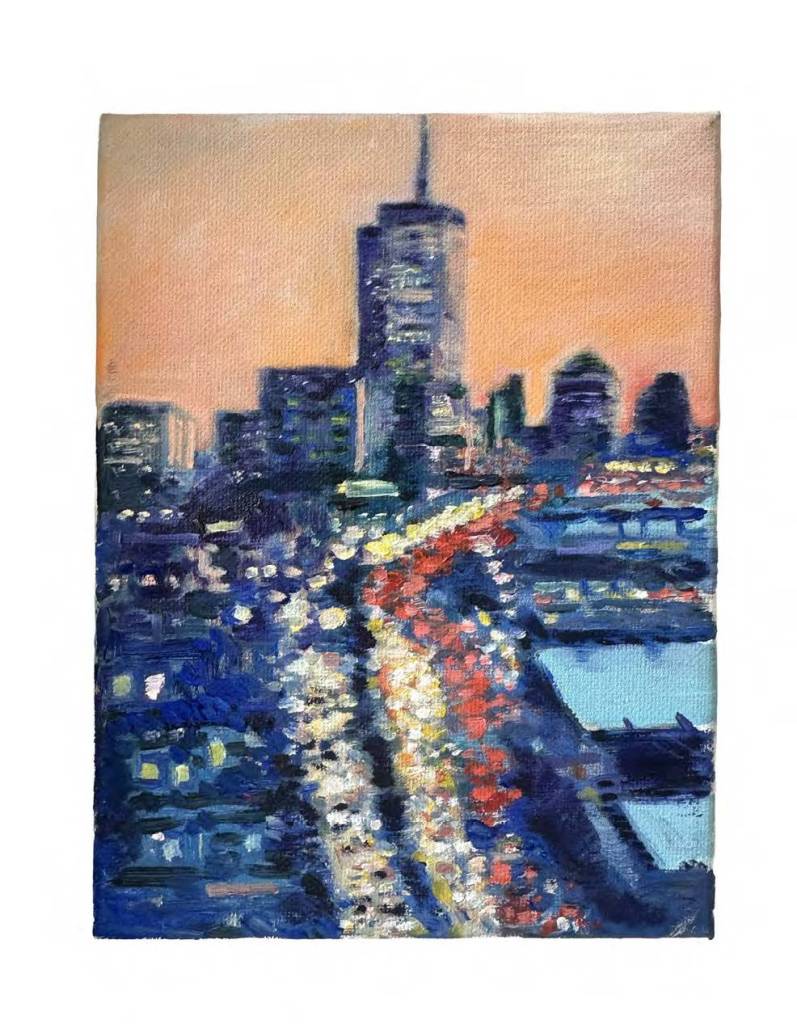
Twin Towers, 2026
oil on canvas, 8 x 6 inches
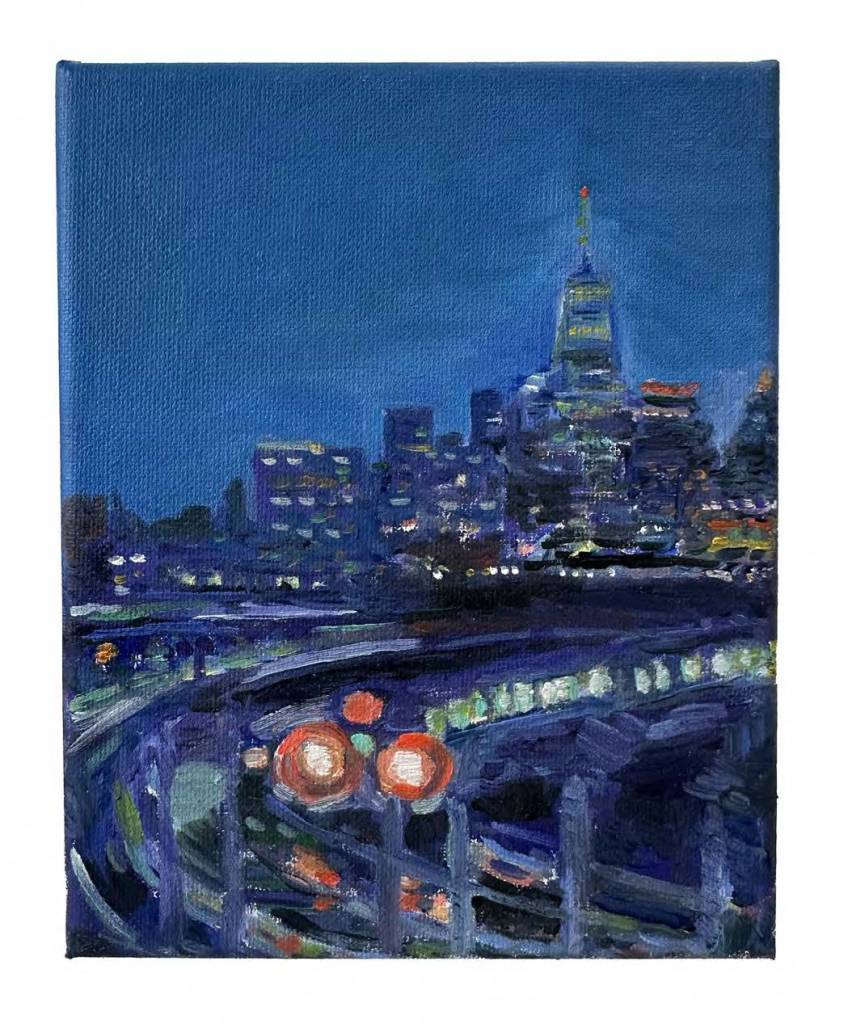
Freedom Tower, 2026,
oil on canvas, 8 x 6 inches
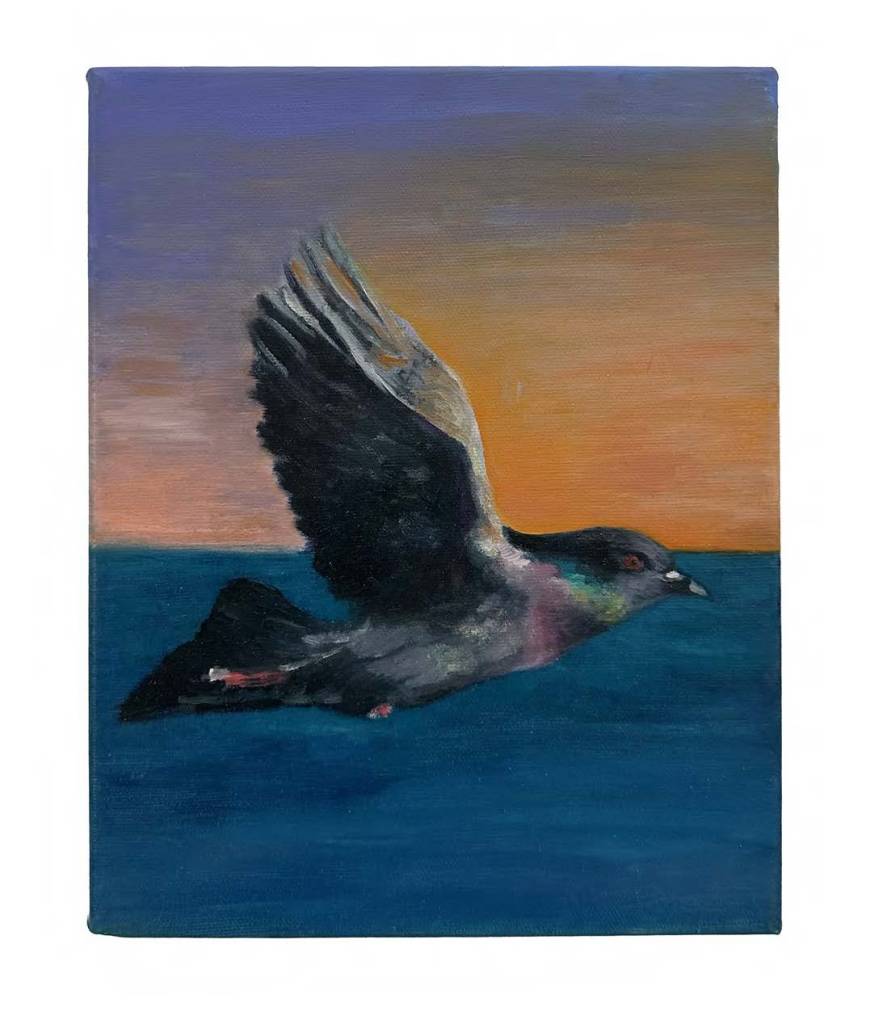
For them, as for many no doubt, New York punctuates intimacy with majesty and vice-versa. It’s an awesome juxtaposition, and isolating focus is useful for balancing the two elements, which are often in tension. Nora’s deftly conceived Pigeon in Flight, encapsulating the city’s humblest avian in mid-zoom over water, vaults it to the elegiac heights of the eagle. It’s the artist’s fanfare for the common bird, man, and woman. George’s 40 gloriously candid Daily Drawings, arrayed salon-style on the gallery’s north wall, span portraiture, caricature, pastiche, cityscape, and outright abstraction, recalling Raymond Pettibon in their uninhibited discursiveness. They drive home the density and variability of the quotidian urban experience and the challenge of securing oneself within it. To a kindred end, Nora, with Cat Eye, insets the profile of a pensive gray feline in an abstracted evening aerial view of the naked city and its eight million stories, as it were, the East River bending at Corlears Hook Park. A pet is a foothold for managing your little patch.

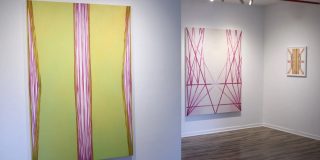
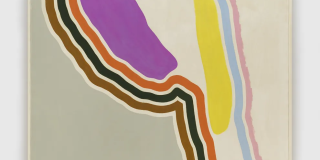
Nora’s small painting Time Café, the show’s title piece, straddles representation and abstraction with optimal precision and makes the endeavor look reassuringly casual. Lafayette Street is perceptible as a mildly congested artery, the titular establishment signified in outsize red text occluded by red, green, purple, and yellow swatches that seem to have a diagonal directionality – as a child she first apprehended cartoons as “moving colors” – suggesting elapsed time and souls. Like Wendy White’s work, the painting captures the whoosh and thrum of urban life with word and image, but Griffin subtly injects a generational factor that enshrines the effect. A larger untitled abstract painting, bright and loosely geometric with calmingly opaque passages, visits stability, permanence, and a more formal sense of history on the scene. It’s a fitting conceptual centerpiece for George’s Head, an incisive visual pun, static and terse unlike the freewheeling Daily Drawings, on one side, and his 1976 cartoon chase scene on the hand-cranked wooden Viewmaster Mutoscope, geared for posterity, on the other.


George Griffin, Daily Drawings, ink on 7 x 5 inches
The Empire State Building, the apotheosis of the twentieth-century metropolis, and Chaplin’s valedictory silent film City Lights, the great American fable of urban romance and fellowship, both debuted in 1931. Soaring progress and street-level decency can coexist, however tenuously at times. Cool doesn’t preclude heart or necessitate flight. The Griffins prove these propositions in a stealthily ensorcelling show that at once takes you back and keeps you here.

“George Griffin & Nora Griffin: Time Café,” Fierman, 19 Pike Street, New York, NY. Through August 7, 2026.
About the author: Jonathan Stevenson is a New York-based policy analyst, editor, and writer, contributing to the New York Times, the New York Review of Books, and Politico, among other publications, and a regular contributor to Two Coats of Paint.