
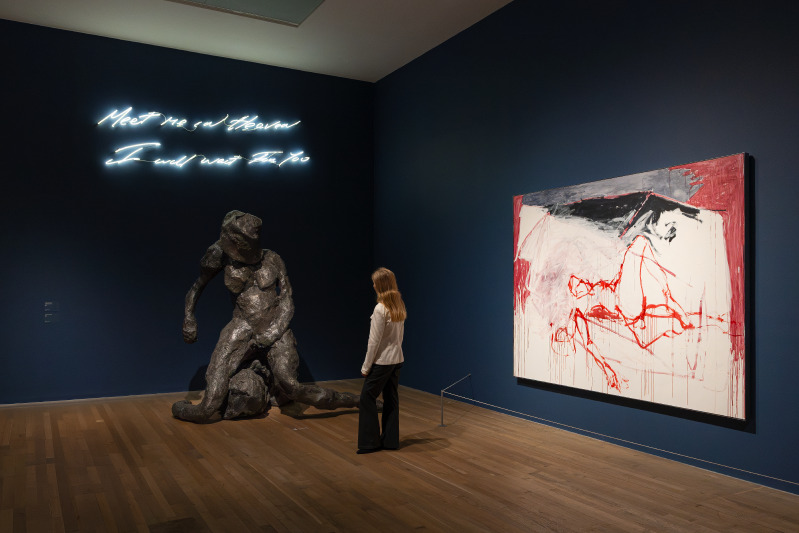
Contributed by David Carrier / Now and again, I have second thoughts about my initial strong response in an art exhibition. That was the case, in a way that deserves discussion, with “Tracey Emin: A Second Life” at the Tate Modern. In Britain, Emin is an art star. Before I went to this full-scale retrospective, I knew about her two seminal works – My Bed, her famously motley and putatively sordid installation, as well as Everyone I Have Ever Slept With, the tent incorporating the names of those thus described. With a life as eventful and stressed as Van Gogh’s, she has become a feminist hero. The subtitle of this show, “A Second Life,” alludes to her survival of devastating cancer surgery. In the wake of her friend David Hockney’s death, some are calling her the greatest living English painter.
As I walked through this exhibition, I was moved by Emin’s ability to surmount difficulties and keep making art, amplified by Martin Gayford’s new book My Heart is This: Tracey Emin on Painting – a decorous yet probing account of her life and art. Emin’s acutely personal work speaks to the larger public. A victim of rape from humble roots, she lives, breathes, and defies the ongoing oppression of male sexual violence and class-based discrimination. She’s a triumphant survivor. That said, from a strictly aesthetic standpoint, I did not respond positively to all of Emin’s works at the Tate Modern. The recent sculptures are, as other critics have suggested, a mistake. And the video Why I Never Become a Dancer, from 1994, though a brave experiment, is underdeveloped.


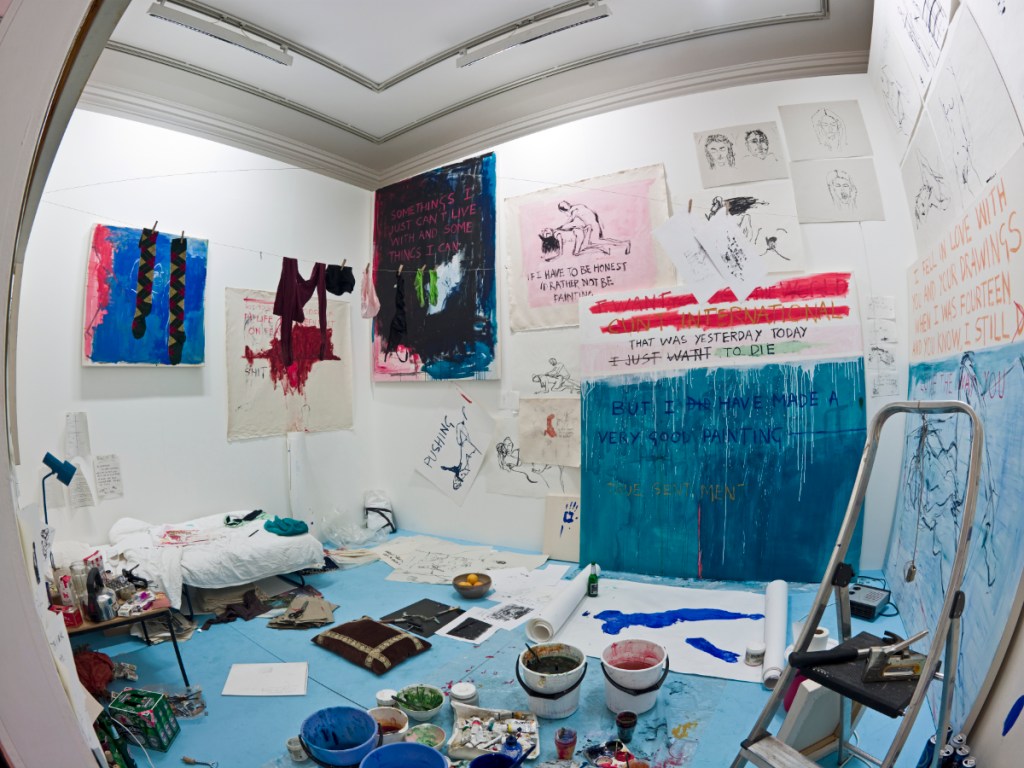
The case for the large paintings, upon which she now stakes her reputation, is more complicated. Can they credibly be shown alongside the works of Edward Munch, per Gayford’s proposition, as ambitious, deeply personal storytelling works? I thought so at first but now I am not sure. There seems to be substantial distance between Emin’s intense feelings and the expressive impact of the paintings, which are characterized by a wash of color, typically red, upon which figures, usually rendered in spiky black lines, are drawn. Emin’s written commentaries and those of her champions testify to her emotional investment in the work, but the linear drawing and the painterly brushwork often do not work in unison as effectively as she might hope.
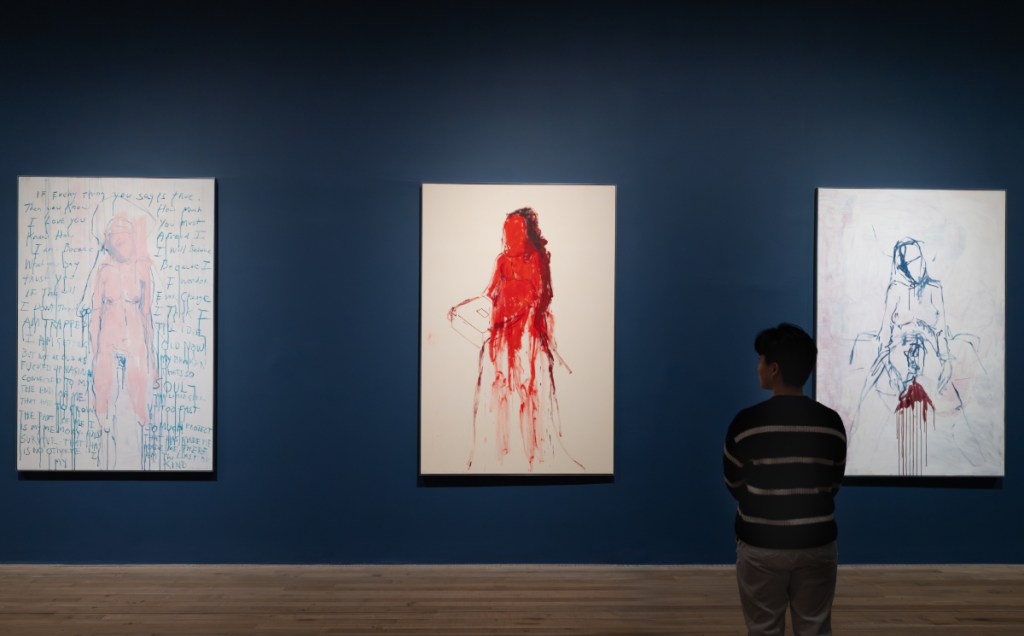

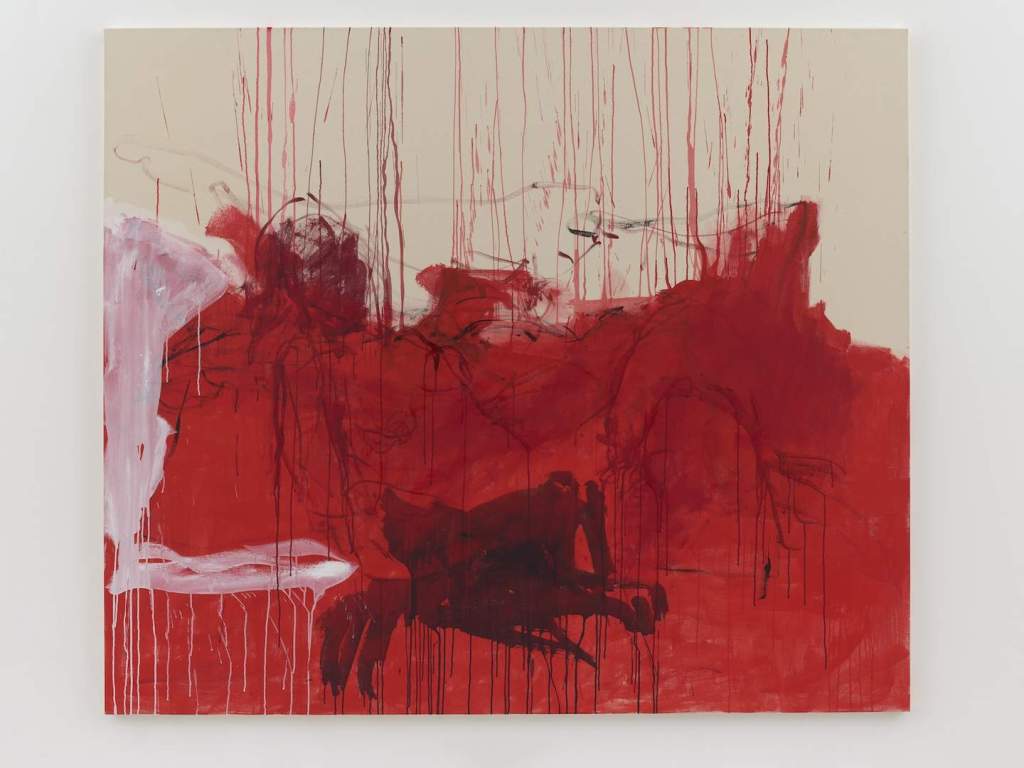


2001. Photo © Tate (Jai Monaghan)
This state of affairs puts the art critic – especially, perhaps, the male art critic – in an awkward situation. From a historical perspective, though, it is hardly unfamiliar. The great Denis Diderot apprehended Jean-Baptiste Greuze (1725–1805) with comparable ambivalence. Greuze’s sentimental pictures are probative documents of the Ancien Régime that, like Emin’s work, tell stories of virtue thwarted in ways that inspire the moral philosopher or political activist but disappoint the art critic. In my judgment, then, while “Tracey Emin: A Second Life” is not a great art exhibition, it is a significant event in social history.
“Tracey Emin: A Second Life,” Tate Modern, Bankside, London. Through August 31, 2026.
About the author: David Carrier is a former professor at Carnegie Mellon University; Getty Scholar; and Clark Fellow. He has lectured in China, Europe, India, Japan, New Zealand, and North America. He has published catalogue essays for many museums and art criticism for Apollo, artcritical, Artforum, Artus, and Burlington Magazine. He has also been a guest editor for The Brooklyn Rail and is a regular contributor to Two Coats of Paint.













I was reading with hopes you’d get down to brass tacks with the work but the review is really just barely a trailer for the release.
I’m looking forward to the expanded version.