

Contributed by Brenda Zlamany / A few days before I saw Backrooms, I attended Julian Schnabel’s In the Hand of Dante and stayed for the Q&A, with Laurie Anderson leading a conversation with Schnabel and a few of the actors on stage. I walked into that theater in a raw, hyper-specific state of mind, very much thinking about time and memory. David Hockney had died, and I was operating in a state of quiet shock. I had spent that morning writing a remembrance for The Observer about my last painting of Hockney as Whistler’s Mother, realizing it had unexpectedly become a final goodbye, a sort of time and meaning shift. To sit in the dark grieving one great artist while watching another’s film about beauty, consciousness, and the survival of the imagination was overwhelming.
From 1981 to 1985, I was Julian’s etching printer. To watch his images unfold on screen was to watch the work of someone whose etching plates I color proofed years ago, recombining images in each print. And the film’s restless geography glides back and forth between New Jersey and Italy. Lately, I have been dividing my own time between Brooklyn and my ancestral village in the mountains of Calabria, where I recently bought a house. The cinematic back-and-forth felt entirely personal. For long stretches, Schnabel’s images pulled me out of my grief precisely because they felt like an echo of my own life.
The audience was one of the most fascinating parts of the room. You could feel people hunting for a thread to make the film behave like a normal story. There isn’t one. At least, not the kind they wanted. Schnabel’s film treats time as a porous thing. It glides through Dante’s world, the present, memory, literature, dream, and performance. The contemporary world unfolds in stark black and white while the past blooms in vivid color, as if the inner life were the only real reality. It embraces pure associative thought, moving the way memory actually moves, through echoes and leaps rather than straight lines. The movie doesn’t ask you to solve it. It just asks to be trusted. I loved surrendering to that.
So a few nights later, I walked into Backrooms with that exact same posture. A little high. Not needing resolution. Still processing a heavy, artistic grief and the sudden collision of my own timeline, I wasn’t looking for a trapdoor or a line of dialogue to turn existential dread into a neat diagram. I just let the rooms keep going. It turns out that’s the best way to watch a film whose entire subject is the refusal of space to resolve.
I sat beside my twenty-five-year-old daughter, Oona, who saw an entirely different film. I am old enough to fondly remember floppy disks and the other textures the film treats as archaeological. That gap between us is part of the movie’s hidden architecture.
I don’t believe linear time is as solid as we pretend, and my painting of Hockney becoming a sudden farewell is proof enough of that. I know photography doesn’t tell the truth. The camera sees one way, and we mistake it for reality. It’s like one-point perspective, an invention that trained the Renaissance eye to trust a single fixed position. But we don’t look from a fixed spot. We move, remember, and revise. We see through fear, class, desire, shame, and grief. A shadow isn’t even a thing; it’s just an absence we’ve collectively agreed to read as form.
The mind doesn’t work like a camera. It works like this movie.
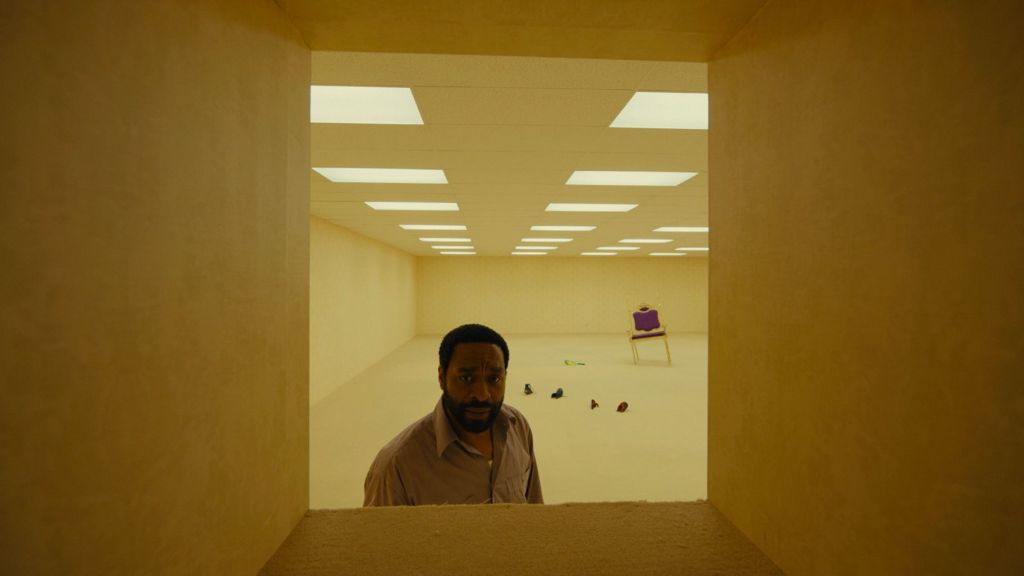
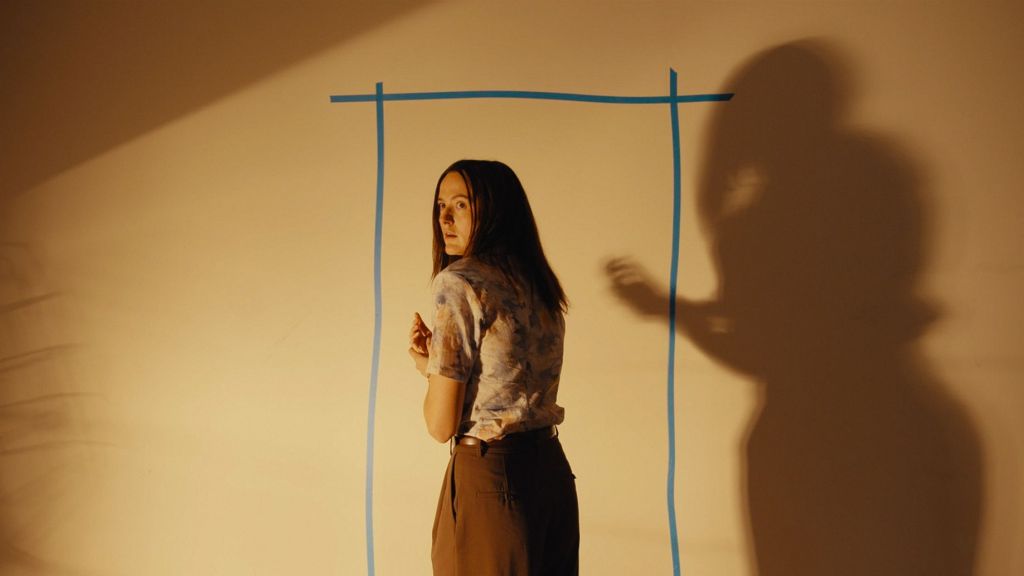
That is the brilliance of Backrooms. Its shifting faces and dissolving walls aren’t cheap horror tricks; their lineage belongs to Cubism. Perception is accumulation of partial views, like the face you saw a moment ago laid over the one right in front of you now. Picasso and Braque understood that painting a face from a single angle at a single instant is a convenient lie. A truthful portrait might have to hold several sides at once.
Simultaneity wasn’t distortion. It was a correction.
You don’t stand in front of a Picasso demanding to know which angle is real. Asking for one stable reality from this film is like asking a Cubist painting to choose a side. This logic is older than Cubism. Alice in Wonderland isn’t just a reference here; it’s a structural map. The Cheshire Cat dissolves. Bodies change scale. Rooms have laws that don’t care about your understanding. You either surrender to the internal logic or you fight it. Escher understood this too. Relativity isn’t surrealism; it’s another rationality. It only looks impossible if you insist on one gravity, one floor, one fixed orientation of the self. Backrooms is horror made out of rules followed too faithfully. Which is why there are two ways to watch the movie. Near the end, it picked the wrong one for me.
I spent the screening wondering how they would close it, half-dreading a disappointment because it was so satisfying as it was and it did not need an ending that made sense. But then the film flinches and it introduces Phil, a researcher from Async, and brings in the suggestion of a control room, an origin point, a primary reality. But there is no outside. There is no final room where a puppet master pulls the strings. It’s just rooms, all the way down. The question was never which reality is real, but who needs one to be. The ending feels built for the viewer who couldn’t sit with uncertainty. The film had been braver than that.
The real horror wasn’t the rooms anyway. It’s self-recognition. Clark isn’t killed by an outside monster, but by a pirate-costumed copy of himself, his own rage and self-pity made flesh. The place doesn’t haunt you with demons. It haunts you with yourself. Yet the movie doesn’t fully trust that psychological weight, so it leans on us to find the decor itself horrifying: drop ceilings, fluorescent light, old carpet, dead office yellow. Right there, the film makes a distinct class choice. The horror isn’t in the carpet. It’s in the eye looking at it.
Why is it self-evident that these rooms are dreadful? They are some people’s lives. What if that room was your everyday reality? I thought of CYO meetings, CCD lessons, and guitar practice in the church basement. I thought of the summer “camp” that was really just a windowless room where you sat and drew because there was nowhere else to go. Cheap furniture stores where we picked out our bedroom sets and paid for them on installment. Multipurpose spaces. Rooms that had to serve too many people for too many reasons.
These weren’t voids. They were social, available spaces for people who didn’t have summer houses or custom lighting. In other words: the majority of Americans. The exact room the film codes as dread is the space where I was formed. It’s the room where I first picked up a pencil. That is the part of the film that stung. It treats working and middle-class communal spaces as uncanny ruins. But those rooms were where things began. It’s where kids waited, got bored, watched adults set up folding chairs, listened to bad acoustics, and made do. By the time an internet-born fear gets scaled through the A24 apparatus, it has already been processed into a luxury aesthetic. The cringe is built into the production level.
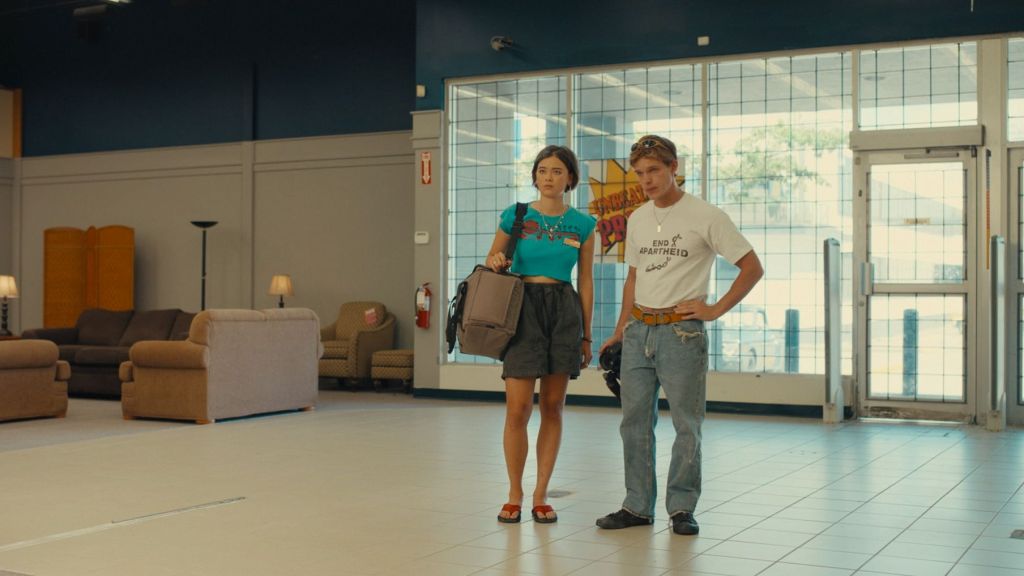
Left: Kat (Lukita Maxwell) Right: Bobby (Finn Bennett)
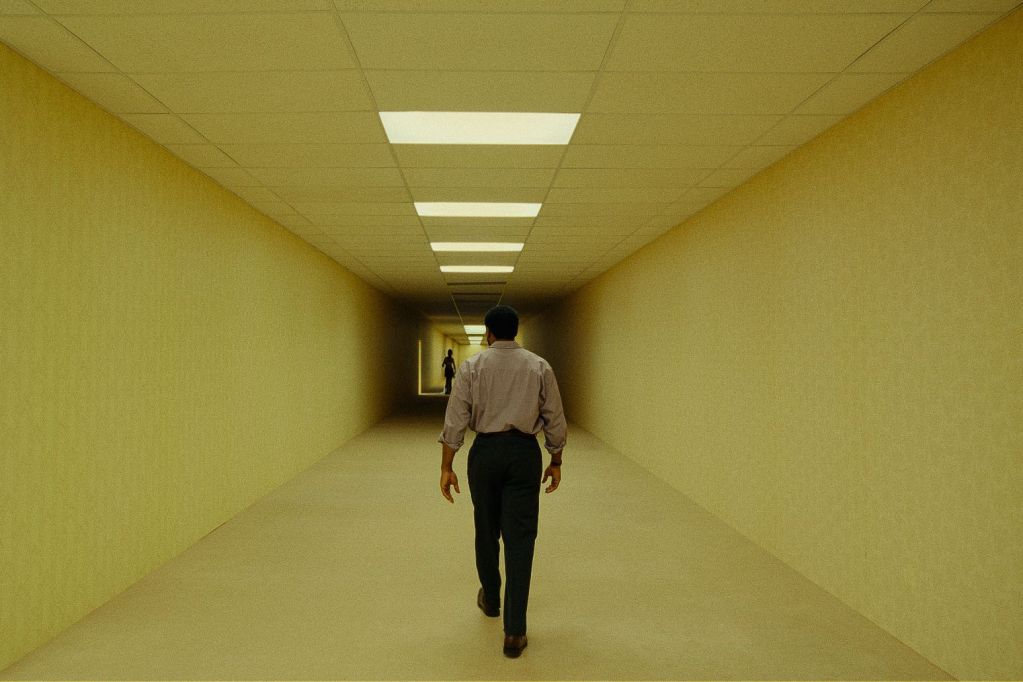
The ending and the class problem spring from the same mistake: both assume there is a correct reality outside the one being lived. That same gap divides memory. The floppy disks and cassettes are a lived world for me. For Kane Parsons, born in 2005, they are mere artifacts. I felt nostalgic; my daughter became an anthropologist. We looked at the exact same object and saw memory versus evidence.
Oona and I sat in the same theater and saw different films. The divide the movie thinks is about belief versus disbelief is actually a divide between memory and class. The film itself feels generated by these competing realities: the young person’s internet archaeology versus the A24 aesthetic machine. Neither can fully claim it, which is why the search for a single origin rings so false.
Mary is the counter-argument. As Clark’s therapist, she is supposed to hold a boundary. Instead, she descends after him, falling into the rooms and the transference itself. The moment she does, her authority evaporates. The healer becomes the hunted. At the table, she stops performing therapy and does the one honest thing left: she makes him look at himself, and admits she cannot help him. That confession of her limit is the truest line in the movie. What saves Mary, if “saved” is even the word, isn’t her clinical training. It’s the cement. She carries a handprint from her demolished childhood home in her pocket, and she finally swings that chunk of concrete at the monster.
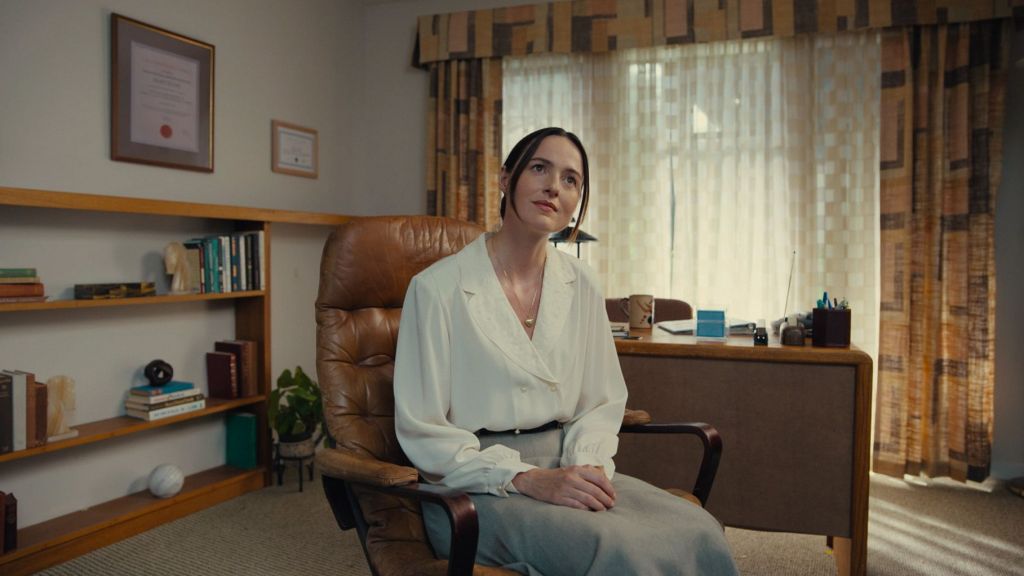
The film won’t say whether she escapes. The last we see of her is a face crowded with eyes, a copy of her, perhaps, trapped somewhere in the grid. I found I didn’t care which version she was. What stayed with me was that she fought using a piece of her own childhood, memory hardened into something she could physically hold. It is, of all things, a Cubist face, several sides at once, too many eyes. At the very end, despite itself, the movie tells the truth its ending had been trying to flee.
I left thinking less about the monster than about that piece of cement. Mary carried her childhood into someone else’s psyche, and it’s what she used to fight. I carried my church basement into a movie theater, and it’s what let me see clearly.
About the author: Brenda Zlamany is a Brooklyn/Calabria-based painter and creator of The Itinerant Portraitist, an ongoing global project spanning more than 3,000 portraits, with work exhibited at the Brooklyn Museum, the Taipei Museum of Contemporary Art, and the National Portrait Galleries in London and Washington, DC. She is a Pollock-Krasner and NYFA recipient and a two-time Fulbright Scholar, most recently to Italy for 2026–27.








Stumbled on this piece when cross-referencing Backrooms and Cubism.
I appreciate your response to the movie.
If you haven’t seen the web-series, I recommend those. Async is not as “in charge” as the movie led you to believe. They are definitely not a privileged vantage point.
I have been looking for a famous still life picture in cubism with a face in it, but I’m just finding skulls and busts of humans. Makes sense. Still lives exclude humans.
My take on the carpeting and fluorescent lighting is this: it is precisely the familiarity, not alienness, which makes it potent. Combine 4 parts familiar and 4 parts just plain wrong [the endlessness of it all, the reversed signs, the odd proportions], and you are in the uncanny valley: a location named in 1970.
Will give the classism more thought. I spent more than my share of time in a church basement, laying on a mat, staring up at the icky tile ceiling with those fluorescent lights during “nap time”. My gut tells me there is a reaction to the elimination of the middle class and its perceived stability going on here, the bourgeoisie malls and office spaces and living rooms misremembered by a group of people famously unable to own their own homes, whose way of buying things or renting videos is isolated, fragmented, doom scrolling into infinity with options which are, like an Amazon search for shoes, filled with odd bootlegs and bootlegs of bootlegs. Eidolons and such so confusing as to betray the notion there might exist a platonic ideal at all.