

72 x 50 inches
Contributed by Elisabeth Condon / Mary Jones pushes divergent visual modalities to – but not beyond – the breaking point in “Reservations” at High Noon Gallery, combining abstraction, décor, and photography in a lush chromatic range and challenging what painting can be or do with digital imagery.
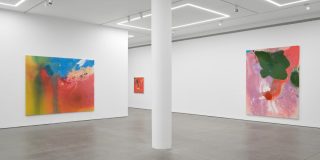
In previous exhibitions, Jones cast skeletal x-rays and expressionist gestures as signifiers of psychological presence. During the pandemic, she swiped and poured ink on upscale interiors from books printed in black-and-white, enlivening the static rooms with gesture. She printed the inked interiors on canvas, then layered hand-painted shapes within them. A muted palette controlled that work’s parallel worlds of printed and directly applied gestures, while the new work incorporates color prints of hospitality environments. Their bright, digital palettes augment Jones’s ghostly vellaturas and distinct gestures in a vivid duet. Punctuating four large, commanding diptychs are easel-size and smaller works. The latter highlight Jones’s painterly touch and sumptuous color, occluding the interiors behind bravura mark-making without omitting them and offering a concision that the diptychs, by design, do not.
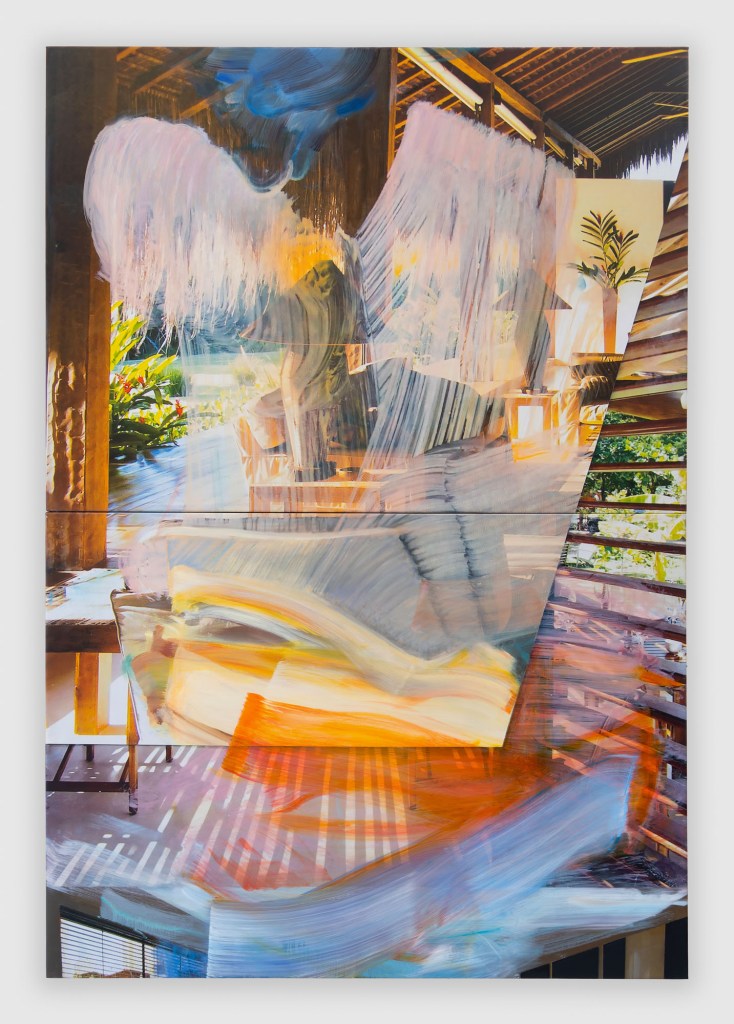
76 x 52 inches

42 x 34 inches
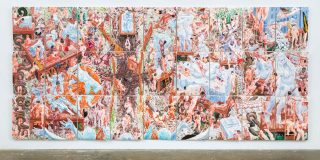
The diptychs dominate the space. Stacked features red and aqua gestures, wide and emphatically completed, across and along the vertical diptych format. The digital imagery reflects time and place through interior and exterior views of luxury suites, with neutral tones offsetting brighter gestures. Some gestures are printed, some directly painted; a blue sweep on the bottom half joins both applications, like a modified x-ray. Seen from farther away, the gestures appear substantial, even heavy, but close-up the paint thins and graphic imagery intensifies. Colliding temporal and material frameworks encourage our diversion to the creature comforts of the swimming pool, patio umbrella, illuminated windows, furnishings, decorative objects, and a painting on the wall (at which we chuckle), but relief is not forthcoming. Instead, we observe a disruptive seam between panels for which gestures cannot quite compensate.
Sun Maze is the exhibition’s most challenging work. It lives up to the title’s promise by way of overlapping views of a hotel room and cabana in a sunbeam veiled in soft color and rhythmic brushstrokes. Wooden shutters open to a patio and landscape gently circled by lofted roofs and striated ground. Responding to the imagery, we might start to relax – until a sharp diagonal slice, coinciding with the seam between panels, disconnects the interior sunbeam from the shutters, exacerbating the diagonal cut and denying us full perception and recognition. It’s a shock, challenge, and delight to feel such defiance in a painting! Underlying the expense of large-scale digital printing and the endeavor of harmonizing abstract gestures in print and paint is Jones’s fierce insistence that painting function on every possible register.

oil on digitally printed canvas, 12 x 16 inches
Door to the Plastic Sunflowers responds to Sun Maze’s irresoluteness. Lavish red, purple, and turquoise brushstrokes swirl through an interior that includes a clothing rack, shelving, and a bed. The shapes of these elements establish a spontaneous geometry over which the colorful gestures cavort. At the top of the painting, a ghostly white brushstroke folding in on itself extends a white curtain outward. A row of vases lines up above the seam, which smoothly bifurcates the bed. Large round forms below and above balance the composition. There are just enough touchstones to stay a long while, despite an egress lined with a jaunty sunflower curtain. Paint, décor, and digital effects align in construct and illusion.

oil on digitally printed canvas, 76 x 52 inches
A reproduction of de Kooning’s Door to the River, made with house painting brushes when he started traveling between New York City and Long Island, lay open in the studio as Jones completed her own Door. It’s instructive to see their paintings side by side. The shape and structure of Jones’s bold gestures relate to de Kooning’s insouciant brush more than you’d think. That’s not the only common characteristic. “Reservations” confirms de Kooning’s observation that “you have to keep on the edge of something, all of the time, or else the picture dies.” It is thrilling to encounter this much risk and rigor in a single body of work.

“Mary Jones: Reservations,” High Noon Gallery, 68 Reade Street, New York, NY. Through July 31, 2026.
About the Author: Elisabeth Condon is a painter and occasional writer. She lives and works in New York City and Tampa, FL.





What an articulate, precisely worded and thought-through review by Elisabeth Condon! It reveals and enlightens us about the work and process in a way that is generous and insightful – makes me want to go back and see this terrific show again!