Contributed by Patrick Bell / When the world stops making sense so does the body; the figure comes apart at the seams and becomes grotesque. “New Grotesque” at Management gathers 15 artists around this idea and the fact that the horror of the 2020s isn’t just lived but also streamed and thereby exaggerated and filtered. Where Bosch, Goya, and Ensor had war and plague of their own, a different kind of suffering is fed to us through the endless scroll. Management’s current show reflects the view that the grotesque has had to mutate to keep pace with the world. The distended, leaking forms here often make humans seem more like animals, machines, or meat than people.
The figure in David Altmejd’s serenely violent Smoking with Oneself has had its head cut off but could not seem to care less. A neon shirt lays on skin bruised purple, and the severed head has the same color of spoliation, as if left to rot on the counter. The two meaty planes of the neck open into two faces, each smoking a cigarette. A glass eye is lodged in the clavicle beneath a single rhinestone, ringed by thin lines that read as cheap tattoos. Two pink-veined dragonfly wings lift off the back, devoid of a central nervous system. The image should be disgusting and offensive but it’s mainly funny.

epoxy gel, resin, hair, acrylic paint, quartz, pencil, Plexiglas, paper,
thread, metal wire, glass rhinestones, steel rods, and concrete
35.5 x 21.5 x 20.5 inches
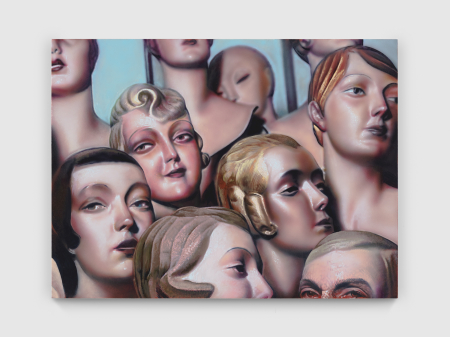
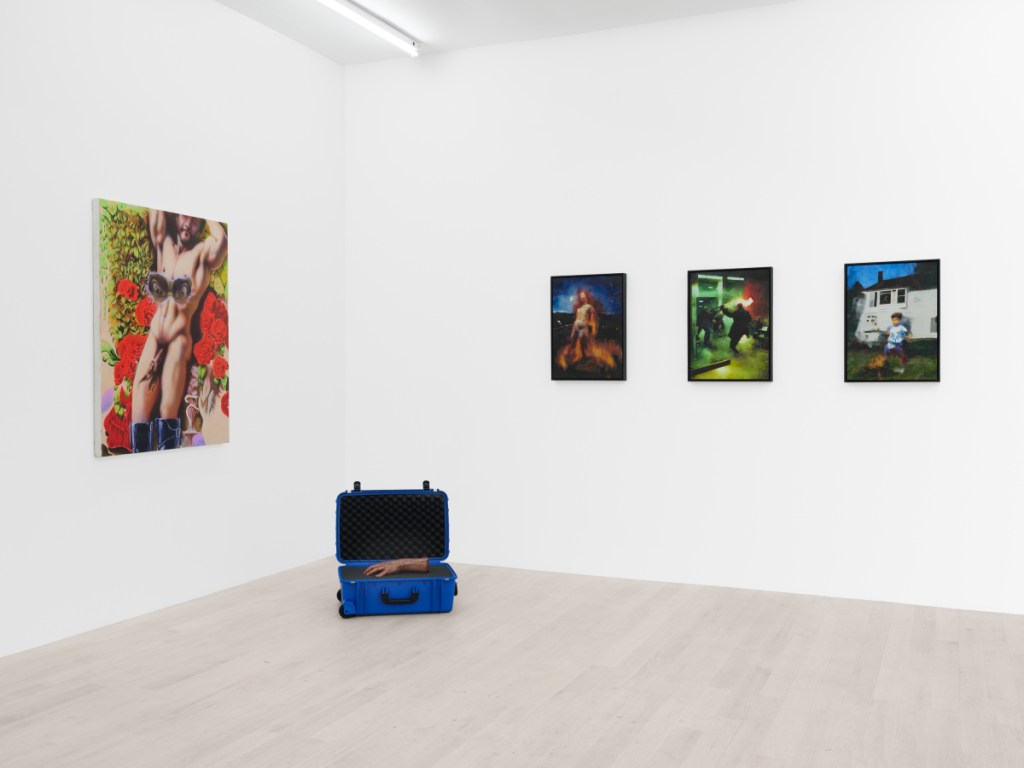
Dread meets the ridiculous in Tim Brawner’s two paintings. Heads gathers a crowd of faces with the glazed perfection of mannequins, groomed 1950s-style. The work seems almost calm until you fix on the menacing face peeking from the bottom of the frame with bloodshot eyes and veins crawling toward the hairline – a hidden antagonist. In Roses, depicting a relaxed nude with gargoyle-like eyes, the penis begins as ordinary anatomy before flowering into a soft-fleshed orchid. Beauty acts as a sort of Venus flytrap, seducing viewers only to unsettle them.

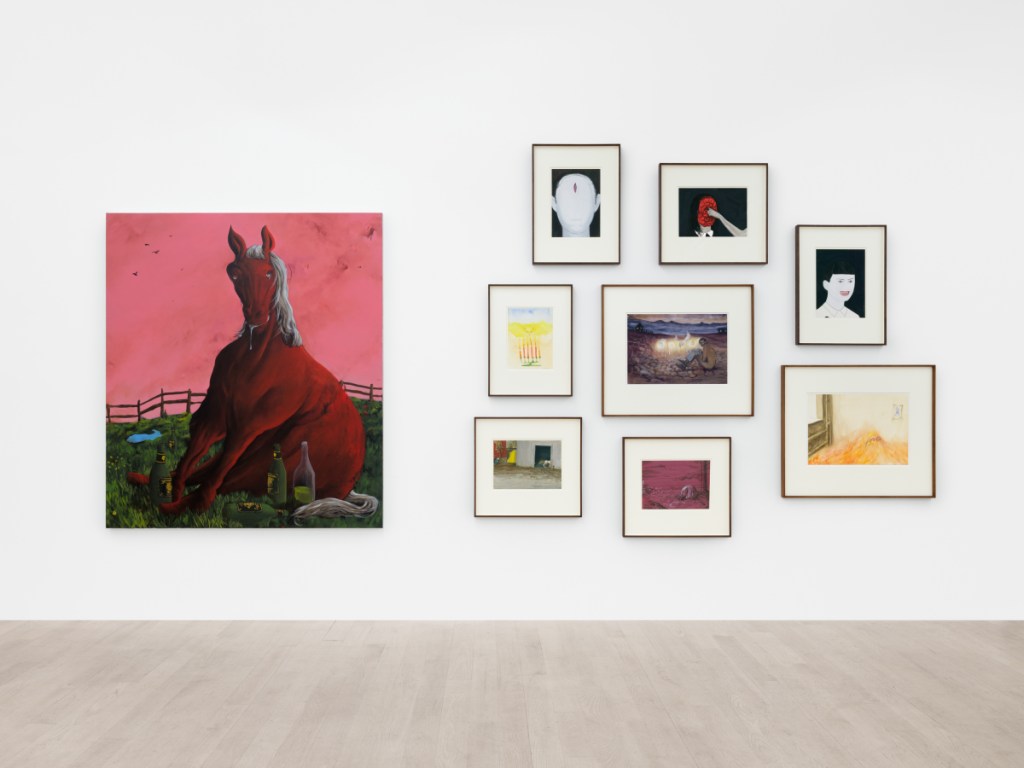
Aleksandra Waliszewska’s untitled gouaches – small portraits and landscapes, reminiscent of the Symbolists – are more immediately nightmarish. One Munch-esque face is marble white and noseless, wearing a sinister grin. Another portrait is a visceral, fleshy mass framed by stringy, wet hair with a single finger entering from the edge of the page. In another piece, a naked form crawls out of a dark barn, a figure wrapped from the waist-up in a blanket is bent before a tree, and at the center a ghoulish man with an enormous cigarette sits in front of four severed heads that glow, drip, and evaporate all at once.

framed: 24.25 × 17.875 inches

framed: 20.25 × 21.875 inches
Jang Pa flays the body and puts it on display. Gore Deco – Grinning Viscera #1 is exactly what the title suggests – intestines, eyes, teeth, hair, and swollen, abstract organs. All of these are painted over a subtle trace of a human figure in soft, warm hues, gestural marks, and violent paint splatter. The body is unpacked and displayed as it might be in a butcher’s window for a holiday. Tucked into the upper corner, a tiny anime creature sits perfectly composed with a little pink heart, out of scale and out of place.

transfer print on linen, 63.85 x 51.2 inches
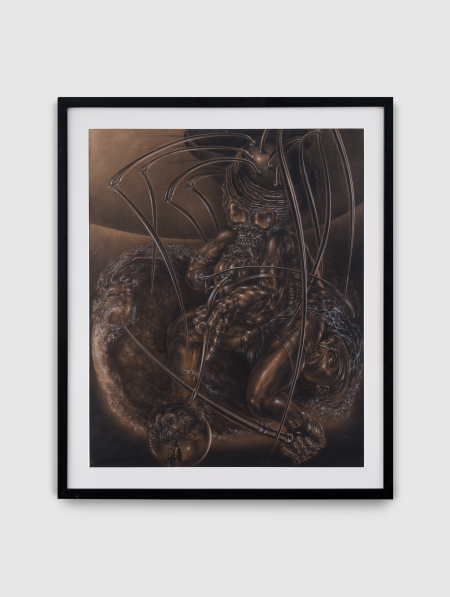
Linda Marwan’s Chimeras (Tatzelwurm, Annalise) is rooted in fantasy and folklore. Two demonic figures, one crimson and serpent-like and the other pink and squat, perch on a structure made of steel tubing. They seem like Halloween props too silly or creepy to sell. They are like Pain and Panic from Disney’s Hercules, waiting for their next assignment from the god of the dead. A few feet away, the cartoon underworld loses all silliness in Sibylle Ruppert’s Le Chant de Maldoror, a singularly troubling piece that unfolds with the hopelessness of the damned. A figure clutches a needled appendage that grows from lumps on its chest and seems to be swallowing or expelling a skull; bodies swim around it; a face winces in agony while a creature ingests a man whole. Bosch’s Garden of Earthly Delights and H.R. Giger’s alien sensibilities come to mind.

acrylic paint, magnets, textile and steel, 26.8 x 20 x 19.7 inches
41.3 x 33.5 inches
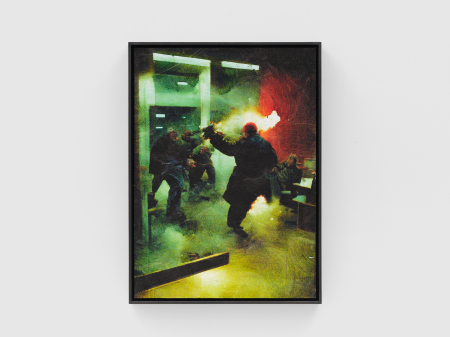
The theme of mediation is front and center in Jon Rafman’s three inkjet prints on canvas, which seem stuck in time by virtue of heavy brushwork and soft, blurring motion. A figure holds still under a supernatural sky while being engulfed in flame as a small boy runs in front of a white house with an animal at his heels. At the center is a robbery gone bad, featuring a gunfight. Unlike Rafman, Inna Smolina leaves her images bare and establishes discomfort through the augmentation of the body. Cyborg (grotesque) is a silver gelatin print of a nude with one hand across the chest, a long cloth spilling out of frame, and the distant gaze of an early Roman figure. Covering her are dozens of small devices resembling insulin pumps, betraying the figure’s otherwise classical bearing. Medical necessity becomes a kind of spectacle.

synthetic polymer paint on canvas, 25 x 18.5 inches
synthetic polymer paint on canvas, 25 x 18.5 inches
Igor Simic’s contribution is perhaps the most insinuatingly comical. A beeswax Mickey Mouse kneels in prayer, hands clasped and face lifted to heaven. The plane between nose and ears is hollowed to a crater of melted wax, the images disappearing as the wax burns in allusion to Icarus and to the votive candle, which now extends beyond saints to rock stars and politicians. Is Mickey, among the most repeated and consumed images on earth, a god or a blasphemer? As with Simic’s wasting mouse, the central idea that the screen has changed the nature of the grotesque lands hardest when employed not merely as a sardonic comment but to ask existentially important questions.

Beeswax and cotton wick, 9.84 inches
“New Grotesque,” Management, 39 East Broadway, New York, NY. Through July 26, 2026. Artists: David Altmejd, Tim Brawner, Miriam Cahn, Willehad Eilers, Christina Forrer, DD Herschlein, Linda Marwan, Tura Oliveira, Jang Pa, Jon Rafman, Andrew Roberts, Sibylle Ruppert, Igor Simic, Inna Smolina, Aleksandra Waliszewska.
About the author: Patrick Bell is a sculptor from Baltimore and a founding member of Red Giant gallery who writes for BmoreArt and Whitehot and teaches at the Maryland Institute College of Art and Baltimore School for the Arts.