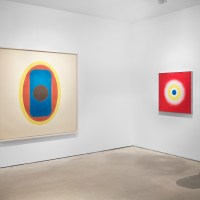
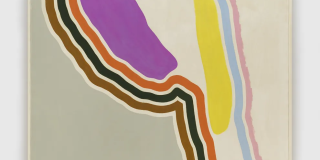
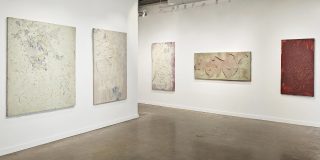
Contributed by Alex Grimley / In the 1972 documentary Painters Painting, Kenneth Noland is asked by director Emile de Antonio, “What does ‘color field painting’ mean?” The plainspoken artist thinks for a second before answering, “What they generally mean, I think, is that the painting is mostly generated by color, rather than, say, drawing or any other means.” Noland’s matter-of-fact response is indicative of his feeling about such terminology. Labels coined in the 1960s like “color field painting” and “post-painterly abstraction” – “a fairly awkward term,” he remarked – circumscribed his art, categorizing it alongside that of painters like Helen Frankenthaler and Jules Olitski, artists whose aims increasingly diverged from Noland’s. “Kenneth Noland: From Center to Edge,” currently on view at Hunter Dunbar Projects, is a concentrated presentation that illustrates the considerable range of the artist’s practice over four decades, from the 1960s to the early 2000s.