Month: March 2024

Gallery shows

Hudson Valley (and vicinity) Selected Gallery Guide: April 2024

Contributed by Karlyn Benson / Turley Gallery in Hudson is moving to a new space on Warren Street and opening three new shows on April 6. Other notable April openings include Becca Lowry and Ashley Lyon at Headstone in Kingston, Debra Ramsay and Leslie Roberts at the Garrison Art Center, and Susan Still Scott and Pearl Cowan at LABspace in Hillsdale. I’m also looking forward to the opening of The Re Institute in Millerton for the season with a show of new work by the space’s founder Henry Klimowicz. At nearby Geary there are a few weeks left to see Will Hutnick’s solo exhibition and on April 20 the gallery will open a solo show of paintings by ransome. Finally, I’m excited to announce the opening of Talking Threads, an exhibition I curated at Susan Eley Fine Art in Hudson featuring seven artists working with textiles. The opening is Saturday, April 6. I hope to see you there!

Gallery shows

Provocative conversations at Platform

Contributed by Michael Brennan / Just over a dozen photographic works, mostly on paper, make up this rewardingly idiosyncratic three-person show “A Matter of Time” at Platform Project Space in Dumbo. Leslie Wayne, a well-regarded and unconventional abstract painter herself, has carefully selected and arranged mostly monochromatic works by Simone Douglas, Joy Episalla, and Beatrice Pediconi. All three artists are engaging with water, time, and photography, and challenging deeply entrenched ideas about how photography can be realized and presented.

Interviews

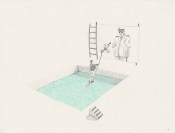
Massinissa Selmani: Outside the frame

Contributed by Rebecca Chace / I met Massinissa Selmani at Civitella Ranieri, an artist residency in Umbria, Italy where we were part of the first group of artists they welcomed coming out of the pandemic in spring 2021. We became a very close-knit group and several collaborations have emerged from our time together. “A Fault in the Mirage,” Selmani’s first New York solo show, is on view at Jane Lombard Gallery through April 27. We spent time at the opening and followed up with a conversation about his work.

Museum Exhibitions Out of Town

Caroline Burton’s compelling in-betweenness

Contributed by Michael Brennan / I took the train to Trenton, New Jersey – TRENTON MAKES, THE WORLD TAKES, the old slogan goes – to see Caroline Burton’s painting exhibition “Way Finding” at the Riverside Gallery in the New Jersey State Museum, which also includes a freestanding library, planetarium, theater, a natural history exhibit, an indigenous peoples’ exhibit, and the obligatory outdoor Calder. The complex, originally designed by Frank Grad and Sons of Newark and constructed in 1965, is a classic example of the liberal utopian/modernist cultural center typically frowned upon these days. But I’m happy to report that the campus, self-contained like Lincoln Center, was teeming with visitors from all walks of life. It is very much a living museum, and ideal for Burton, a reconstructed modernist, who in fact depicts its architecture in some of the works on view.

Solo Shows

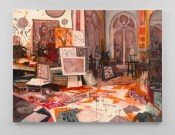
Vera Iliatova: Women in the studio, now and then

Contributed by Larissa Bates / Vera Iliatova’s solo show “The Drawing Lesson,” on view at Nathalie Karg Gallery, offers cinematic montages of female artists at work in a Brooklyn studio. The nine gestural oil paintings in warm greys and buttery mauves, with skirted figures moving indoors to backlit space, mark a departure from the haunted pastoral landscapes of Iliatova’s previous exhibitions. The dappled light, painterly marks, and muted pallet of the composite narrative interiors bring to mind Susan Lichtman as well as Manet. Gritty barges, a consistent motif of Iliatova’s, chug up the East River, glimpsed through single-paned industrial windows. These and concrete floors are reminders of the post-industrial spaces carved into the Brooklyn studios where Iliatova has spent decades working. As Dudley Andrew observes in the press release, she renders the place of rendering, depicting young women as simultaneously busy and solitary.

Solo Shows

Beatrice Caracciolo: Exquisitely stealthy

Contributed by David Carrier / What does it mean for a contemporary artist to be inspired by an older text or artwork? The Gospel of Matthew 15:14 says: “If the blind lead the blind, both shall fall into the ditch.” Moved by those words in 1568, Pieter Bruegel the Elder painted The Blind Leading the Blind, which hangs in Museo di Capodimonte in Naples. Now stirred by that picture, Beatrice Caracciolo, a young artist who grew up in that city, has drawn The Blind 16: one large image of the blind beggars and several smaller details also derived from the Bruegel. Between Matthew and Bruegel and then Bruegel and Caracciolo, there’s a kind of creative slippage whereby the meaning of the prior statement is transformed. At each stage, Matthew’s basic conception is partly preserved while something is added or subtracted. He doesn’t specify, for instance, that there are six blind men. Caracciolo shows his entire work, but without color, in grisaille. In smaller rectangular works on paper, she focuses on the trees and on some of the individual blind men.

Solo Shows

Andrea Belag: Fusing gesture, light and color

Contributed by Riad Miah / Andrea Belag, in her current exhibition, “Twombly’s Green”at Steven Harvey Fine Arts Projects, uses oil paint as a calligrapher might, employing sweeping gestural marks, scrapes, and wipes, as well as color itself, as her visual vocabulary. The paintings, of course, are not to be “read” in a linear manner but rather to be encountered and experienced. 

Solo Shows

Nora Riggs: Charming and more

Contributed by Michael Brennan / Nora Riggs tells stories of our modern lives, recording their details. Her mindfully hung exhibition at Tappeto Volante, titled “Uneasy Listening,” traces how her paintings developed, beginning with four small gouaches placed on the lefthand wall of the front chamber. They appear as modest studies. But they also isolate anxious drama, such as that of a young woman searching for a missing earring on the dance floor, in a different way than the larger paintings in the main chamber do. The gouaches feel more interior, spotlighting vignettes, whereas the larger paintings pass searchlights over more expansive tales. Riggs’s gouaches also reveal her penchant for pattern and decoration, leading me suspect that she’s internalized the lessons of Matisse.

Solo Shows

Mary Shah’s sense of direction

Contributed by Jonathan Stevenson / If the paintings in Mary Shah’s 2022 show “Dream Opera” suggested struggle from below against a resistant surface, her new ones in “Sunbird” – now on view at Rick Wester Fine Art and at least as impressive – declare liberation and ascent. Reinforcing this sense of breakthrough is a pronounced directionality, epitomized in Starlings (Jewel Street), whose arrow-like line zigs decisively to the left. The title presumably discloses Shah’s proximate visual inspiration. But, showcasing abstraction’s great virtue of allusiveness, which she is adept at harnessing, the painting’s imagery could also summon fish in the ocean, for instance, as well as birds in the sky. 

Solo Shows

Christopher Wool’s winning gambit

Contributed by Adam Simon / I’ve known Christopher Wool for a long time, since we were both teenage students at the New York Studio School in the 1970s. Philip Guston made annual visits and I remember his indignation at being asked to look at Christopher’s work. I believe he said that Wool’s all-over paintings should have been shown to someone like Larry Poons, not to him. In retrospect, Guston’s dismay seems to have been prescient and a little ironic. Wool’s breakout text paintings in the 1980s produced a similar response among painters as Guston’s cartoonish figure paintings had a decade earlier. Both overturned current orthodoxies. 

Solo Shows

Elizabeth Schwaiger’s deft summations

Contributed by Peter Malone / Elizabeth Schwaiger’s paintings, recently shown in “Now & Now & Now” at Nicola Vassell Gallery, are inventive and visually compelling. Her confident brush handling is on full display across 30-plus panels that serve up disorderly interiors, some suggesting artists’ studios. One is apparently based on Picasso’s mid-century studio in Cannes, one of the most photographed art studios in history. Despite its internet-snatched-reversed-horizontal-copyright dodge, which flipped an art nouveau element with a nearby archway, Ward for Abiding Hubris confessed its source. This prompted me to make a mental wager as to whether the art studio meme or the namedropping aside would prove dominant. Fortunately, the former prevailed, and then broadened to other interesting aesthetic matters. 

Museum Exhibitions

Howard Hodgkin’s Indian court collection: enigmatic or just good?

Contributed by David Carrier / Some very successful artists are also collectors, and the art that artists collect can reveal or confirm something about their own work and social attitudes. For example, Edgar Degas’ abundant holdings included works by Édouard Manet, which shows that Degas elevated aesthetic qualities over political beliefs. Unsurprisingly, Pablo Picasso traded art with Henri Matisse. Given Picasso’s obsessive rivalry with the Frenchman, he must have enjoyed keeping score with his frenemy as well as infiltrating Matisse’s collection with his own work. What then are we to make of British painter Howard Hodgkin’s trove of Indian court paintings, now on view at the Metropolitan Museum of Art?

Solo Shows

Allen-Golder Carpenter: Winter in America

Contributed by Mary Jones / Allen-Golder Carpenter’s debut NYC show, “To Dream of Smoke,” examines the aesthetics of hip-hop culture as a window into “masculinity, pride, posturing, incarceration, censorship and social programming.” A gender non-conforming interdisciplinary artist, activist, and poet born in Washington, DC, in 1999, Carpenter’s view is personal and close to home. Their work centers on rap music as a vibrant expression of Black culture, including the discomfiting relationship rap often has to violence as a statement of manhood, and the subsequent trap of prison. Carpenter explores the unrealistic expectations that many young Black people develop when drawn to an aesthetic that glamorizes violence, money, and fame. They deliver a complex message with the brutal declarations of an activist, but also the compassion of a poet.  

Screens

Movies of 2023: Barbenheimer and beyond

Contributed by Jonathan Stevenson / Last summer’s Barbenheimer phenomenon – the ballyhooed simultaneous release of Oppenheimer and Barbie, two expensive and well-acted films with sophisticated political messages rendered by leading auteurs – afforded 2023 the façade of audacity. But they came out during the writers’ strike, which signaled, if somewhat below the radar trained on the films, the uneasy and uncertain relationship between streaming and Hollywood.

Solo Shows

Diane Simpson’s elegant quirkiness

Contributed by Laurie Fendrich / While still in graduate school at the School of the Art Institute of Chicago in the late 1970s, the Chicago sculptor Diane Simpson (b. 1935) experienced a serendipitous moment. Through a store window, she caught sight of a child’s chair made from corrugated board. An array of little flutes connecting layers of liner board made the piece unbendable and weight-bearing while keeping it lightweight. Simpson went out and purchased some of the material and shifted from collagraph printmaking – a process that uses a plate with collaged materials – to sculpture. After learning to use a jigsaw to cut the board at a 45-degree angle, she made interlocking flat shapes of her own design, then assembled them into full-fledged sculptures.