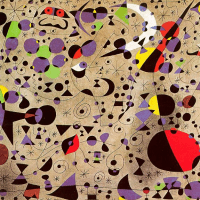
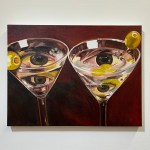
Contributed by Jonathan Stevenson / Last weekend in Brooklyn, for the tenth time, Norte Maar presented its unique and superlative CounterPointe dance-and-art performances. Each included seven dances, each of them a collaboration between a female choreographer and a female visual artist. Interpreting the programs is doubly subjective given that two main variables – dance and visual art – come into play.
Month: March 2023
Artist’s notebook: Sue McNally
Artist Sue McNally, a 2015 Two Coats of Paint Resident Artist, lives in Newport, Rhode Island, where her recent work is on view at Overlap, a new artist-run space in the neighborhood. Overlap founder Susie Matthews, who has been making and showing her artwork in Rhode Island for over 25 years, wants the space to appeal to creative thinkers who live amid a bustling tourist trade that favors seascapes over more challenging propositions. To celebrate the opening of the gallery and Sue’s show, Two Coats of Paint invited her to share some of the ideas and influences that have helped shape her work over the years.
Taney Roniger and the miracle of charcoal
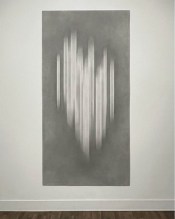
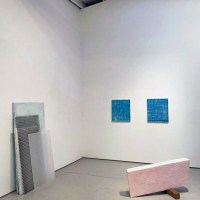
Contributed by Michael Brennan / I spent spring break at Studio 34 with Taney Roniger, mostly silent, measuring the depth of her drawings. Her solo show there, “Drawing is a Verb,” includes eight works on paper, mostly made of charcoal drawn on slightly textured hot-press watercolor paper. Each drawing is mounted directly on the wall, unframed, using hidden magnets. Her presentation of drawing as a primary medium – not something to be imported into painting or something else later, not for studies – is authoritative. Too often, drawing shows read as frame shows. Drawings presented like these, unmediated by glass or frame, preserve subtle surface incident that would be lost if they were conventionally sealed-off and protected. The collective series title, Myyrmaki, refers to a Lutheran church in Finland, a source of inspiration for the artist, known for its architectural engagement with fluted light.
Miyoko Ito: Past ordeal to beauty
Contributed by Laurie Fendrich / When I walked into the large middle gallery at Matthew Marks, where the stunning work of Miyoko Ito (1918–1983) from the 1970s is concentrated, a person in the gallery turned to me and said, “Give me a coffee machine and a cot and I can spend the rest of my life here.” I completely understood. I first encountered Ito’s work when I was in graduate school at the Art Institute of Chicago. Along with my teachers Ray Yoshida and Richard Loving, Ito joined my roster of painting heroes. The current exhibition includes three small, figurative lithographs, but the thrust of the show is the paintings – painstaking abstractions with allusions. Sixteen, spanning the period 1942 to 1983, the year of her death, are on view. All are modest in scale and, though there are color constants, each has its own particular – and novel – composition.
David Humphrey: Art is an ass
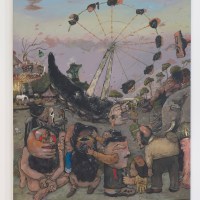
Contributed by Jonathan Stevenson / As “Ass Backwards,” the title of David Humphrey’s new show of paintings at Fredericks & Freiser, suggests, they are less in-your-face than much of his recent work. But they remain as busy, visually precise, and narratively provocative as ever, suggesting that it is not Humphrey’s approach to painting but rather his apprehension of the world and his place in it that have changed.
Gale force: Alyse Rosner at Rick Wester
Contributed by Riad Miah / “Bracing Against the Wind,” the title of Alyse Rosner’s solo exhibition at Rick Wester Fine Art, can be read literally and poetically. While her paintings depict dynamic elements of nature, they also reveal the intuitive hand of the artist. This allows the viewer to decode her process in making them, which includes rubbing, repetitive application, imparting decorative motifs, and more.

Heather Stivison: Seeds of Change
Contributed by Kathy Imlay / Heather Stivison’s paintings in “Seeds of Change: Paintings of Climate Change and Hope”, imply unseen possibilities for restoring the natural balance of our planet. In her first New York solo exhibition—on view at Pleiades Gallery in Chelsea through April 15, also and as an online exclusive with Imlay Gallery — Stivison explores the notion of seeds from both literal and metaphorical perspectives. She sees potential for change hidden within us as seeds buried in the ground, both filled with untapped promise.
Beautiful games: Football, art, beauty, spectacle
Contributed by Astrid Dick / On December 18th, 2022, Argentina, my country of origin, won the FIFA World Cup in Qatar against France, my country of residence. It was perhaps the most epic and thrilling final in this international tournament’s history. Two months later, Argentina’s victory is still slowly settling in my mind. As time passes, I realize more than ever how football – or fútbol, soccer, calcio, etc – at its highest level is a collective practice that parallels the practice of art, where the individual and the team refine and adapt their senses and skill, where gestures leave their imprint in memory, and where a decisive move can determine the outcome.
Mining Krzysztof Grzybacz’s oblique gestalts
Contributed by Margaret McCann / “At the Center of the Onion is Another Onion” is Polish painter Krzysztof Grzybacz’s first solo show at Harkawik. Sturdy yet subtle, his paintings are as elliptical as they are intense. Beyond unpeeling their complexity, his work offers consideration of a larger onion, that of figurative painting’s path through eastern Europe.
Riad Miah: My eyes just heard my brain
Contributed by Sharon Butler / As I walk through the dimly lit space behind an elegantly nostalgic bespoke clothing store on the Lower East Side, I feel as if I’ve landed in Desperately Seeking Susan, the iconic film starring Madonna that captured New York creative life of the 1980s. On the other side of a worn red curtain looms Riad Miah’s bright, busy studio. Confronting me is a plethora of colorful canvases, covered with writhing shapes, floating freely on irregular canvases.
Art and Film: The 2022 notables
Contributed by Jonathan Stevenson / This is a little late, but just in time for the Oscars. Filmmaking in the time of Covid is looking healthy, so no epochal disquisition is needed – just the usual caveat that these picks are inevitably subjective and, in some cases, perhaps eccentric.
As long as you want, at My Pet Ram
Contributed by Jenny Zoe Casey / The two-person exhibition “as long as you want,” featuring work by Julia Blume and Heather Drayzen, on view at My Pet Ram on the Lower East Side, is perceptively based on the referenced fragment of poetry written by Sappho over two-and-a-half millennia ago as a reminder of love, endurance and adaptation, and complemented by a slyly kindred show of drawings. Work by Joshua Drayzen is also on view.
Paul Mogensen’s ordering formulations
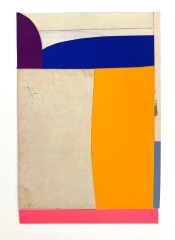
Contributed by Michael Brennan / Paul Mogensen dismisses the Renaissance. Not its considerable artistic achievements, of course, but rather its excessive emphasis within conventional art history. Mogensen is experiencing a renaissance himself with “Paintings: 1965-2022,” at Karma, a de facto mini-retrospective that includes 20 paintings and works on paper. Karma, a gallery known for its adventurous curatorial program and savvy publishing arm, has done a great deal more than most museums to sustain a variety of NYC-specific historical discourses since its inception in 2011. In the case of Mogensen, along with fabled colorist Robert Duran, Karma’s program is potentially the second coming of the legendary Bykert Gallery. This is a considerable achievement in a contemporary art world often characterized by “context collapse.”
Elizabeth Gourlay: Connecticut colorist
Over 13 years ago, Two Coats of Paint noted Elizabeth Gourlay’s exhibition of abstract paintings in Chester, Connecticut. On the occasion of her outstanding solo exhibition of paintings and collages at the New Britain Museum of American Art, Two Coats took the opportunity to catch up with her.
Kahori Kamiya’s expansive intimacy
Kahori Kamiya’s New York debut solo exhibition “Long Eclipse” at Amos Eno Gallery in Brooklyn is a powerful and personal exploration of her Japanese cultural identity and experience of womanhood. Through her works, Kamiya delves into her own existential and spiritual contemplations, reflecting on acutely personal experiences such as breastfeeding her baby, facing racial discrimination during the pandemic, and grieving the loss of her mentor.