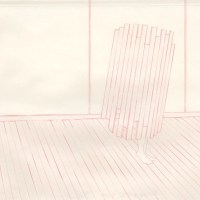
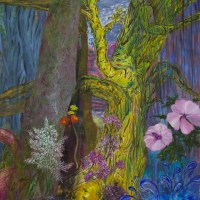
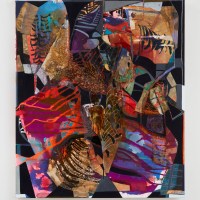
Contributed by Zach Seeger / Dennis Congdon, whose paintings depict acrid colored heaps of art garbage, once told me, “I tend to appreciate painters who work economically with what they’re given from their surroundings. You know, like my grandmother, who lived on a farm, and would whip up a meal with practically nothing in the fridge.” I too was raised to appreciate this beauty-through-austerity approach, and in light of tariffs and stagnating sales, painting with economy and valuing actual pigment may not just be in fashion but necessary. “The Big Seed,” Eric Hibit’s painting show at Morgan Lehman, is a tribute to physical pigment and the conservationist spirit, and a showcase for acute observational detail and the sheer joy of painting.
Solo Shows
Hope Gangloff: Dashing preconceptions
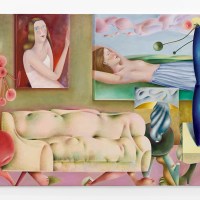
Contributed by Jonathan Stevenson / At first blush, Hope Gangloff’s remarkable new paintings, on view at Susan Inglett Gallery and largely set in a notional rustic retreat, could be mistaken for blown-up greeting cards for vacationing hipsters, perhaps with a sly nod to David Hockney. Pristinely applying acrylic paint, she crafts them like illustrations, and they are unabashedly luminous. But the ecstatic vibe that characteristically radiates from that quality, though present, is winkingly deceptive. While Gangloff paints friends and actively cherishes the intimate golden moment, existential concerns burn through her work.
Sam Anderson: Feeling is structural
Contributed by Patrick Ryan Bell / Situated in Baltimore’s Old Goucher neighborhood, art hall has rapidly established itself as a pivotal space for contemporary art. Once a Hells Angels bar, the venue has undergone a thoughtful transformation that embraces its history and urban context by way of significant international artists tailored to Charm City’s audience. In a city shaped by economic precariousness, institutional neglect, and fierce grassroots creativity, art hall presents an alternative model: serious contemporary programming without the trappings of market pressure or institutional polish. Owner and director Shawn Mudd is not looking to feed or mimic New York but instead to divert its pipeline, bringing established artists to Baltimore. Now up is Sam Anderson’s solo exhibition, “There’s a Girl in My Soup,” which features a wide range of her work. It fits the gallery: rigorous, poetic, and strange.
Camilla Fallon: Womanizer
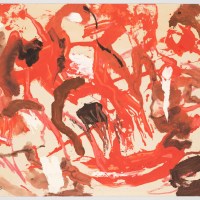
Contributed by Amanda Church / Following the fleshy path of Rubens, Lucian Freud, Joan Semmel, and Cecily Brown, among many others, Camilla Fallon has recently focused her loose, lush brushwork on the female body’s midsection, specifically the navel. “The Navel Is the Center,” her current show at The Painting Center, consists of eight medium-scale paintings and four very small ones, most providing an intimate view of this inverted body part. Under such close scrutiny, it becomes symbolic, implying vulnerability, contemplation, and introspection.
Maria Helena Vieira da Silva: Master of the grid
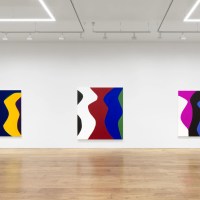
Contributed by David Carrier / Thanks to remarkably cultivated parents, Lisbon-born Maria Helena Vieira da Silva (1908–1992) was exposed to a lot of important art from early on. When she was just five, she saw the work of Paolo Uccello, a clear influence, in London’s National Gallery. Moving to France in 1928, Vieiro da Silva showed in Paris in the late 1920s and 1930s, took refuge from the German occupation during World War II in Brazil (her husband, Arpad Szenes, was a Hungarian Jew), and after the war returned to Paris, where she had a successful career. The expertly installed exhibition currently at the Peggy Guggenheim Collection in Venice aims to bring her art to the attention of contemporary audiences.
Jan Dickey: The art of breakdown
Contributed by Lucas Moran / In art, limitations often define, shape, and mold strengths. We can embrace drawbacks and spin them into gold. An impoverished de Kooning, living off ketchup packets and free coffee, turned to house paint to create some of his most compelling work. A bedridden Matisse cut paper. Scarcity, oppression, impairment – these forces have shaped the course of art history. Rather than relying on convention, Jan Dickey – investigator, tinkerer, and forager as well as painter – has immersed himself in studying how things break down, bond, and hold together. “The High Collapse,” now on view at 5-50 Gallery, is the culmination of that endeavor….
Benjamin Klein’s quiet defiance
Contributed by R. Blake Miller / Benjamin Klein’s solo exhibition “Sentinels and Satellites” at Tappeto Volante Gallery is at once enchanting and unnerving, like the fresh memory of a dream seen vividly even as it slips away. With an unapologetically saturated palette, the Brooklyn-based artist lays down paint in both translucent coats of tinted light and thick pools, blending natural textures with sublime color-mixing techniques. A surreal story involving animals and their plant counterparts unfolds. What initially feels inviting and innocent becomes tinted by dread. Mythic symbols hover beyond easy reading, coaxing viewers to explore their relationships with art more deeply.
Rick Briggs’s compositional irreverence
Contributed by Jason Andrew / It’s refreshing and a little humbling to walk into a gallery and be blitzed by art that’s cleverly derived from years of play, probing, and practice. Rick Briggs’s solo show at Satchel Projects shows us how open-ended and liberating painting can be.
Curtis Mitchell’s powerfully oblivious dogs
Contributed by Adam Simon / I tend to rail against art openings. Few attendees of a crowded art opening ever get to really see the show; the glimpses they’re afforded are more like scrolling Instagram than anything approaching contemplation. I felt differently at the opening of Curtis Mitchell’s pop-up show “19 Black Dogs” at the untraditional talent agency called No Agency on Bowery. The work does lend itself to contemplation, but at the opening of this show, Mitchell’s sculptures – stuffed dogs he purchases on the internet and then abuses in various ways – were contextualized by a young, hip crowd, connected I assume to No Agency rather than to Mitchell. Some appeared to be fashion models.
Dan Schein’s muddy sublime
Contributed by Lucas Moran / On Instagram, where most artists list their websites, exhibitions, and accomplishments beneath their handles, Dan Schein keeps it simple: “artist/painter,” followed by “Person Who Stutters.” It’s fitting for a painter whose work, some now on display at JJ Murphy Gallery, feels as though it may sometimes have a tough time coming out of him. But Schein, a painter’s painter, knows how to elicit beauty from struggle….
Pierre Obando’s potent hybrids
Contributed by Michael Brennan / Pierre Obando presents ten paintings, made between 2021 and 2025, in “Some Kind…,” his first exhibition at the Bushwick salon Starr Suites. While his imagery is for the most part recognizably organic, it is not easily decipherable.
Ray Hwang’s schematic dexterity
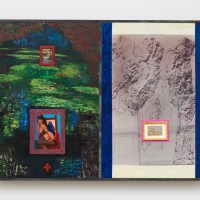
Contributed by Kate Sherman / “Ghost Coast,” Ray Hwang’s solo show at Tempest Gallery in Ridgewood, conjures an alchemical whirlpool of memory, meaning, and the self. In the line of sight from the gallery’s entrance hangs where there’s smoke-, a large and densely layered painting that evokes stained glass reliquaries or maybe a personal treasure map of candle-lit memories….
Divergent simplicities: Diana Horowitz and Janice Redman
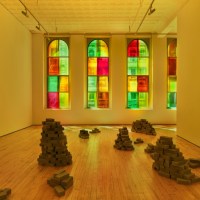
Contributed by Margaret McCann / In two shows at Bookstein Projects, excess and essence complement one other from opposite ends of simplicity. Janice Redman’s “Rough Alchemy” in the side gallery presents mostly small, hand wrought sculptures that project vulnerability, earnestly offering themselves in all their imperfections to our subjective examination. In the main gallery, Diana Horowitz’s “Light is a Place” highlights objectivity in landscape paintings that broadcast optical truth from across the room despite their tiny size. In portraying distance, they keep their own, reticently holding the walls.
In Conversation: Diana Copperwhite and Erin Lawlor
In this thoughtful exchange, artist Erin Lawlor talks to Diana Copperwhite about the role of intuition and emotion in their work, their love of music, and their mutual interest in painter Howard Hodgkin. Copperwhite’s paintings will be on view alongside Hodgkin’s work at the Auckland Art Fair from May 1-4, and Lawlor ‘s solo “Divining” opens at the Highlanes Municipal Gallery in Ireland on April 26.
Rob de Oude: See what happens
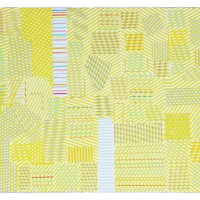
Contributed by Jacob Cartwright / It is no contradiction to observe that Rob de Oude paintings in his solo show “Rhyme and Repeat” at McKenzie Fine Art are created with an exceedingly sober methodology, yet achieve intoxicating outcomes. To make something and to see something are two different things, and revealing the interrelationship between them— as de Oude’s do— is one of the greatest pleasures that paintings can offer. While it may seem inapt to call such an exacting technician an experimental painter, the designation fits. De Oude conducts his investigations in the controlled environment of his studio, where variables are adjusted with one goal in mind: to see what happens.