Contributed by Franklin Einspruch / If there’s a unifying characteristic of worldwide modernisms, it is the challenge they present to the necessity of certain elements of inherited pictorial and sculptural forms. Looking back on artists who produced their first mature works in the latter twentieth century, it’s illuminating to ask whether the artists lodging that challenge were accusatory or reverent. That seems to be a more salient distinction than whether they were modernist or post-modernist. The accusatory mode was reformist, premised on the conviction that received traditions were presumptive, limiting, or saddled with unsatisfactory politics. Practitioners of the reverent mode might have agreed, but they clung to the possibility of renewal from within the confines of art. The work of Giorgio Griffa is an exemplar of the latter.
“Paths in the Forest” at the Clark Art Institute is Griffa’s first American solo museum exhibition, coinciding with his 90th birthday. The installation in the Tadao Ando-designed Lunder Center at Stone Hill flatters the work handsomely. The show’s title, referencing the opening canto of Dante’s Inferno, echoes the walk through the Berkshire woods from the main campus to the gallery. “Midway upon the journey of our life / I found myself within a forest dark, / For the straightforward pathway had been lost,” as Longfellow translated it. After Art Informel, the path for painting was far from bright or straight.
Griffa found his bearings via what Barnett Newman used to call ideographs. Nowadays, the term is hardly used. Griffa’s work merits its revival. Yve-Alain Bois, writing about Newman, described the ideograph as “a sign, but it is a sign of a special kind, one that emphasizes a certain circularity between its signification as a sign and the actual situation of its utterance.” For Newman, it was a mechanism for transmitting ideas without resorting to names. But the expression of names remains an option: Griffa frequently writes on his paintings. Using flat brushes full of thin acrylic, working on the floor, he forms marks and words on unprimed, unstretched canvases. Tacked to the wall, they possess the scale of billboards but the intimacy of handwritten poems.
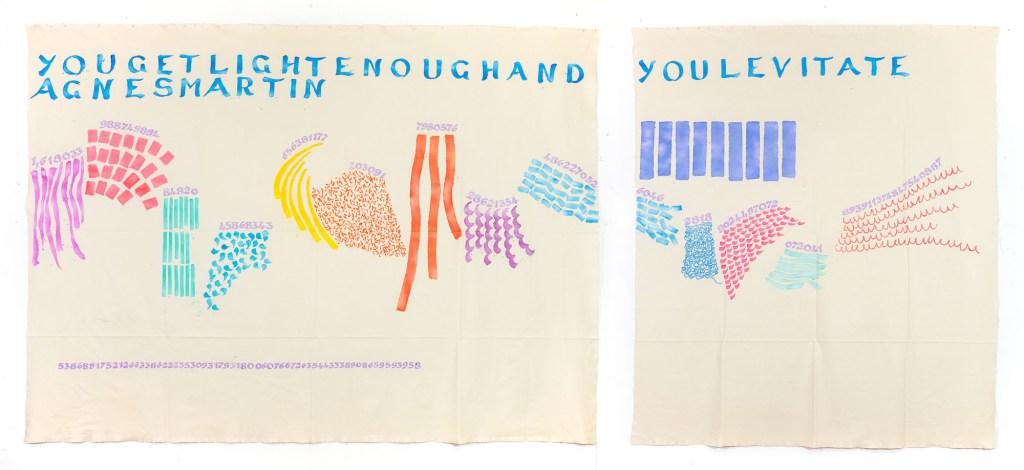
The works are brainy, influenced by D.T. Suzuki and the writings of Matisse. Art historian Flaminio Gualdoni characterized Matisse as Griffa’s “tutelary god,” providing an anti-hierarchical model in which an equality of means could emerge, as Griffa himself put it, “between materials, between me and materials, between the hand and the brush, between the hand and the mind.” Suzuki was the source of Zen-inflected avoidance of painterly finish, process without concern for outcome, and the impetus to let materials speak for themselves through bare supports and the action of liquid medium upon them. Griffa drew further affirmation from a modernist Zen aesthetics by way of Agnes Martin. Canone aureo 958 (Agnes Martin) (2016) quotes her essay “The Untroubled Mind”: “You will not think form, space, line, contour / Just a suggestion of nature gives weight / light and heavy / light like a feather / you get light enough and you levitate.” In Canone aureo, “YOUGETLIGHTENOUGHANDYOULEVITATE” drifts in blue lettering across two unequally sized canvases as big as tarps. Excerpts from the infinite unrepeating decimals of the golden ratio appear alongside marks that wordlessly express their nature.
While operating in a conceptual register, Griffa’s works are technically anchored in the methods of Morris Louis and incorporate his sensuality to a surprising degree. Griffas do not fly away into untethered cogitation. They are profoundly concerned with paint and the mechanics of its absorption into cloth. The catalogue quotes him from a 1973 interview: “It’s truly reality that materializes before my eyes, and so I simply focus on making it present, with the utmost awareness.” Elsewhere: “I make lines … I can’t even say that. I pull color across canvas.”
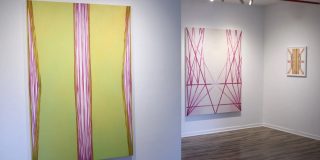
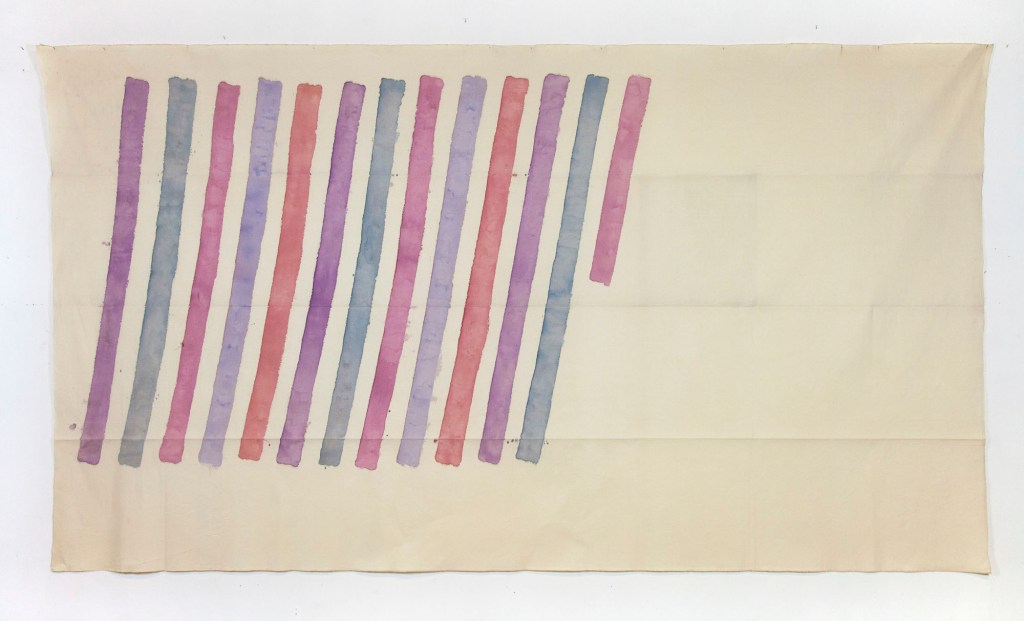
Kenneth Noland’s horizontals from the 1960s, some of which I recently saw in a private collection, provide useful contrast to Griffa’s Linee orizzontali (Horizontal Lines) from 1973. Noland established the rectangle as a presence unto itself; Griffa, with no border except cut cloth, let it fade out into an edgeless horizon. Noland’s bands were complete and emphatic; Griffa’s are conspicuously hand-drawn, and the bottom line casually discontinues two-thirds of the way across the canvas. The Nolands are intended to remain flat rectangles forever; the Griffas have light creases because he folds them for storage as a gesture against preciousness. If the Nolands exude more visual pressure, the Griffas might be a little more human. Each is an artifact of a process, but the Nolands are more artifact and the Griffas more process.
The conscious act of discontinuation appears in other works, particularly the series titled Segni (that is, signs; recall Newman’s ideographs). In Undici segni (Eleven signs), various shapes spill forth from the left edge of three separate pieces of jute-dark canvas without ever reaching the right. Griffa has numbered them, breaking down an image that arrives holistically in the viewer’s consciousness into the discrete steps that went into its making. More or less following Suzuki, he contends that the incompleteness and sense of process better reflect the nature of reality than art that strives for resolution. There are reasons to doubt this as a general rule. We perceive things whole, which arguably correlates to reality as much as deciphering component experiences. (So argued the phenomenologist Maurice Merleau-Ponty.) Finished art, which most of it is, may be an attempt to represent wholeness. But within Griffa’s priorities, the premium on process is a productive stance.

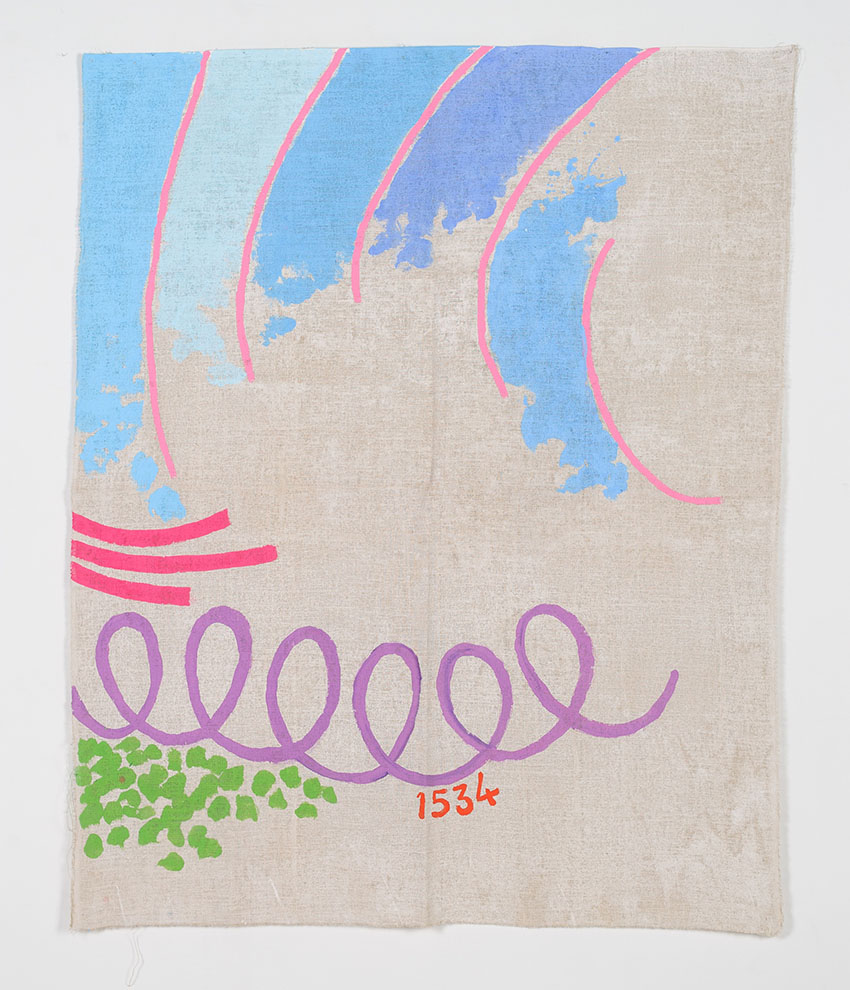
(Three Lines With Arabesque No. 1534),
1995, acrylic on canvas
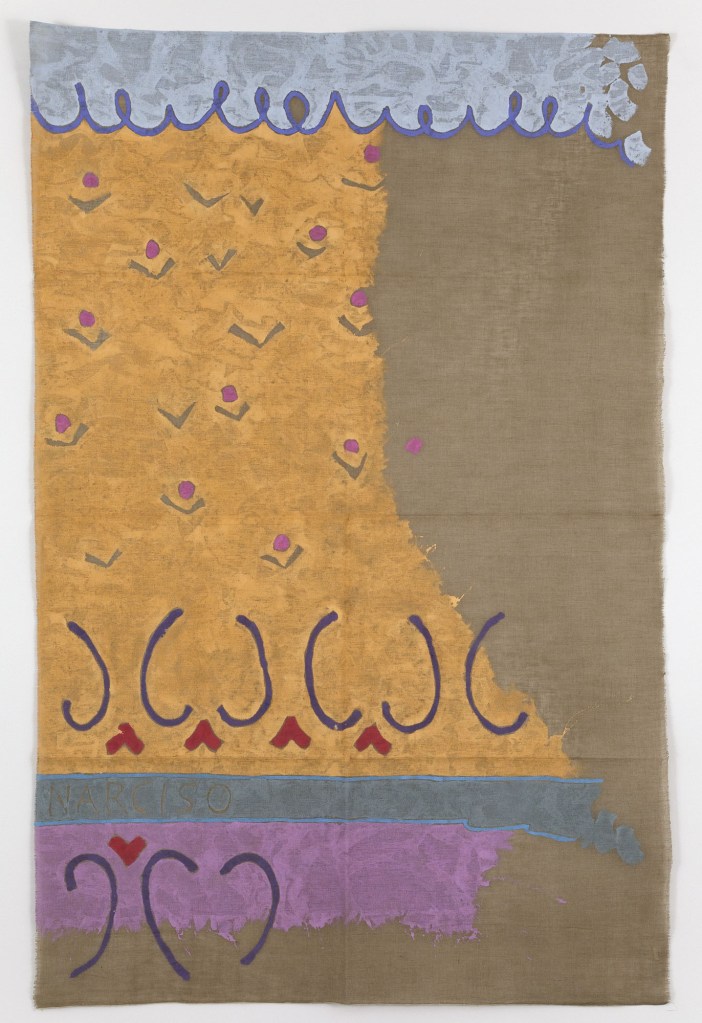
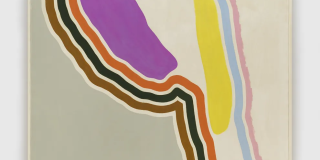
In a 2025 statement in the catalogue, Griffa inveighs against a Principle of Domination that gave rise to a “demand for perfect marks that are one of a kind, signs of the artist’s hand,” as well as manifestations of technology-induced woe and environmental degradation. He counters: “In my work, marks bear their own identity, their own age-old memory, not mine.” Nevertheless, handwriting is evident, even in the abstract shapes. Griffa’s Narciso, which Yale art historian Joanna Fiduccia labors valiantly to connect to Caravaggio’s Narcissus, derives tonally and structurally from Matisse circa mid-1910s. The discontinuation of forms from left to right is so overt that the powder-blue border across the top splits into flakes. The desired effect was “this painting is discontinued.” The achieved effect was “I have discontinued this painting.” That’s the problem with trying to get rid of hierarchies: they tend to reappear as contrarian maneuvers.
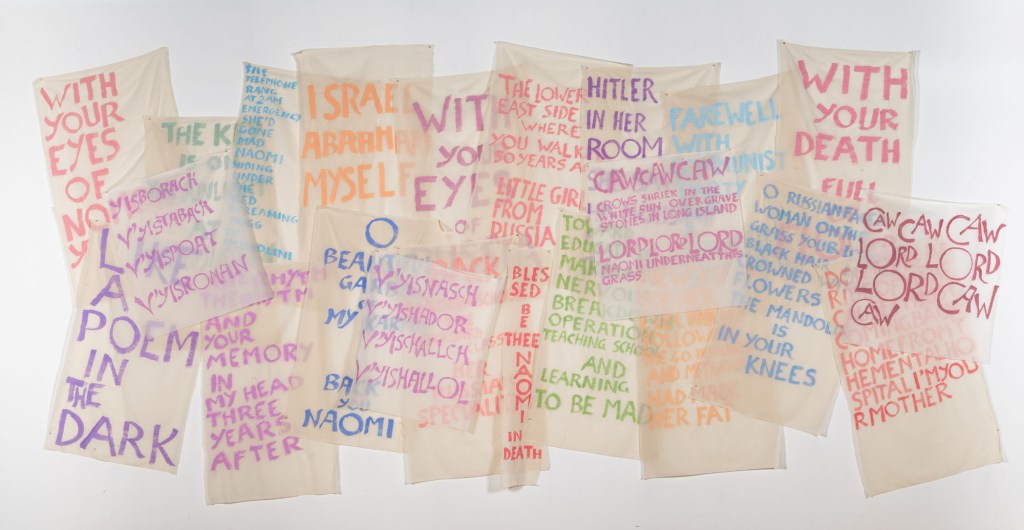
Griffa’s self-consciousness recedes when he works in a spirit of admiration, such as his rendition of Allen Ginsberg’s Kaddish. This work of reverse ekphrasis tacks up canvases with Ginsberg’s poetic lines written lovingly upon them into an exuberant pile. Equally charming is On the Road, an homage to Ginsberg’s fellow Beat, Jack Kerouac, that takes on special significance in light of the title of The Clark’s exhibition. Here, a pathway of marks in different colors and qualities snakes back and forth across the canvas. It ends midway because we are still in progress. In these recent works, Griffa’s reverence has extended to his own person – not as pride, but as enjoyment of his bodily, painterly action. May he ever continue thus.
“Giogio Griffa: Paths in the Forest,” The Clark, 225 South Street, Williamstown, MA. Through October 12, 2026.
About the author: Franklin Einspruch is an artist and writer working in painting, printmaking, and comics. His art criticism appears regularly in The New Criterion. He is the editor of Aphorisms for Artists: 100 Ways Toward Better Art by Walter Darby Bannard (Allworth Press, 2024) and the proprietor of an independent publishing and exhibition project, Dissident Muse.