
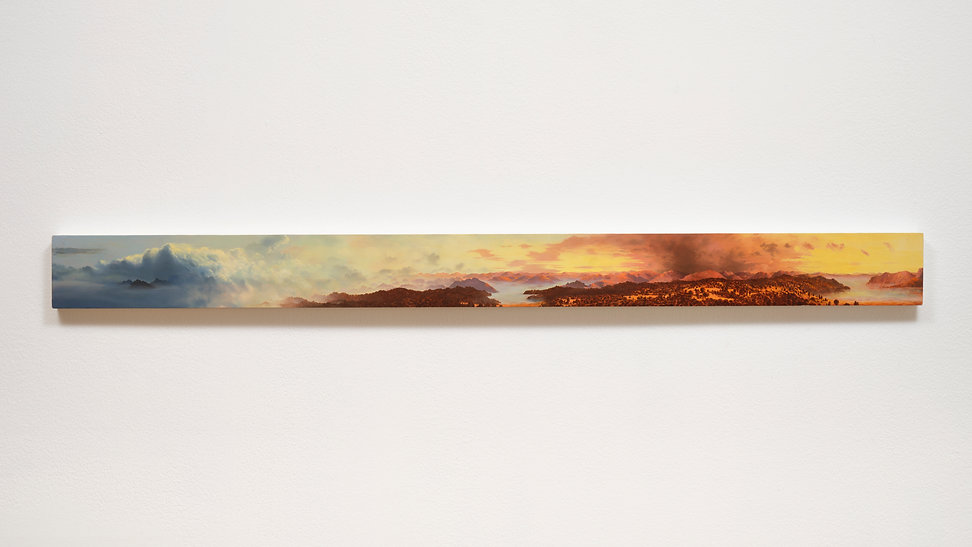
Contributed by Elizabeth Johnson / As the British Museum celebrates the 230-foot-long by 20-inch Bayeux Tapestry, Ki Smith Gallery features “Places That Never Were,” Jim Sullivan’s extremely narrow imaginary landscapes. Displayed as a continuous frieze separated by small breaks, Sullivan’s paintings resemble Chinese handscrolls: long, portable paintings produced since the Jin Dynasty in the fourth century. Though these were generally viewed one section at a time and accompanied by commentary and poetry, the antique Asian format resonates in Sullivan’s compositions, which join vignettes of air, land, and sea by avoiding linear seams. Trimmed down to dimensions such as 3 x 36 and 6 x 96 inches, the paintings heighten an emotional connection to nature by suggesting the slimmest glimpse through a crack beneath a door.
Viewed right to left in the Asian manner, Sullivan’s Ocean Warming starts with tawny Hudson River School-like mountains flanking tiny sailboats, transforms into a smoke-covered Mediterranean landscape that progressively cools around blue water, and terminates in the romantic chill of clouds and distant hills. Humanity challenged ends in oblivion. Read left to right, the visual story predicts human survival, danger giving way to navigable waters. Both dire and edenic, Ocean Warming intersperses beautiful and cataclysmic views, resisting definitive positive or negative connotation, though the title and narrative suggest fear about climate change.

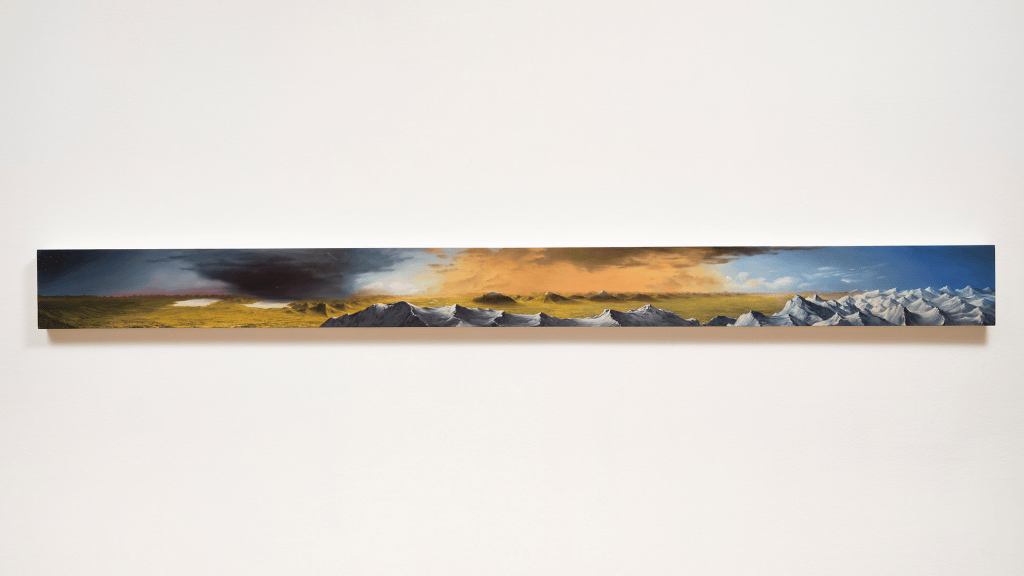
Saudade and Great Northern Basin lean into Renaissance space. Saudade, Portuguese for longing, presents clouds, mountains, and water as a continuous mottled pattern, interlocking with warm and cool colors and flowing around a tiny thunderbolt shaped like lambda, which in Greco-Roman symbology means awakening and solidarity. Vague transitions resemble flashback sequences in movies; the landscape seems to be mourning its own past. Great Northern Basin measures space through independent zones that are sky blue, lurid orange, smoky black, and sunset magenta. An arm of pale, gothic mountains anchors two-thirds of the foreground, pointing towards a distant patch of night and stars. The psychological gulf between a realistic foreground and abstract background underscores just how far away those stars must be.
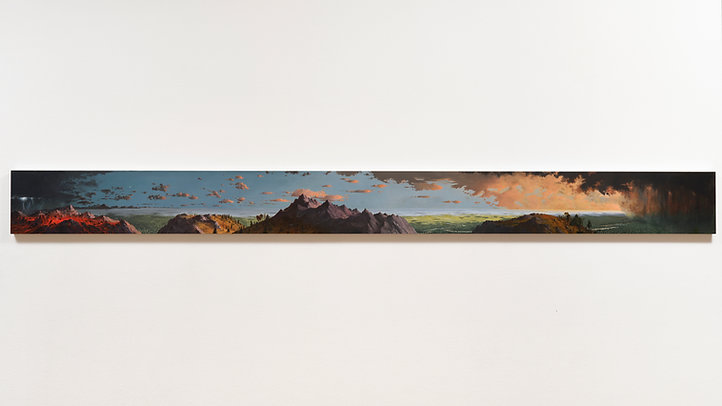
Four paintings picture Earth during volcanic upheaval. Though Places That Never Were doesn’t include humans or animals, Sullivan’s volcanos seem to stand in for humans –earthy, hulking, angry forms spewing lava, smoke, and flames. The central mountain in Convergence acts as a fulcrum between a raincloud and a volcanic temper tantrum beneath a tiny pale moon and forked lightning. Foregrounded fiery cones in Release and Volcanic Ash draw viewers into the destruction and the newly created mountains studding the surrounding sea in The Remains below a bindi-dot moon at the painting’s edge. Volcania features snow-capped peaks and teal-blue sky lit by a bright orb that recapitulates Sullivan’s former suns: ominously orange bulbs of Volcanic Ash, a lemon disc in violet haze in Lull, a tangerine button in Sea Rise at Sunset, and a ghostly sun in pink and blue cloud cover in The Vapors.
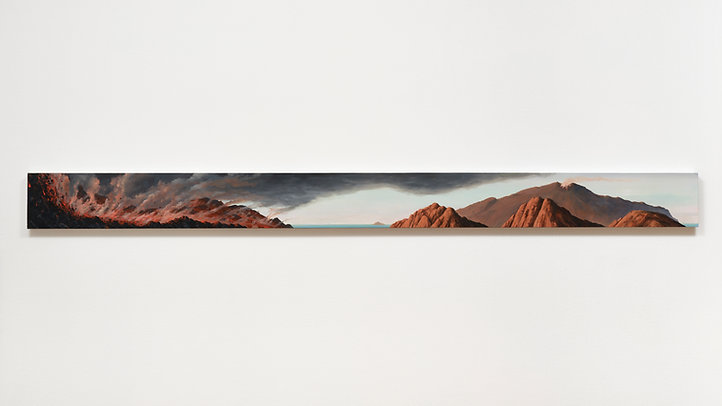
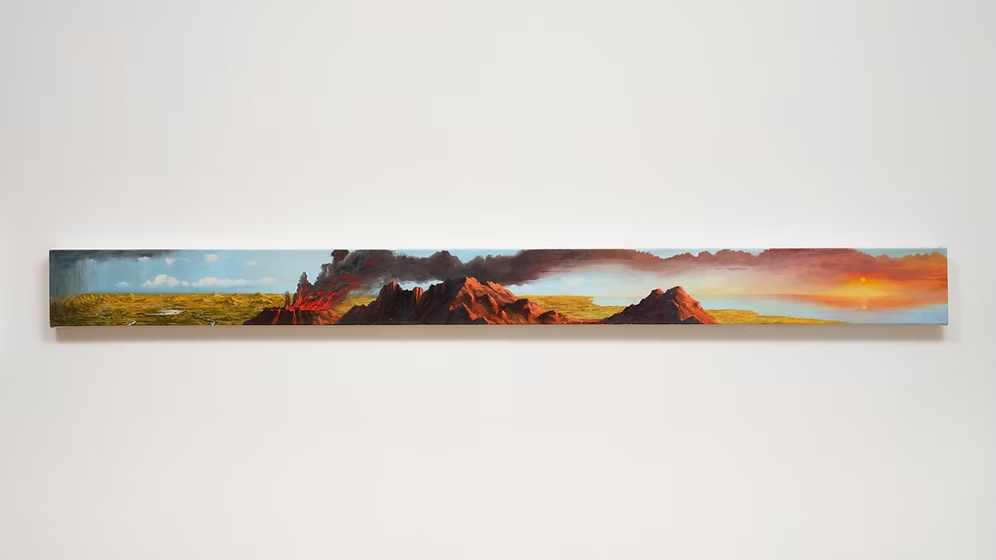
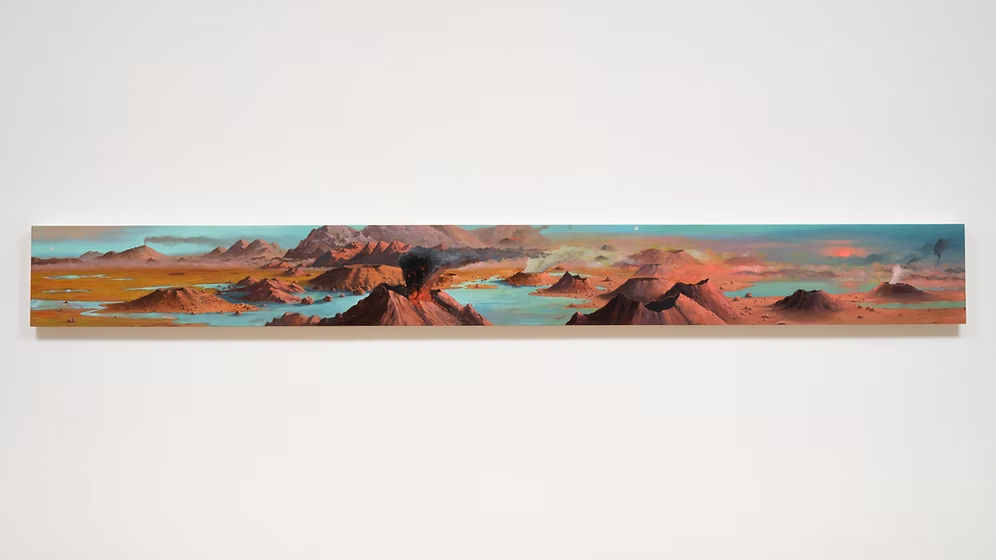
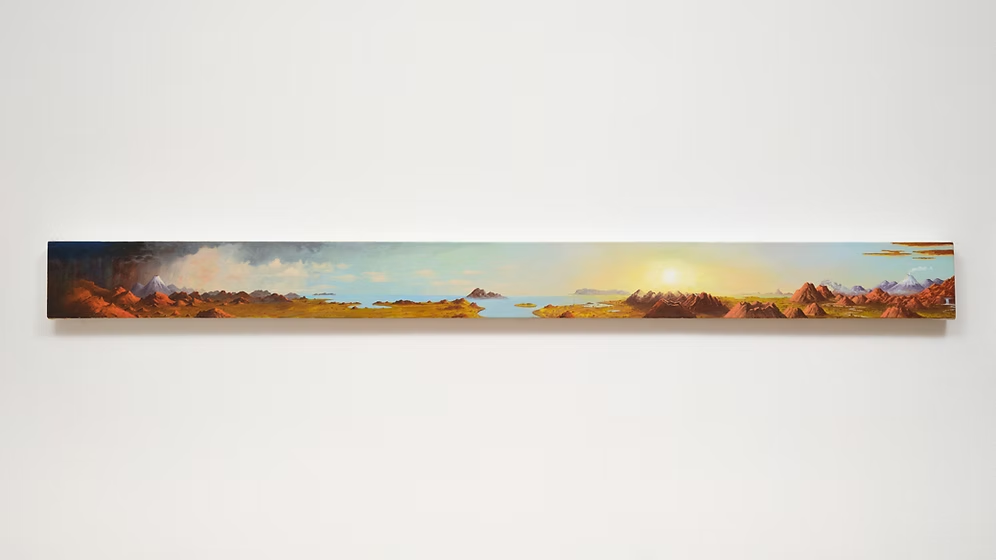
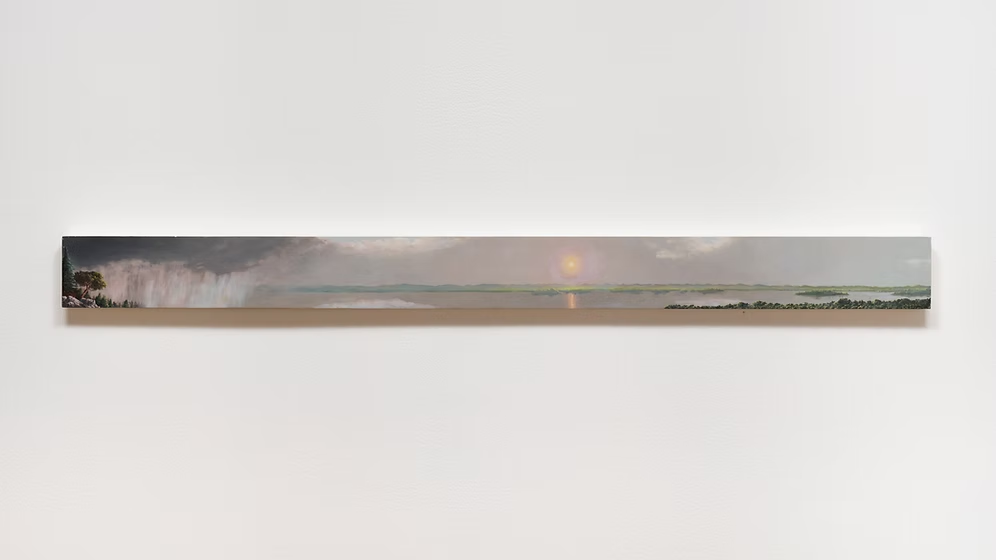
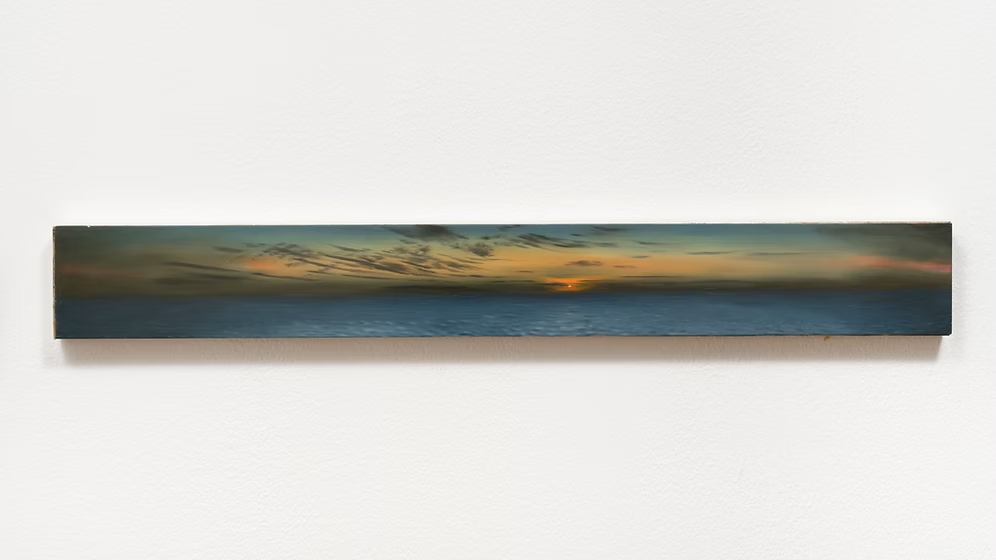
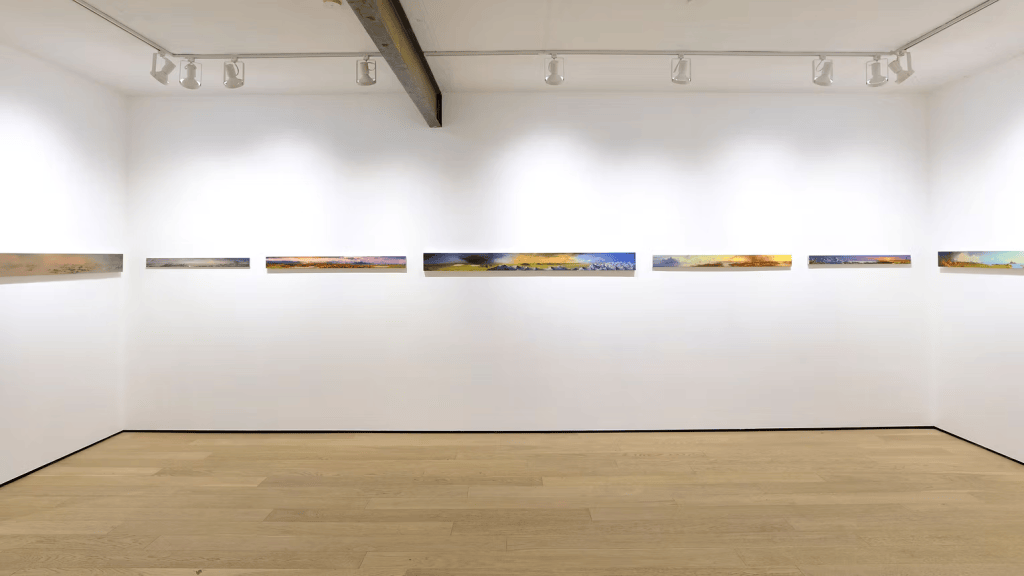
Places That Never Were imagines nature’s enduring point of view through heroic division, stitching together and stretching apart idyllic and destructive vignettes. Whereas unifying views mostly employ Renaissance perspective, transformative ones often unspool in the Asian manner, treating scale and perspective associatively. Cutting and pasting eons of ice, flood, life, and fire into a fractured pattern, Sullivan projects a panoramic view suggesting geologic time. Mountains, lakes, rivers, waterfalls, clouds, storms, and trees mingle in ways that they don’t in nature. Stasis and flux collaborate in thin, illusionary paintings that, remarkably, make sense of our planet’s nearly incomprehensible physical story.
“Jim Sullivan: Places That Never Were,” Ki Smith Gallery, 170 Forsyth Street, New York, NY. Through October 11, 2026.
About the author: Elizabeth Johnson is an oil painter, art writer, and curator based in Easton, PA. Her reviews and interviews have appeared in The Brooklyn Rail, Artspiel, The Artblog, Roborant Review, Delicious Line, and Painters on Paintings, in addition to Two Coats of Paint.






Elizabeth,
Once again I am quite taken with your writing in this review of Jim Sullivan’s exhibtion.
Like the best writing, it is based on perception, close scrutiny, and palpable description rather than theory. I value your empirical faith in visual art and your wide exposure to many cultures of diverse pictorial value. Of equal and amusing interest to me, is the way these interests serendipitously intertwine and overlap.
I lived in Japan for two years and was therefore interested in your descriptions of the Asian influence in Sullivan’s work (I took a 5-day journey down the Yangtze many years ago during a dramatic rainstorm). In your review, I also enjoyed your associations to the “Hudson River School-like” landscape. Most especially to specific details on color: the bindi-dot moon; ominously orange bulbs; a lemon disc in violet haze; a tangerine button. In another topical realm, you suggest the environmental degradation that I observe daily beside the Hudson and other bodies of water. This concern was of course something Thomas Cole focused on in his paintings, his commentary on industrialization, and themes of the journey of life throughout his work.
I only got back to the city last night and am disappointed to have missed the show. But thank you for conveying so much in your writing.