oil on canvas, 30 x 40 inches
Contributed by Bill Arning / Rebecca Morgan has mounted her sixth solo show at Asya Geisberg’s Tribeca gallery, and one could be forgiven for assuming we already know what it will look like. Morgan has developed a well-loved signature style of crisply drawn, feminist-infused, instantly recognizable images drawn from art history, with large doses of Guston, R. Crumb, and Peter Saul fused with the more confrontational depictions of women by women associated with Lisa Yuskavage, Kathe Burkhart, Betty Tompkins, Judy Glantzman, and Marilyn Minter. Critic John Yau has also linked her work to Li’l Abner and The Beverly Hillbillies, as she brings the denizens of her native Appalachia into fine art.
This heady mix has made her very popular, and it seemed unlikely she would mess with a winning formula. Yet when the first images from this new series appeared, there was genuine surprise that a successful artist would so courageously shift her depictive strategies, moving from crisp and instantly legible to murky and hard to parse. Instead of neatly descriptive contour lines, Morgan now allows images to mumble rather than declare themselves. Technique is everything here: she has welcomed larger undefined sections, painterly layering, and contradictions that slow viewing way down. As a result, each picture is more psychologically resonant.

oil on canvas, 48 x 36 inches

Morgan has crafted these woozy depictions in response to the daily horror she finds in our MAGA-inflected news cycle and that familiar panic that this season of violence and cruelty may never end. Hunter Gatherer in the Apocalypse features one of her Valkyrie-like women standing over a bearded man pierced with a spear. A cute puppy looks either bemused or concerned about what is going on. When It Happens similarly has a Trumpian corpse rotting under a rainbow. The butt-forward angle of the body, crowned by a jubilant crab waving its claws at us, might just put you off your lunch.
In the titular Painting in the Apocalypse, Morgan adapts the artist’s new atmospheric approach to a fire-and-brimstone vision of a studio residency in hell, with a volcanic lava glow filling the space with noxious fumes. A Poe-like raven perches atop the canvas while Morgan’s semi-self-portrait glances out nervously. The classic studio self-portrait trope of the artist making eye contact with us, going back to Velázquez’s Las Meninas, takes on new urgency amid contemporary anxieties about surveillance and political scrutiny. Even typing the words “Trumpian corpse” above gives me a paranoid shiver. A few pieces hark enjoyably back to Morgan’s earlier graphic style. The smaller Druski as Erika Kirk is a straightforward portrait based on the comedian’s viral portrayal of a famous conservative woman. Because so much uncomfortable political comedy is already contained in the source material, Morgan doesn’t need much in the way of painterly effects to make the image memorable.
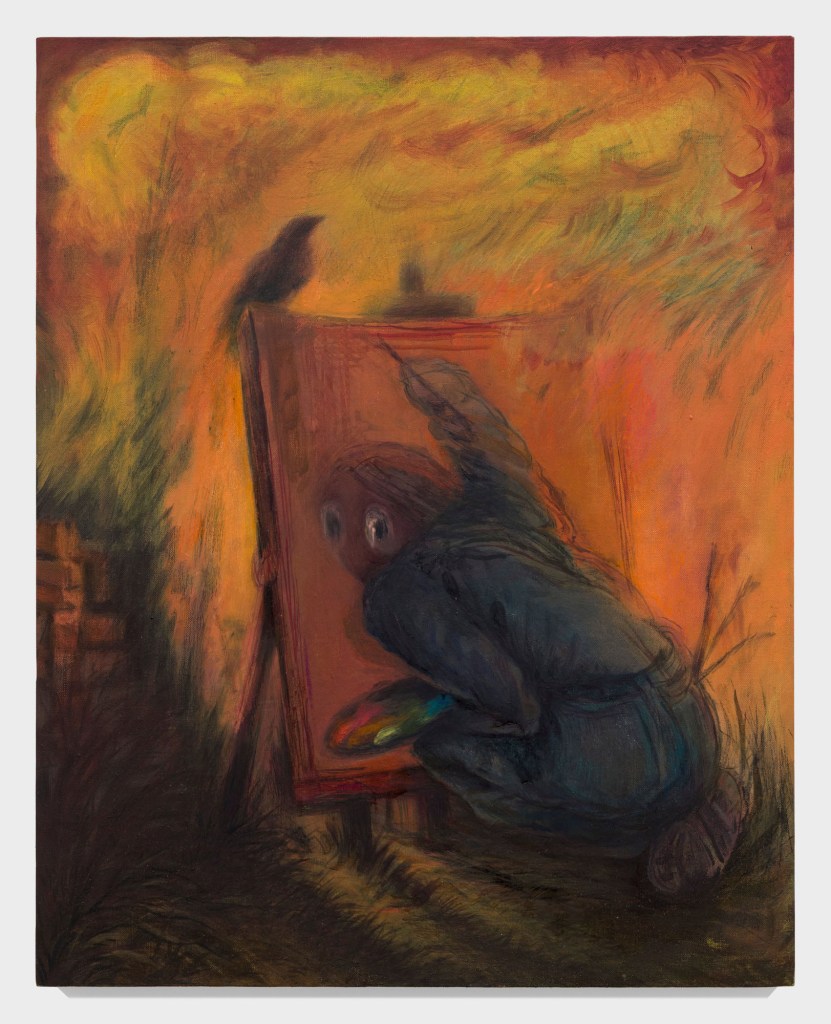
oil on linen, 30 x 24 inches
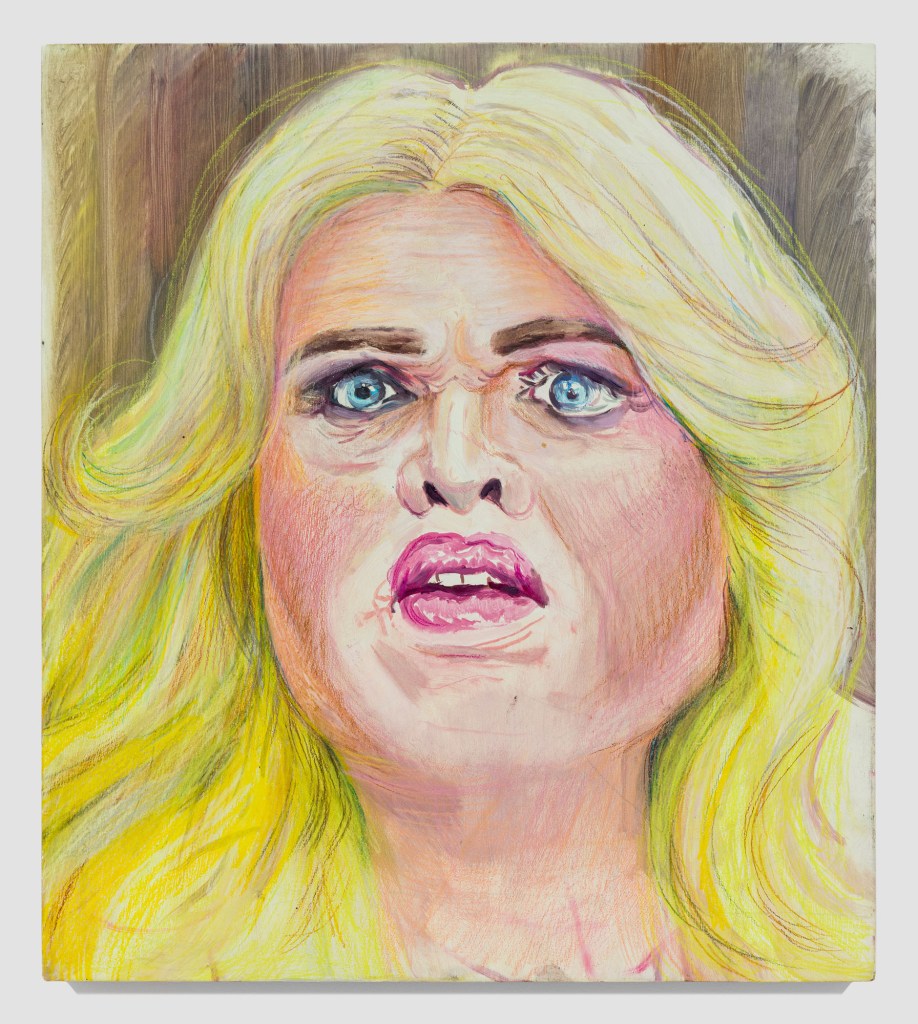
oil on panel, 18 x 16 inches
Yet the highlight of the show operates in a very different emotional register. Morgan invites in another art-historical guest, Sylvia Sleigh, known for refined, elegant nudes painted from a female perspective. Since Sleigh’s death in 2010, her influence has grown enormously. Morgan depicts her romantic partner in Andy after Sylvia Sleigh, a painting so affectionate it nearly expunges the acerbic humor dripping from the rest of the exhibition. Here we see what Morgan does with a figure she doesn’t loathe. Andy reclines in a patented male odalisque pose, his shirt open but his shorts still on, allowing him a degree of modesty incongruous with Morgan’s usual aesthetic. Unlike Sleigh’s male models, however, he isn’t particularly sexualized. One imagines him less as a stud than world-class cuddler. I’m reminded of John Currin, whose female nudes can be terrifying creatures, except when he depicts his partner, sculptor Rachel Feinstein, and suddenly switches into the key of love and affection. Morgan does something similar here, wonderfully evoking the quiet joys of long-term partnership.
For a successful artist to negotiate a substantial shift in studio practice and leave viewers eager to see where it leads is a rare triumph. Morgan has made her pictures less immediately decipherable and, in the process, considerably more expansive. This bodes well for whatever comes next.
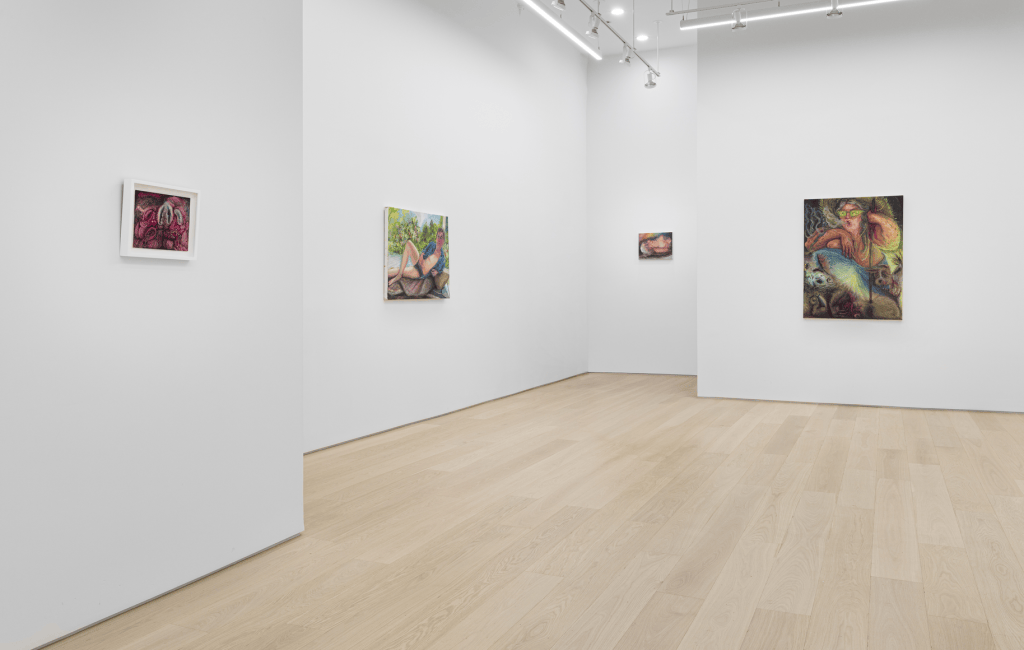
“Rebecca Morgan: Painting in the Apocalypse,” Asya Geisberg Gallery, 45 White Street, New York, NY. Through October 24, 2026.
About the author: Bill Arning is a curator, critic, advisor, writer, and itinerant maker of pop-up shows based in Old Chatham, New York.