
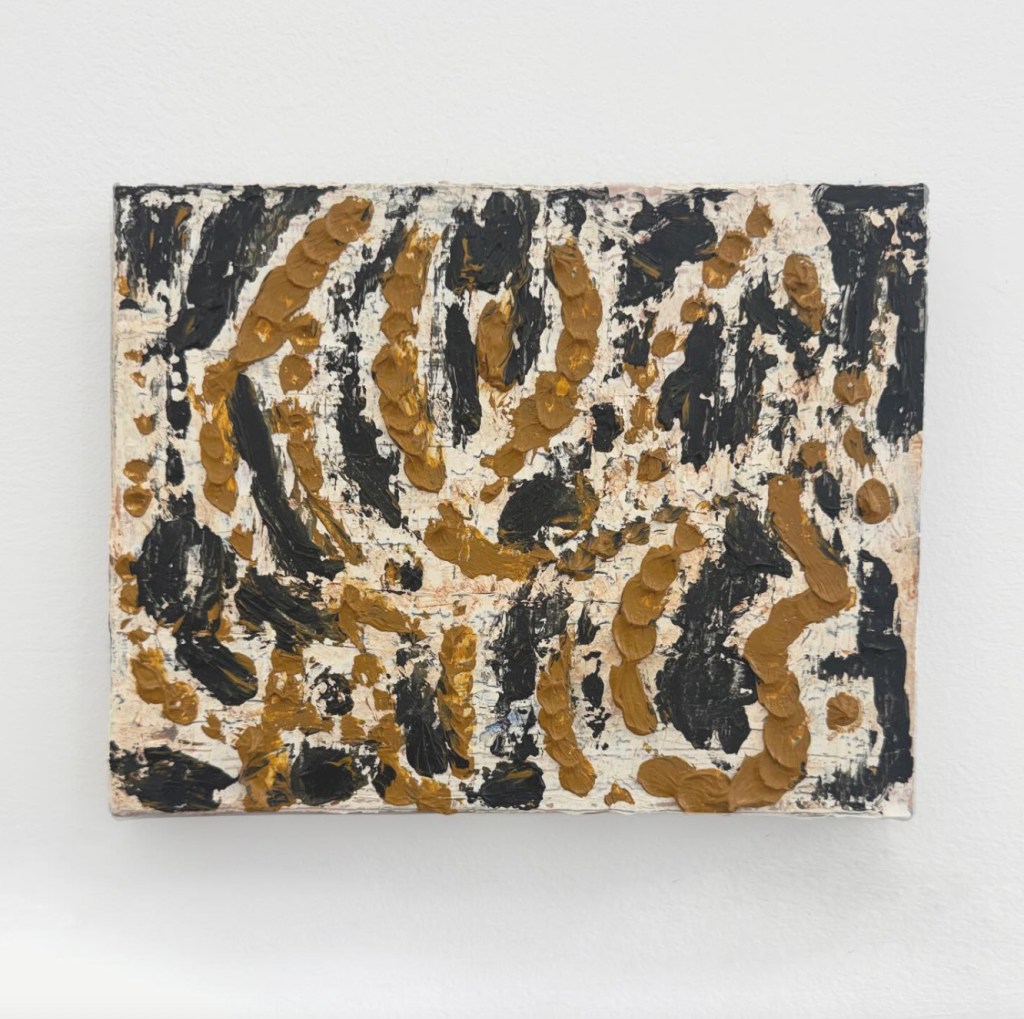
Photo courtesy of Teffia Primary.
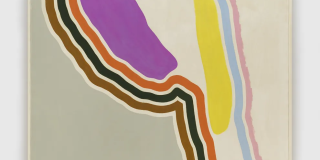
Contributed by David Whelan / Peter Acheson’s paintings and sculptures live on the edge of composure through seemingly dashed-off operations, loose frameworks, and blurred boundaries. By making artwork with such a loose grip on solidity, Acheson invites us to step away from the known towards an enchanting oblivion. The title “Fifty Miles” comes from poet Gary Snyder’s response to the question of how famous he wanted to be: “Fifty miles seems about right”. Fifty miles is a human scale – not the span of global art fairs or finance but that of friendship, shared resources, and habitat. It is also roughly the distance between the gallery and the artist’s studio, which put a smile on my face. The show is curated by Teffia Primary and hosted at Maiden Lane Gallery, an old two-story building full of oddball characteristics. The space is connected to the local YWCA, whose preschool playground can be seen from the second-floor window, reminding us we are in a space of growth and play.
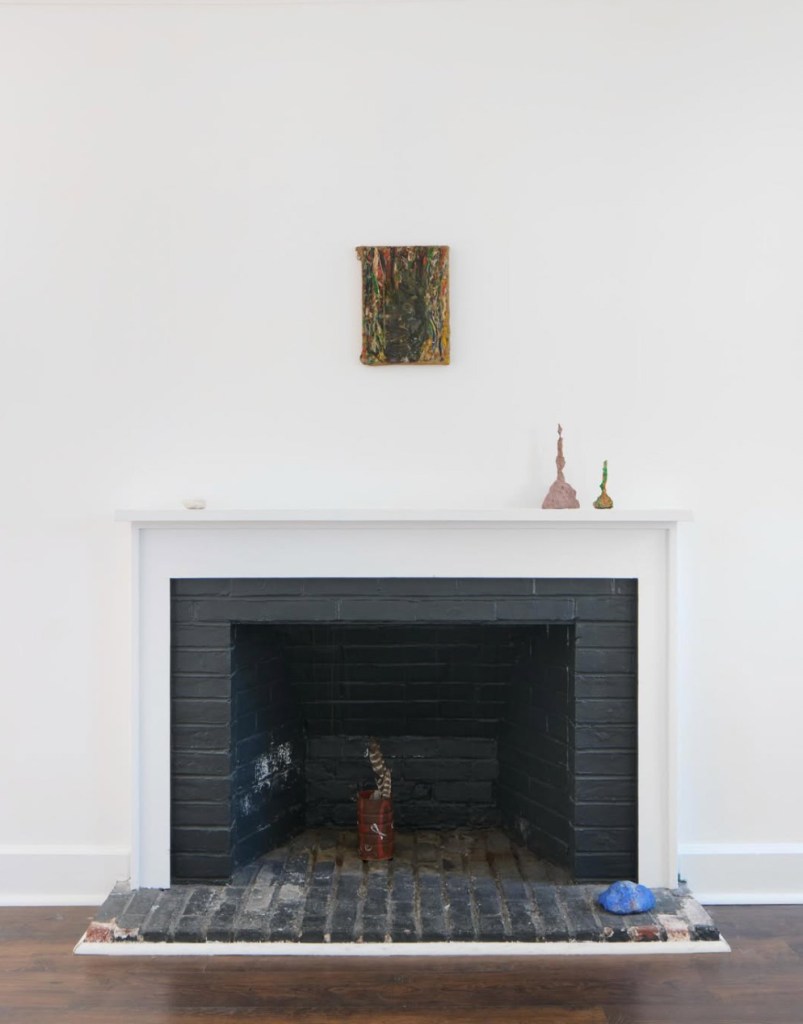
Downstairs above the gallery’s fireplace is Lesson From the Dark, a mixed-media abstraction painted on coarse burlap. Towards the left and right sides, two columns of primary colors twist over each other in variable brushstrokes. Their integration stops short of creating a muddy brown. The center of the composition is painted with broad dark strokes, not quite a void but suggesting an absence. Moving closer to the painting, I noticed a small brush pushed into the surface, camouflaged within the painterly facture. The piece seems to be a variation on the Ars Poetica: a painting that contemplates the art of painting, here as emerging out of darkness and descending back into it.

Photo courtesy of Teffia Primary.

Photo courtesy of Teffia Primary.
Upstairs, the surface of Trunk is thick with impasto paint in shades of green, blue and brown, mimicking striations of tree bark. The earth tones are mellow and relaxed, but the sides of the canvas are painted fluorescent red, reflecting off the white wall like an aura, as if the painting were levitating. To my eye, the red is garish and hard to take. But I don’t think Trunk is just a formal exercise in harmonizing oppositions or a defiant gesture against taste. Instead, the painting says something about opacity and radiance – how light can emanate from the most unexpected places.
Painting for the older brother left the biggest impression. Its grey atmosphere with brown stains, subtle ellipses, and X-ed out composition feel like a response to loss, an attempt to visualize what remains when something slips away. The words composing the title are inscribed on the painting’s bottom edge in a friendly blue cursive, legible but sinking into paint. Looking again, the spiraling ellipses reminded me of both ribcages and clouds, a chilling combination. Written language is a common refrain in this exhibition. Nearly half of the paintings on view include words or letters. The brushstrokes themselves look like written language. Acheson seems interested in the fundamental desire to write something into the world, leave a mark, make sense of it. But since the language is cryptic or abstract, the inscriptions have a loose claim on meaning.
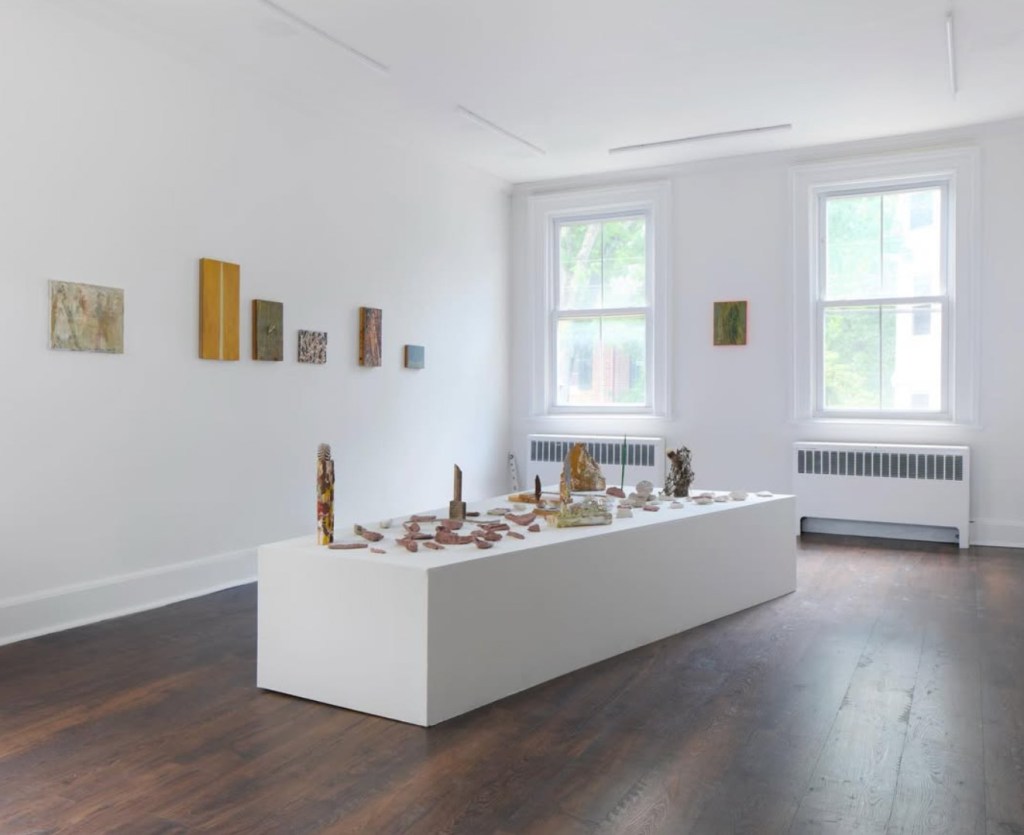
installation view. Photo courtesy of Teffia Primary.
Also permeating the exhibition are the many clay sculptures peppered throughout the show, formed simply by the artist’s hand closing around wet clay. The result is a small, ribbed form, vaguely excremental, reminiscent of neolithic sculpture or something a child might create when squeezing wet earth. They radiate a repeated desire to grasp something tangible. And there are many sticks in the show, some found and some manufactured. Their proximity to their original tree-form is variable. What they have in common is thinness. Haids Stick Painting is a narrow piece of wood bowing slightly at its center, with subtle green shapes painted along the raw reddish wood. It is a painting on the verge of disappearance.
“Fifty Miles” resonates strongly in this moment. The United States is going through a significant transition with a certain outcome. Images of strength and composure dominate the news, perhaps an overcompensation for the decline of American power. In this atmosphere of strongman posturing, the show signals gentle repudiation. The malleability and open-endedness of the work reflect a porous state of being. Few of us can accept this truth let alone celebrate it. Acheson invites us to do both.
installation view. Photo courtesy of Teffia Primary.
“Peter Acheson: Fifty Miles,” Maiden Lane Gallery, 51 Maiden Lane, Kingston, NY. Through July 12, 2026.
About the author: David Whelan is an artist living in the Hudson Valley. He has published art reviews in Artforum, The Brooklyn Rail, Effects Journal, and Two Coats of Paint, among other publications.









terrific clear writing on Peter Acheson’s work.
thanks for the exacting language.