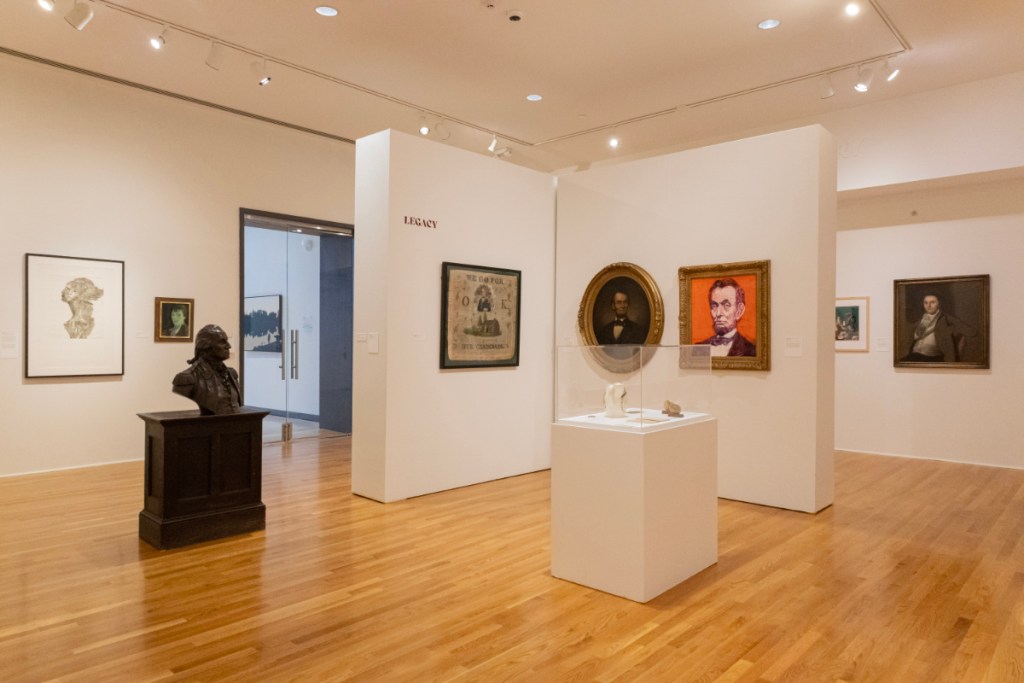
Contributed by Jonathan Stevenson / Celebrating the 250th anniversary of a country putatively vaunted for its liberal pluralism when in fact it is nearly as bitterly divided as it was during the Civil War has been a fraught affair, by turns sheepish, rueful, and obtuse. It is difficult to find a cultural sweet spot in the absence of a palatable center. Waterbury’s Mattatuck Museum rises to the challenge with the portrait exhibition “About Face,” which spans the eventful quarter-millennium and presents multiculturalism not as a political accident subject to debate and correction but as a rooted and immutable structural feature of the American polity. Impeccably curated by Rebecca McNamara – the museum’s new chief curator – in her inaugural effort, the show is a triumph of sensitivity and finesse. Some 50 portraitists, broadly construed, are represented, several internationally renowned and many regionally notable. McNamara identifies five thematic throughlines coursing through America’s 250 years – self, collective, legacy, critique, and studio – and loosely organizes the exhibition around them. These filters sharply array key concerns of art history while signaling the range of perspectives artists themselves fix on the society around them. Each chimes historically and sociologically, with depth and subtlety.
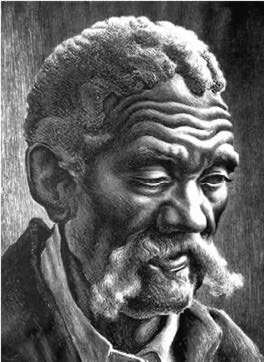
lithograph, 12.625 x 9.5 inches

three colors with photogravure, 39.25 x 27.5 inches
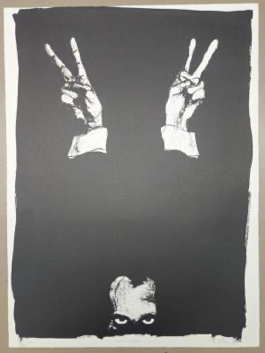
1984 lithograph, 23.875 x 17.5 inches

c. 1920, oil on wood panel,
21.625 x 16.12 inches
“Legacy,” arguably the most politically loaded category, features two portraits of Abraham Lincoln – Calvin Curtis’ elegiac one made in the late 1800s and another by Hunt Slocum from 2016 showcasing an endearing ordinariness. Among the “collective” works, Thomas Hart Benton’s 1941 lithograph Aaron depicts a weathered Black farmer admiringly yet remorselessly, which might be expected of the arch champion of Regionalism. Regarding the “self,” Robert Rauschenberg’s poignantly fractured 1999 intaglio ‘topher intimates both the artist’s love for his son and the fear of estrangement a gay man might harbor. The “critique” pieces are relatively few but, like the clownish Hollywood Indian of Fritz Schneider’s eponymous 1973 painting and cartoonist Pat Oliphant’s wearily sardonic 1984 lithograph I Have Returned of a resurfacing post-Watergate Richard Nixon’s discombobulated head and V-signaling hands, assertively normative. The “studio” selections register the inevitable contrivance of all art, especially the kind consciously targeted for posterity. Yet McNamara took care to include three of Kay Sage’s penetratingly empathetic portraits of the young women and the old man who sat for her – rare for the artist, who was known primarily as a Surrealist – suggesting the power and progress of art in general and portraiture in particular.

79.5 x 72 inches

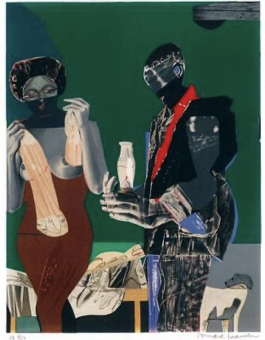
25.25 x 19.25 inches
Without strident editorializing – written curatorial sentiment is craftily interstitial – “About Face” casts diversity in the United States as a fait accompli, a historical fact not imposed but evolved. This mindset is of a piece with Waterbury’s own identity, framed with affection and nuance in other exhibitions at the museum, as a town of industry that drew on foreign labor to make its bones as the “Brass City,” supplying buttons and snaps that inflected fashion and burnished soldiers for most of America’s 250 years. From this standpoint, the exhibition embodies a kind of liberal patriotism that, in the curator’s unobtrusive but evident conception, has enabled this country to flourish as a big tent. Capturing a like spirit, the contemporary music genre “Americana,” interposed between predominantly white and right country-and-western and white and left indie rock, is more eclectic and ethnically variegated than either, cohering through a shared nod to the place this community calls home that endures space, time, and strife. Thus, Romare Bearden’s 1973 lithograph Before the First Whistle (Early Morning) links African Americans to the industrial bustle of America at large; the pastoral affect of Nigerian-born Boluwatife Oyediran’s A Father’s Love (2021) resonates with that of William Chadwick’s 1925 painting Lady with Narcissus. “About Face” earns its crowning message: that it is the potential for seamless inclusion, sometimes contested but never extinguished, that makes America great.
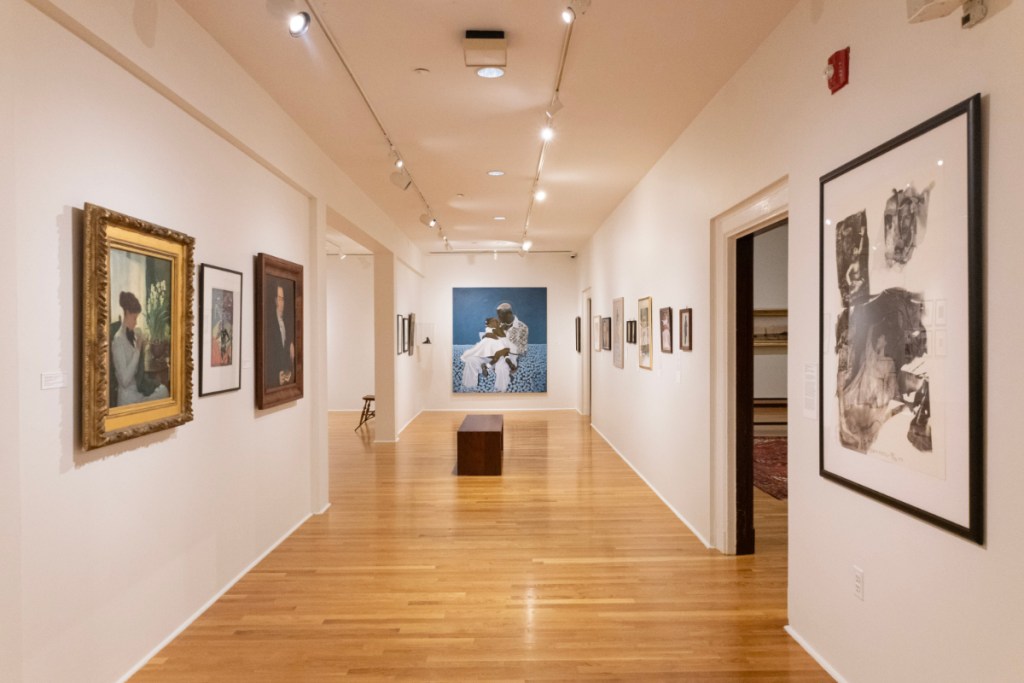
“About Face: 250 Years of American Portraits,” Mattatuck Museum, Whittemore & Noonan Galleries, 144 West Main Street, Waterbury, CT. Through August 16, 2026. Curated by Rebecca McNamara. Artists: Charles Akers, Romare Bearden, Georgia Bemis, Thomas Hart Benton, Suzanne Benton, Dawoud Bey, Maryna Bilak, Stella Bloch, Louise Bourgeois, George Catlin, William Chadwick, Tommy Cheng, Elsie Whitmore Southwick Clark, Liz Cohen, Calvin Curtis, George Deem, Ralph Earl, Auguste Edouart, Walker Evans, Judah Frisbie, Nicholas Galanin, Herculaneum Pottery Company, James Herring, William Jennys, Ben Johnson, Lois Mailou Jones, Jeanette Harrison Sheppherd Loop, Danielle Mailer, Marisol, Reginald Marsh, Marc Mellon, Patrick Bruce Oliphant, Boluwatife Oyediran, Ammi Phillips, Robert Rauschenberg, John H. Rogers, Kay Sage, Fritz Scholder, Hunt Slonem, Frederick A. Stone, Elkanah Tisdale, Helen Torr, [Unidentified artists], James Augustus VanDerZee, William Villalongo, Bessie Potter Vonnoh, Inez Nathaniel Walker, Andy Warhol, Samuel Woolf, David Wu Ject-Key, and N.C. Wyeth.
About the author: Jonathan Stevenson is a New York-based policy analyst, editor, and writer, contributing to the New York Times, the New York Review of Books, and Politico, among other publications, and a regular contributor to Two Coats of Paint.