Tag: David Whelan

Solo Shows

Lois Dodd: A balm against cynicism

Contributed by David Whelan / I first saw a Lois Dodd painting in 2004. View through Elliot’s Shack Looking South was part of a group show at our college gallery when I was a freshman. The painting absolutely stunned me and served as a touchstone throughout my education and early adulthood. Dodd’s solo show “A Radiant Simplicity” at The Art Gallery at Brooklyn College might have done the same for others.

Gallery shows

Allen Berke and Lise Soskolne: A world distorted

Contributed by David Whelan / “Esthetic Bomb Shelter,” at Ulrik gallery, comes at a time of overwhelming crisis. Conflict and hostility seem to have entered every aspect of life without clear exits. Painters Allen Berke and Lise Soskolne tap into this quandary by visualizing moments of discontent and unease, abstracting form and narrative. Though unsettling, the works are also strangely enjoyable, prompting a kind of cognitive dissonance in the viewer. 

Solo Shows

Jilaine Jones’s unfolding curiosity

Contributed by David Whelan / If I asked you to make a sculpture about walking through the woods, what would you make? How would you go about expressing an awareness of your body in relation to the dense forest – stepping over downed logs, ducking under branches, feeling your feet against the ground and the sun warm on your skin? In A Walk with D. Ann at 15 Orient, Jilaine Jones suggests that we aren’t just walking through woods but having the experience of being human. There is an emphasis on gravity and things returning to the ground throughout the show. Landscape and motion, forms and space, combine to build emotional weight in the sculptures, asserting a presence while keeping their origins just out of grasp.

Museum Exhibitions

Dike Blair: The humanity of light

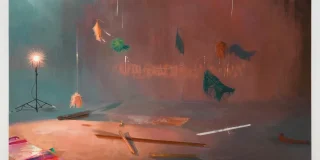
Contributed by David Whelan / The idea for the exhibition “Dike Blair: Matinee,” now at the Edward Hopper House, came from a discussion the artist had with curator Helen Molesworth in front of Edward Hopper’s 1938 painting New York, Movie. The picture is split in two: on the left a black-and-white film plays on a movie screen, and on the right a stairway leads away from the film, perhaps outside. In front of the stairway is a female usher, leaning languidly at the threshold, bathed in ambient light. The usher, the viewer, and possibly even Hopper himself stand at the boundary, resonating an ambivalence towards a life mediated by technology.