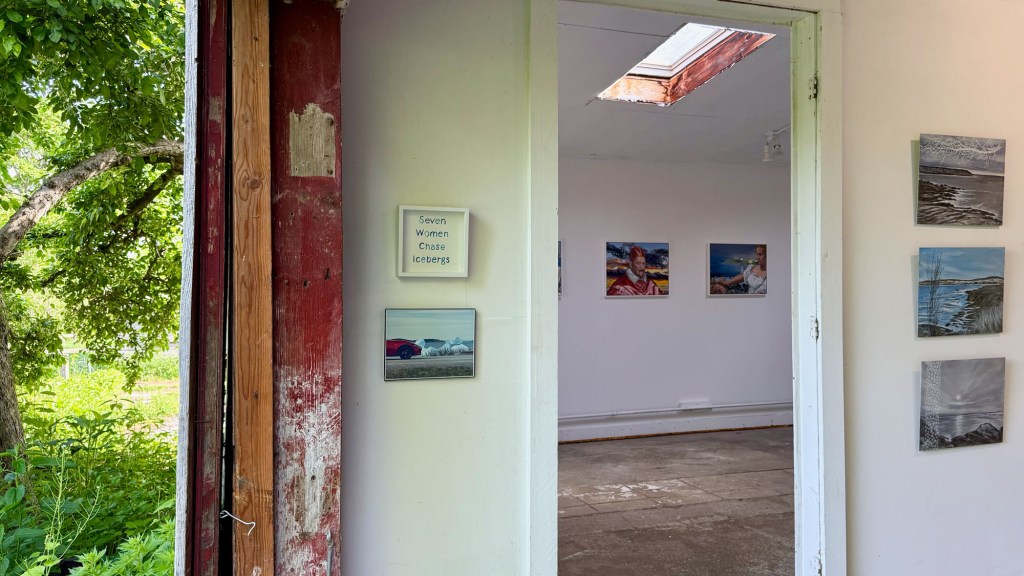
Contributed by Lawre Stone / The Re Institute – a dairy barn built in the 1960s that Henry Klimowicz has repurposed as rustic art gallery – seems to arise sublimely out of nowhere, exuding the freedom and wonder of the open road. Presently installed on the ground floor is “Seven Women Chase Icebergs” – paintings, drawings, and works on paper by seven women convened by Brenda Zlamany for a residency at Pouch Cove in northern Newfoundland in spring 2025 to respond to the remote landscape. The thrill of yielding to an unknown environment permeates the exhibition.
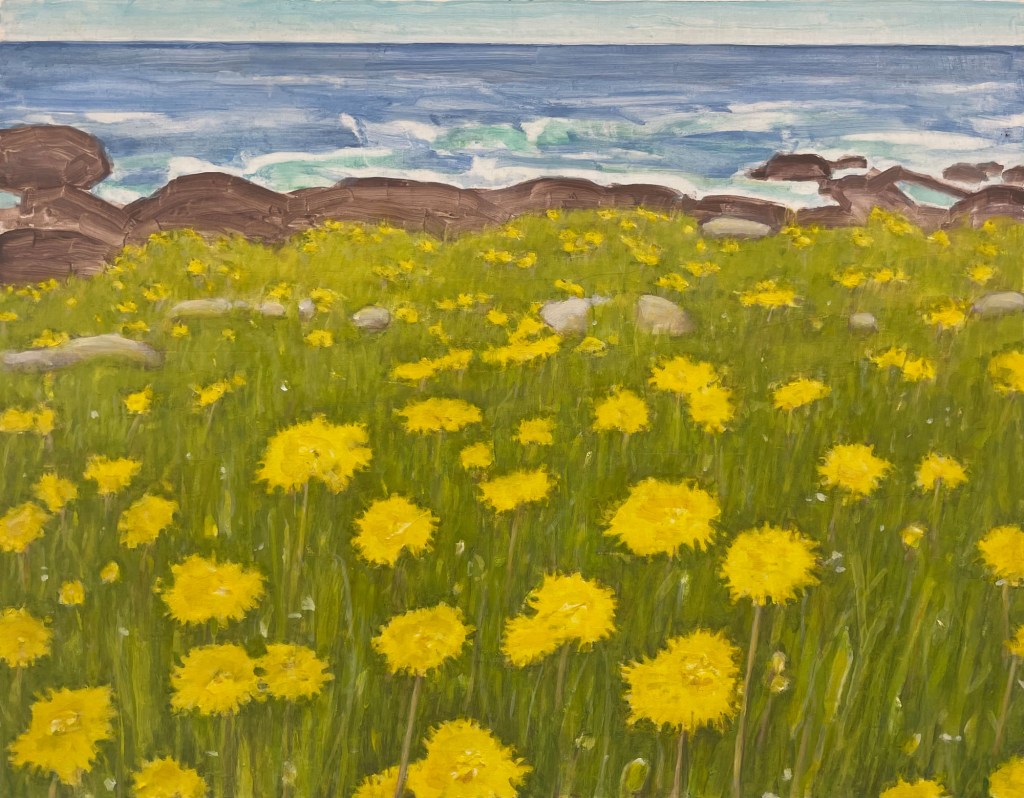
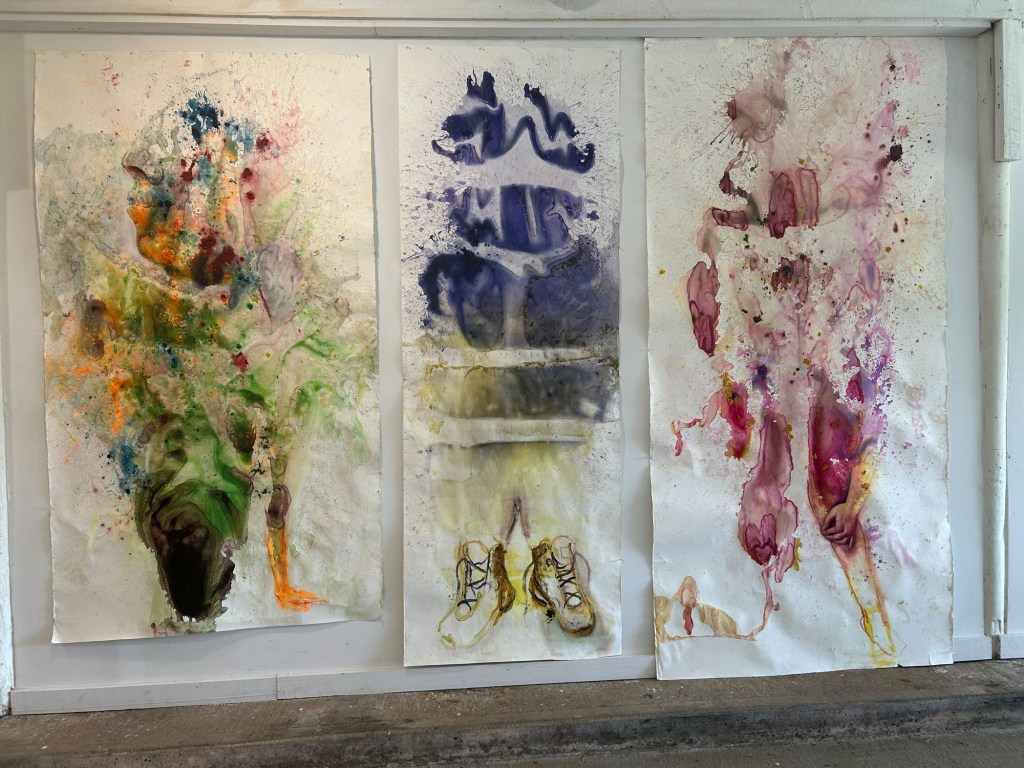
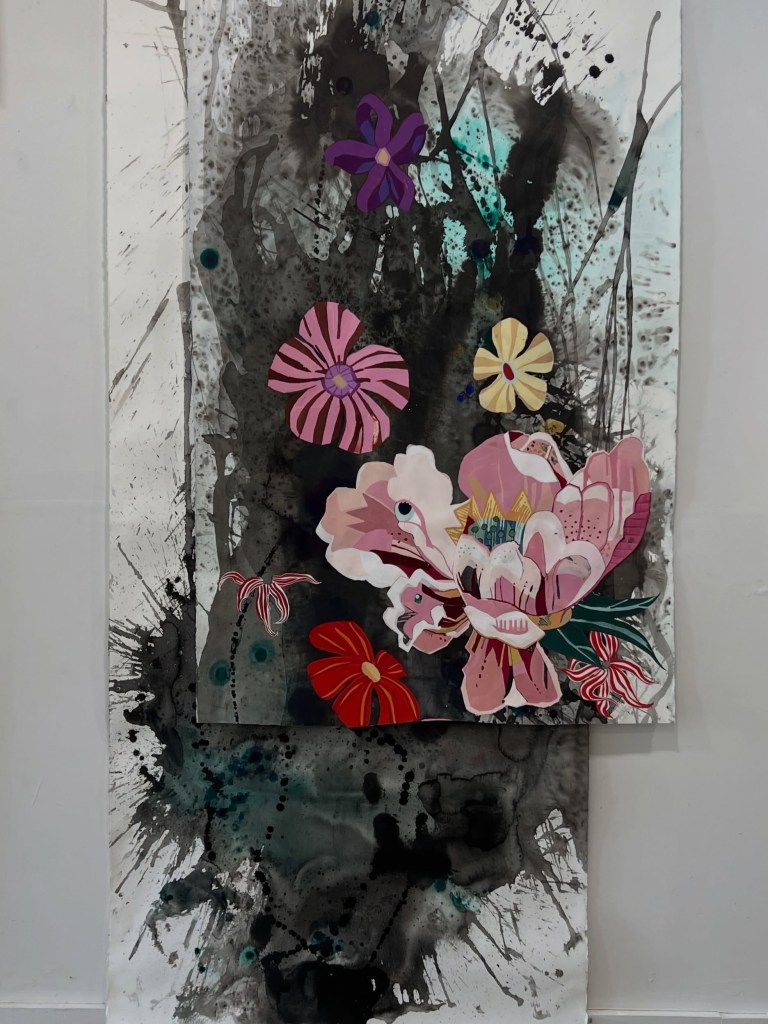
Daisy Craddock’s electric fields of dandelions burn with lemony yellows and sun-kissed greens, and, in some pieces, waves breaking in the distance on the rocky North Atlantic shore. In contrast, Trine Bumiller’s “Avalon” paintings of the quiet, foggy cove project the calm but somber mood of an overcast day, devoid of human presence yet imparting grief and loss with branches and plants. In Elisabeth Condon‘s large-scale vertical scrolls, dark, inky grounds host supersized lilies painted in opaque pinks, reds, and oranges. Innovative layering pushes the blooms forward, reflecting a happy experiment. Barbara Friedman’s “The Figuration of the Invisible,” three works on paper reaching from the ceiling to the floor, pools of red, fuchsia, green, and deep violet in thin, abstract puddles suggest a hand, a face, breasts, a leg, and booted feet, recalling the goddess’ birth from sea foam and Botticelli’s famous painting.
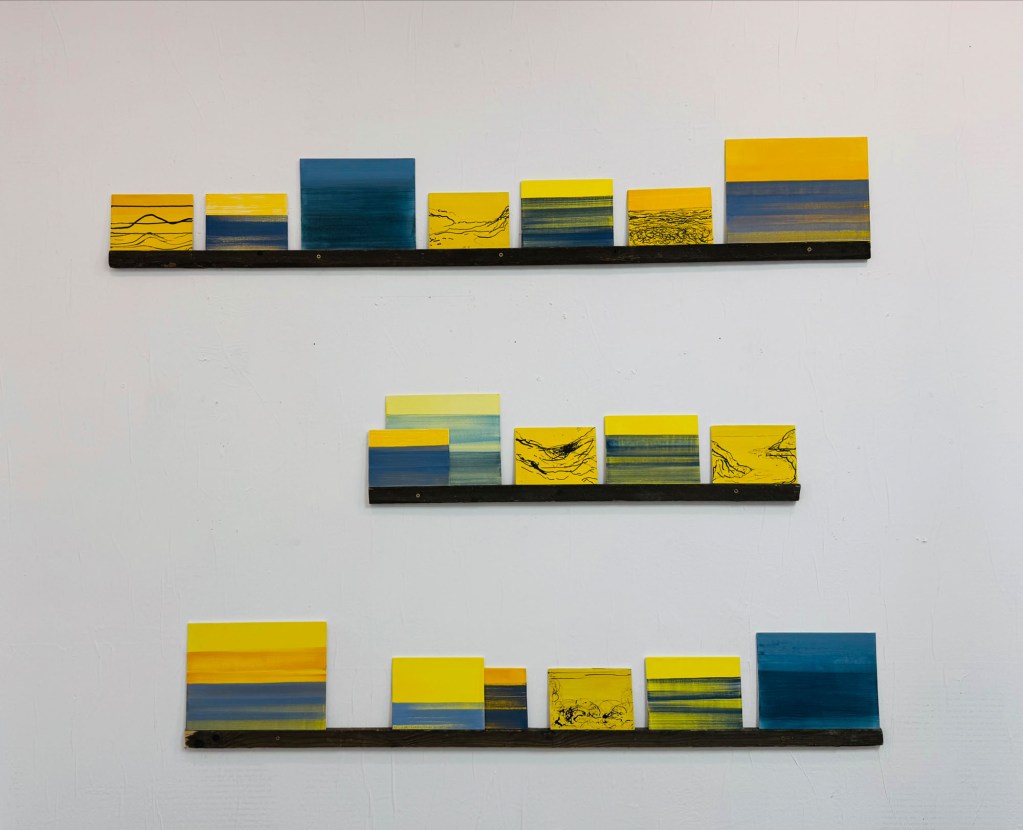
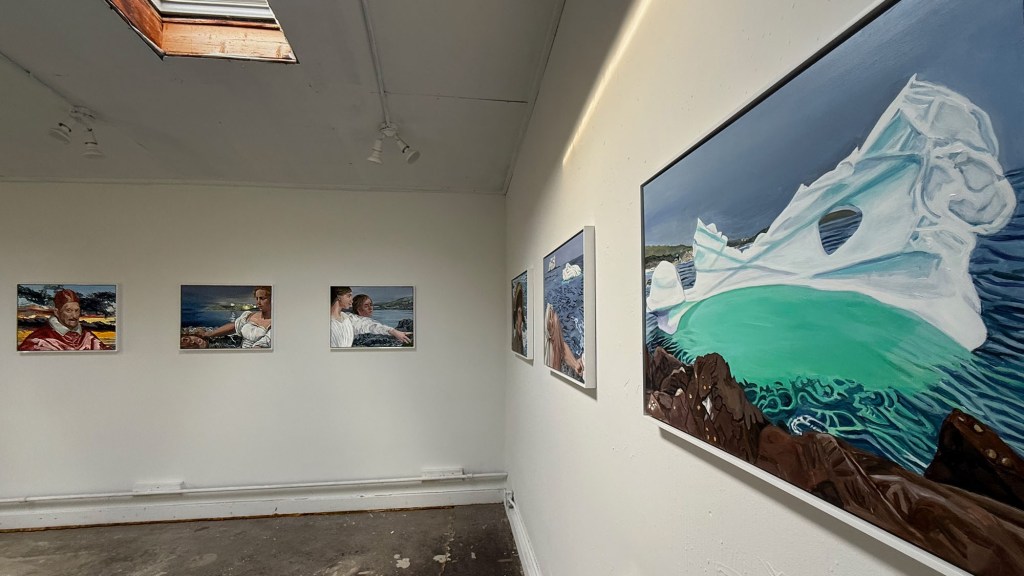
In a side room, Gill Ord’s “Pouch Cove Horizons Installation” positions 17 small gouache paintings on three parallel shelves made from found wood. Painted in bright yellows, gradient blues, and black lines, they read as snapshots of an ever-changing seascape – to wit, Pouch Cove. Facing them is Zlamany’s “A Rake’s Progress,” series of eight self-portraits contemplating art history and the landscape. My favorite is the beguiling After the Death of Marat, depicting Zlamany as the dying French martyr with an iceberg floating in the distance.
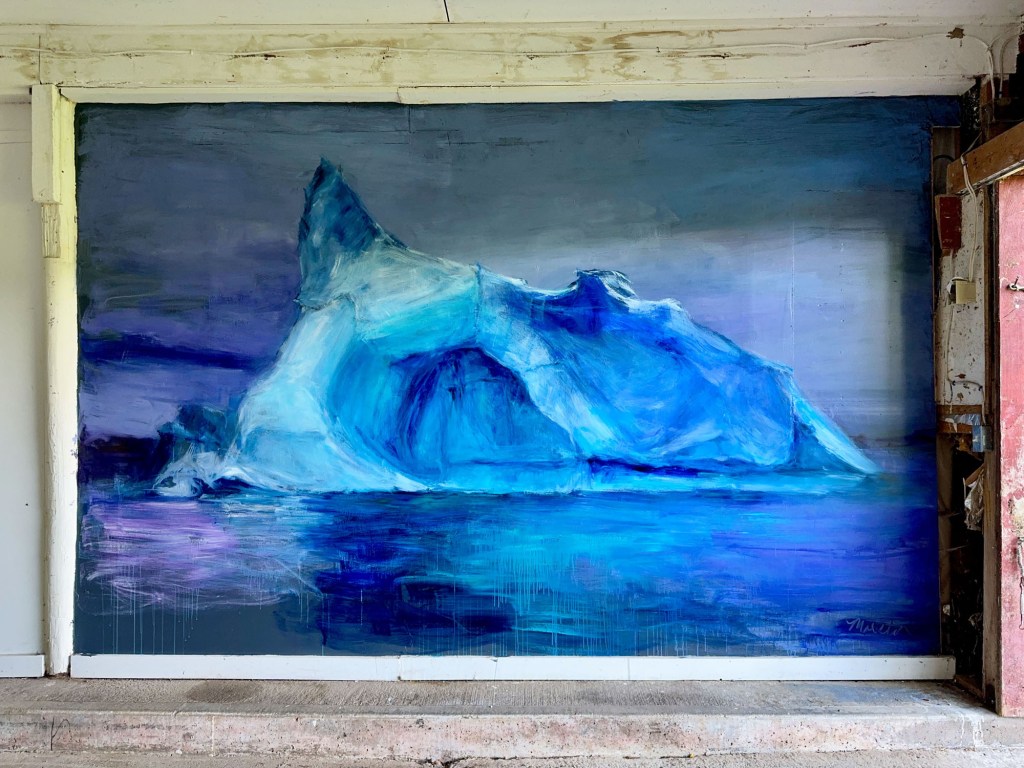
Each artist painted at least one iceberg, and the motif satisfyingly unifies the show. Known as Iceberg Alley, the waterways of northern Newfoundland and Labrador have attracted many artists, including Hudson River School painter Frederic Edwin Church, who made an expedition to paint icebergs there in 1859. Karen Marston’s Melting Ship speaks to this tradition and brings something new. Painted in situ on an 8-x-10-foot wall just inside the barn’s open door, her iceberg drifts improbably close to the adjacent grassy field. On the day I visited, raking sunlight streaming through the door lit up the piece, linking the iceberg and the Hudson Valley landscape, suggesting climate change and improbably fusing idyll and crisis. In Church’s time, icebergs were considered exotic novelties from distant climes, practically inconsequential. Today, their melting and calving signal environmental disaster. “Seven Women Chase Icebergs” at once affirms the power of artists to gather and ponder and acknowledges nature’s majestic fragility.
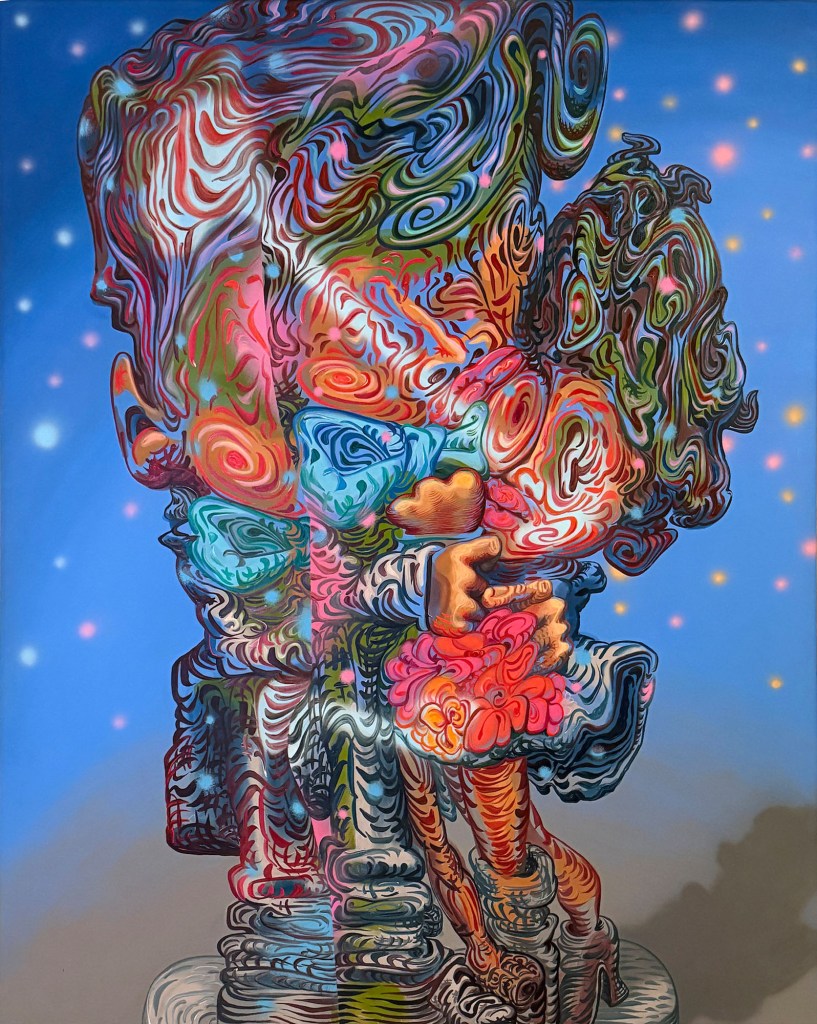
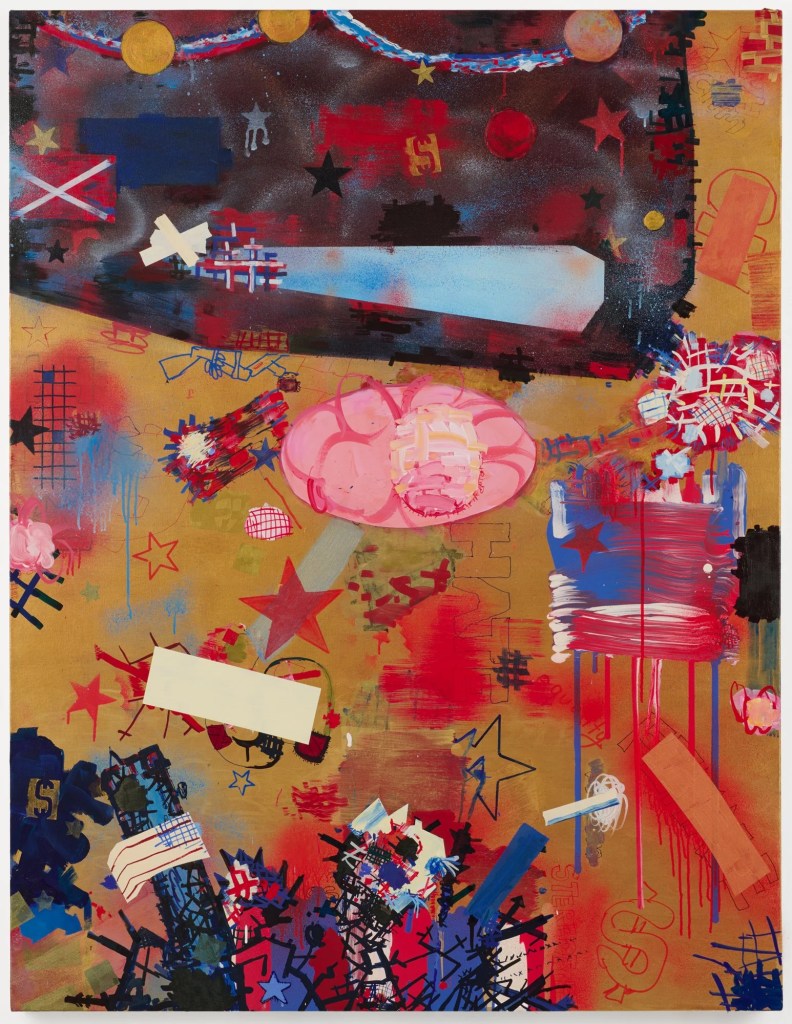
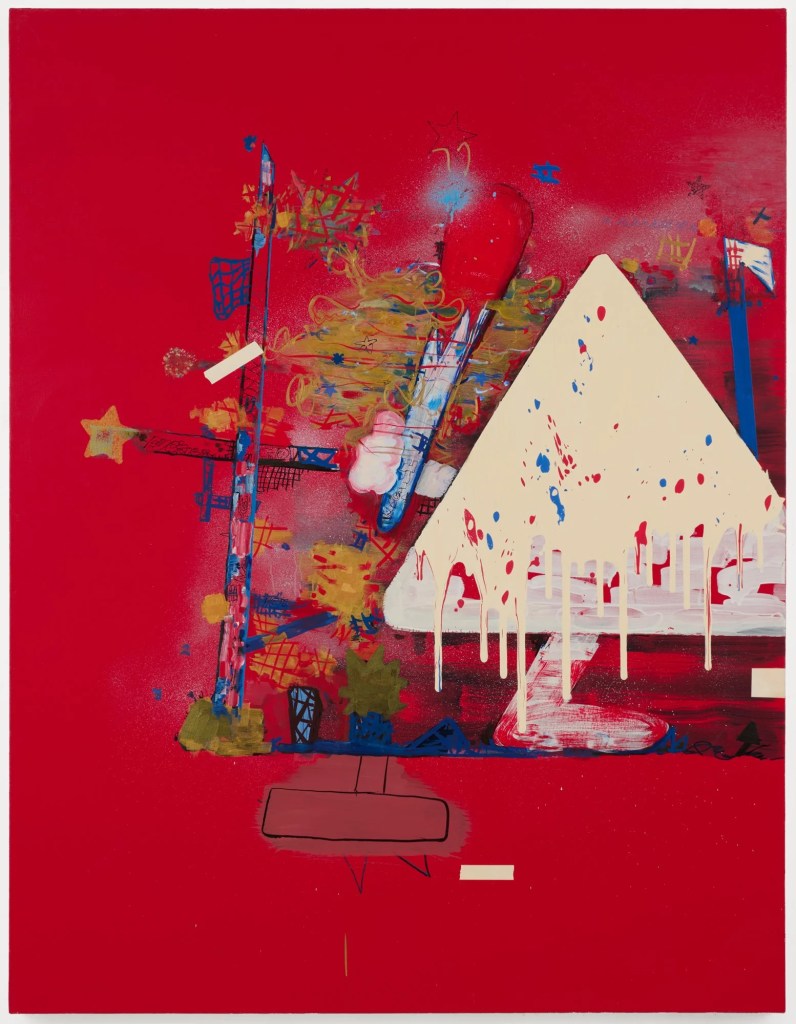
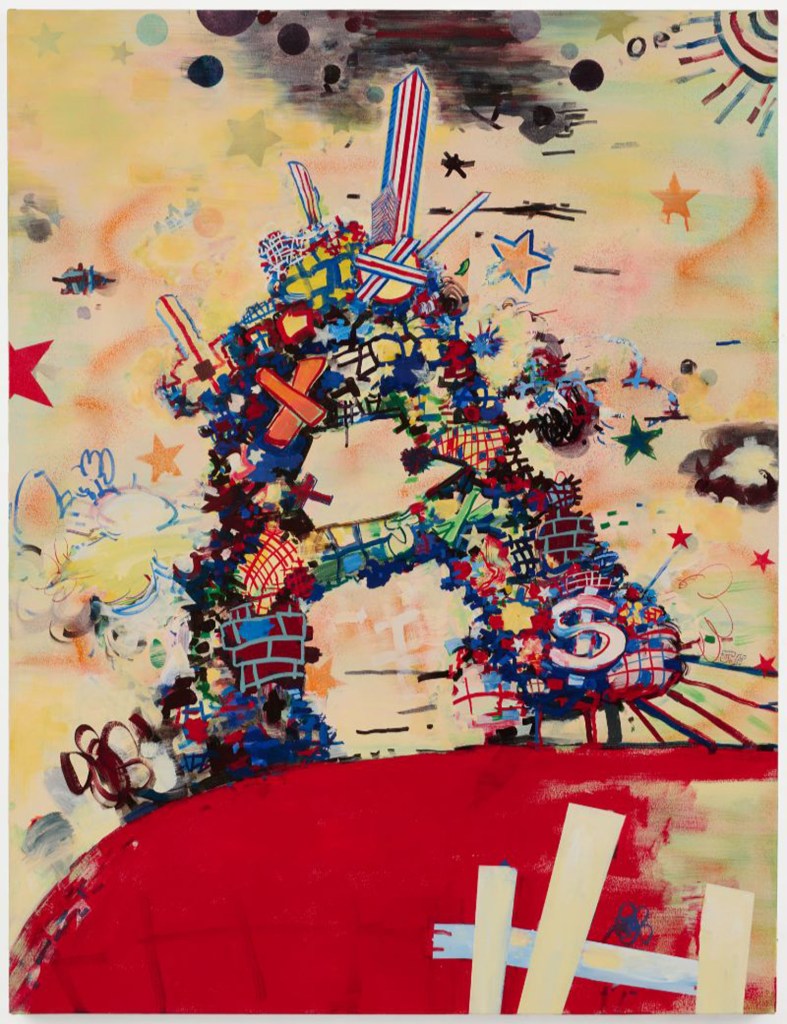
Upstairs, in the hayloft, “Who’s Afraid of Virginia Woolf” brings together paintings by James Esber and Jane Fine – an artist couple – plus one boffo collaborative work on paper. It is by design more interior than the downstairs show, and no less compelling. Fine’s work straddles the realms of abstraction and representation, with abstraction the baseline. The works combine multiple painting techniques, from flat areas to drips and pours to brushwork. Imagery is distilled into simple cartoons and includes symbols referencing personal and collective memory. A dollar sign, the letter A, the word JANE, and a puffy flower hover in a depthless, schematic space. The accumulation of actions and marks, embedded in thick acrylic medium, gives these paintings a strong physical presence. Walls, picket fences, an unsteady cabin, and stylized flowers are set against an otherworldly sky, coalescing into a personal landscape. Esber, in contrast, starts with the human figure, deconstructing bodies and connecting disparate elements with sophisticated color and stylized marks. Heads dominate, with morphing facial features that sometimes vanish. Figures are distorted, often grotesquely, as in Mad magazine’s satirical illustrations. His works feature guns, soldiers, a flag-waving hand, and caricatures, both shocking and amusing. Meanwhile, saturated, unnatural colors – purples, reds, and blues – evoke the artificial without toy-store cheer. The light enveloping these paintings is dim.
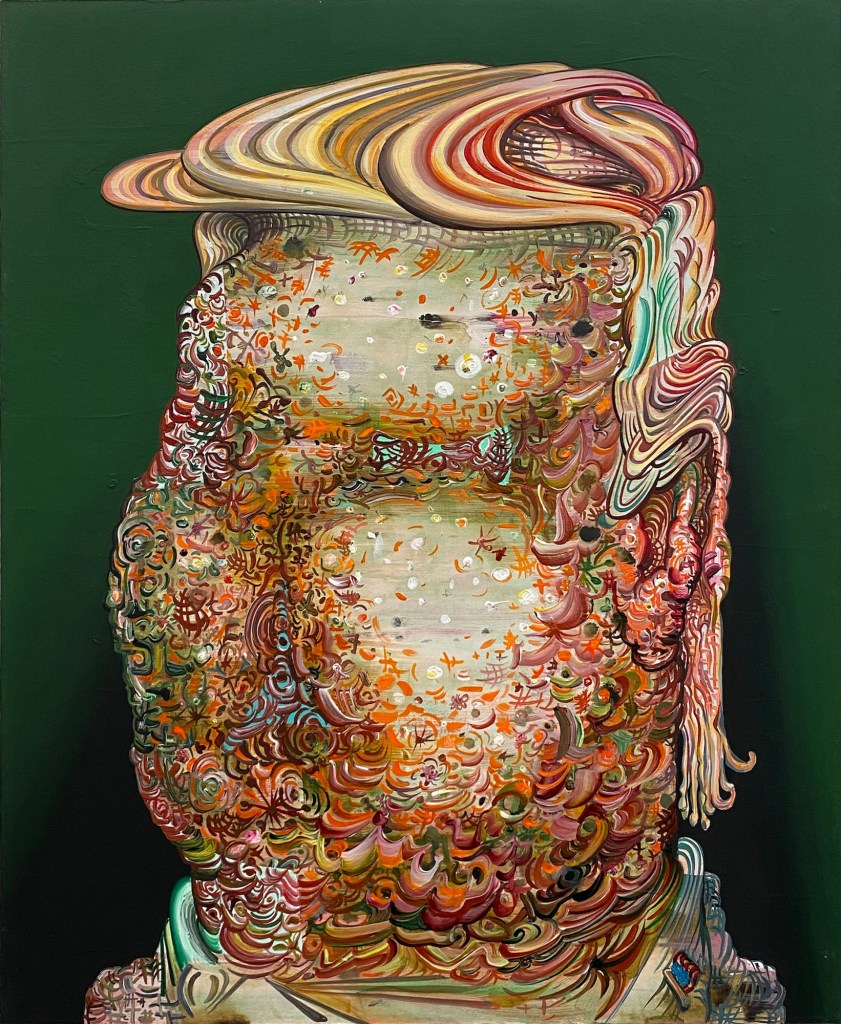
While the artists have very distinct visions, the overlap of palette and mood here is uncanny. Fine’s landscape Strange Fruit excavates multiple layers of societal distress, its title referencing Abel Meeropol’s song protesting the horrific lynchings of African Americans, recorded by Billie Holiday. Anchoring the piece are pale red bricks, from which scrappy trees and flowers grow, one sporting a ‘70s-style happy face. The flat, patchy sage green background is neither sky nor land. In Esber’s Blemishes, a large, cartoonish head swells, its jowly outline resting against a forest-green ground, the featureless face pockmarked with colored dots and dashes like a piece of meat. Topped with a toupee-like mat of swirled yellow hair, though, the painting’s allusion to the current president is unmistakable. Together, the two paintings evoke a fraught historical, political, and cultural tableau.
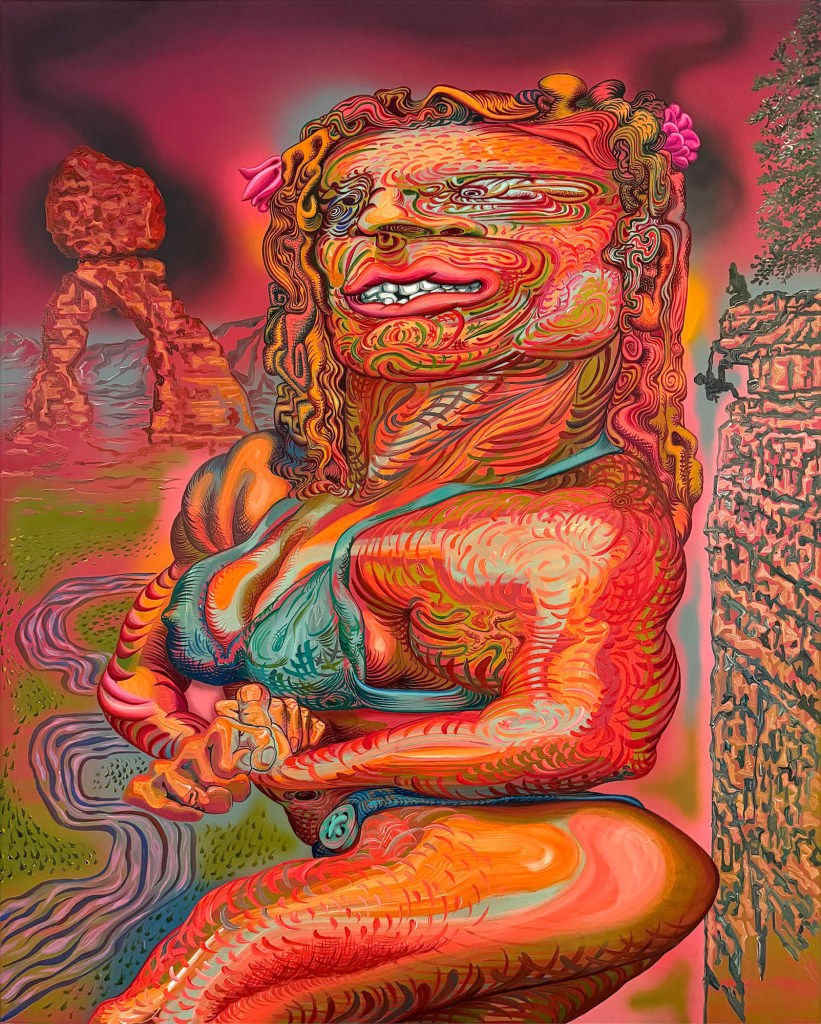
Esber’s Flex shows a colossal, bikini-clad bodybuilder with Botoxed lips, a mangled grin, and spiraled eyes, rippling her muscles. The painting burns with closely valued reds, oranges, and violets, generating an apocalyptic mood. Next to it is Fine’s Teheranica, where five-pointed stars and drone-like craft move through an exploding sky. Below appear the ruins of a city. An orange, blimp-like shape, its bulbous form mirroring the thigh and buttocks in Flex, appears to have been hit by a cluster of projectiles. Fine’s three red, white, and blue paintings are openly political. In Patriot, a large white, drippy triangle moves past crumbling blue scaffolding on a flat red field. The Admiral stacks dollar signs, broken brick walls, skyscrapers, and industrial fragments on a deep red base. Gulf of América maps perilous moral decline with stars, broken guns, explosions, and backwards American flags. Like Edward Albee’s eponymous play, Esber and Fine petulantly lament and challenge the status quo, calling out folly and urging the rejection of falsehood and delusion.
“Seven Women Chase Icebergs,” The Re Institute, 1395 Boston Corners Road, Millerton, NY. Through July 11, 2026. Artists: Daisy Craddock, Gill Ord, Trine Bumiller, Karen Marston, Barbara Friedman, Elisabeth Condon, Brenda Zlamany.
“James Esber and Jane Fine: Who’s Afraid of Virginia Woolf?,” The Re-Institute, 1395 Boston Corners Road, Millerton, NY. Through July 11, 2026.
About the author: Lawre Stone is an artist based near Hudson, NY. A Two Coats of Paint Resident Artist in October 2025, Stone is a 2026 recipient of the Martha Boschen Porter Grant of the Berkshire Taconic Foundation.