
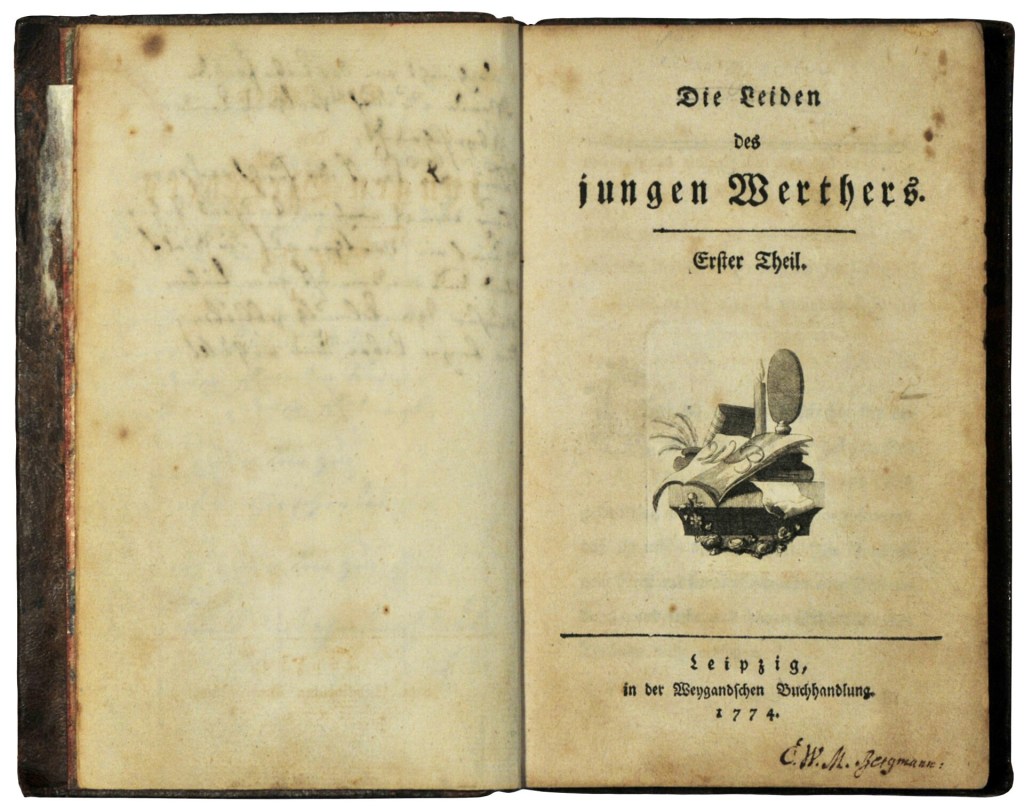
Contributed by Laurie Fendrich / Two Coats of Paint Press recently published a limited edition of Johann Wolfgang von Goethe’s semi-autobiographical, epistolary novel, The Sorrows of Young Werther (1774). I discovered the book when I was in my early thirties and ever since it’s lived in my brain. It’s among the first books to probe the inchoate longings of artists, and a powerful exploration of the subjective side of the artistic personality. I’ve met very few artists who have heard of it, let alone read it, so it surprised me to learn that a fellow artist had recently discovered it and published a special edition with a dedication reading, “To all the artists who have ever lived and worked in New York City.” Despite having been written more than two-and-a-half centuries ago, Werther raises provocative questions for artists working today.
Goethe anonymously published Werther when he was 24, but his authorship was common knowledge. Like the eponymous protagonist, Goethe had fallen in love with a woman – her fictional counterpart had the same name, Lotte – engaged to another man whom she then married. Although he regretted publishing the book and wrote a “softened” version in 1787 that remains the most widely reprinted one, writing the book was cathartic for Goethe and it became a bestseller. “Werther fever,” as the craze was called, was the first recorded pop culture phenomenon. Young men throughout Europe copied Werther’s dress – yellow waistcoat, blue jacket, and yellow trousers, with brown boots and a felt hat. Merchants flogged porcelain teacups and kettles, linens, and tin containers decorated with scenes from the book. There was even an “Eau de Werther” perfume. Places he visited in the novel became tourist destinations, and reports of young men experiencing such intense anguish after reading it that they committed suicide as Werther did led several cities to ban the book.
Werther belongs to the German proto-Romantic Sturm und Drang literary movement that celebrated raw emotions and saw the heart as taking precedence over reason. During the same period, many people were attracted to the notion of “sensibility,” whereby humans can cultivate a heightened sensitivity to beauty and morality. Thomas Carlyle, a contemporary of Goethe’s, said that Werther expressed “the nameless unrest and longing discontent” felt by a generation disillusioned with the Enlightenment. He coined the term “Wertherism” to describe the self-absorption and self-indulgence he thought the book unleashed. But the book had legs. Napolean carried a copy during his Egyptian campaign of 1798. It hovers in the background of Jane Austen’s Sense and Sensibility (1811) and appeared in Mary Shelley’s Frankenstein (1818) as one of three books the monster discovers in a suitcase while wandering in a forest. In 1853, William Makepeace Thackeray published a snarky poem satirizing the book. Jules Massenet’s opera Werther debuted in 1892. In the rather unromantic twentieth and twenty-first centuries, Werther has continued to be a touchstone for writers – for instance, Thomas Mann, whose novel Lotte in Weimar: The Beloved Returns (1939) grew out of it. Many hardnosed modernists, of course, couldn’t stand the hero. In 1972, W.H. Auden condemned Werther as a ”complete egoist,” a “spoiled brat,” and a “horrid little monster.”
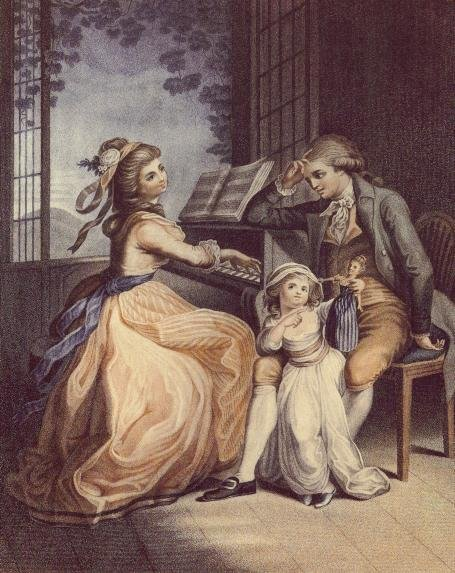
The story begins with Werther’s arrival in the fictional small town of Walheim. He’s left his mother’s house to replace the banal conformity of modern urban life with solitary nature walks (at one point, he wishes he were a ladybug), poetry (especially that of Homer, whom he sees as close to nature), and occasionally drawing. Werther admits to wild mood swings; today, he might be considered bipolar. Though highly educated, intelligent, and earnest, he has yet to find a purpose in life and is debilitatingly introspective. He’s convinced that his intelligence and sensitivity are superior others’, and that “to be misunderstood is the miserable destiny of people” like him. Although Werther considers himself an artist, he lacks even a modicum of an artist’s ambition.
Werther meets and falls in love with Lotte, who’s betrothed to another man, Albert. Werther is so smitten that the news barely registers, and he becomes increasingly obsessed with her, visiting her almost every day. Lotte, for her part, clearly enjoys his company and keeps dropping hints that she has feelings for him as well (a contemporary guy might call her a prick-tease). The two develop an erotically charged “friendship.” To escape this fraught situation, Werther leaves Walheim for a low-level job in a prince’s court in another town, where he loathes his boss and his middle-class vocation, resolving to ascend to the town’s snobbish aristocratic social circle. After he crashes a party and is rudely snubbed, he quits his job and returns to Walheim. Discovering that Lotte and Albert have married, he loses all hope for his love life and social standing and can find no pleasure in anything. His emotions become so uncontrollable that he passionately kisses Lotte, who reacts with indignation. “This is the last time, Werther! You shall not see me again.” A few days later, Werther does himself in.
The novel is not a moral vehicle. It never really examines, for instance, why Werther starts off with healthy promise and ends up a suicide. A German scholar and friend told me “Sufferings” is the more accurate translation than the conventional “Sorrows” for the title of the book. In any event, to treat Werther’s travails as a product of mental illness is to dismiss the unfocused longings of his soul as contemptible – something our late-stage capitalist society does as resolutely as Werther’s aristocratic one. Genuine Werther types are hard to find in this world, where artists are more likely to spend time crafting “mission statements” and descriptions of their “practices” than to trumpet any wistful longings. Werther is a mere wannabe artist, but like many an artist manqué, he’s self-absorbed. His envy of Lotte’s husband smacks of the standard artist’s grievance of insufficient recognition. The joy Werther feels on his solo nature walks is akin to that felt by artists working alone in their studios. In Werther’s case, though, solitude turns into destructive loneliness.
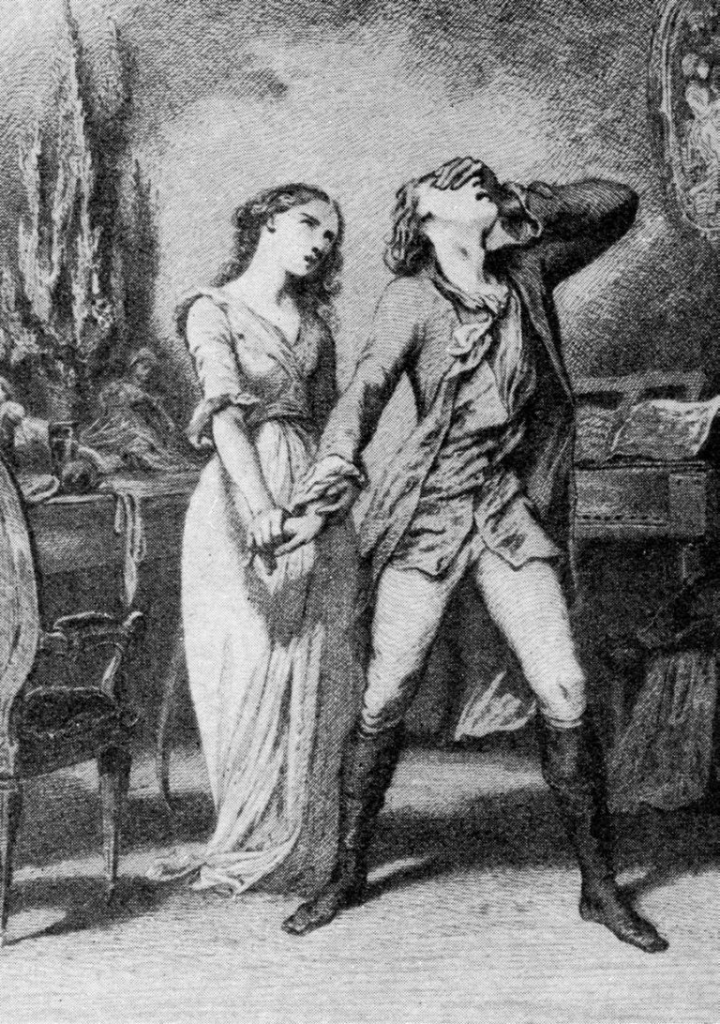
Johann von Goethe, 1844, Etching
Just as Lotte offered Werther scraps of encouragement that kept his hope for possessing her going, today’s art world offers smidgeons of success – shows, reviews, sales, other artists’ pats on the back – that keep artists’ hopes for grander fulfillment intact. To sustain a life as an artist, perhaps it’s best to embrace Georges Braque’s famous proclamation: “I love the rule that corrects the emotion.”
Johann Wolfgang von Goethe, The Sorrows of Young Werther [1774] (New York: Two Coats of Paint Press, 2026).
About the author: Laurie Fendrich is an abstract painter and arts writer who lives in Lakeville, CT. She is represented by Louis Stern Fine Arts in Los Angeles and is a frequent contributor to Two Coats of Paint.














With Braque on this…
Your German friend’s comment re the best English translation as more ‘sufferings’ than ‘sorrow’, is the heart of the matter which you brilliantly bring to us from 1774. We continue learning what a complete egoist can do.
Made me think about Nicolas de Stael who did as Werther, fell in love with a married women and threw himself out a window in Antibes…