Contributed by Jonathan Stevenson / There’s a plausible argument that American culture is in a state of arrested development, ever bending back to a kind of national adolescence born of a persistent self-image of fledgling prodigy. Leslie Fiedler made the case as to literature at mid-century with Love and Death in the American Novel, insisting on the sober maturity of European letters in light of imperial decline and epochal devastation against the exceptionalist puerility of American fiction. Becca Rothfeld deftly rehabilitates and contextualizes this point of view in a recent New Yorker piece, landing it on a hortatory if plangent note: “Perhaps now that we are standing amid the ruins of the East Wing and the wreckage of the post-war liberal order – now that we, too, occupy and uncomfortable interregnum between two social formations – we will find it in ourselves to put away childish things and write something new.” Assuming this contention has some validity, is contemporary American art similarly retrogressive?
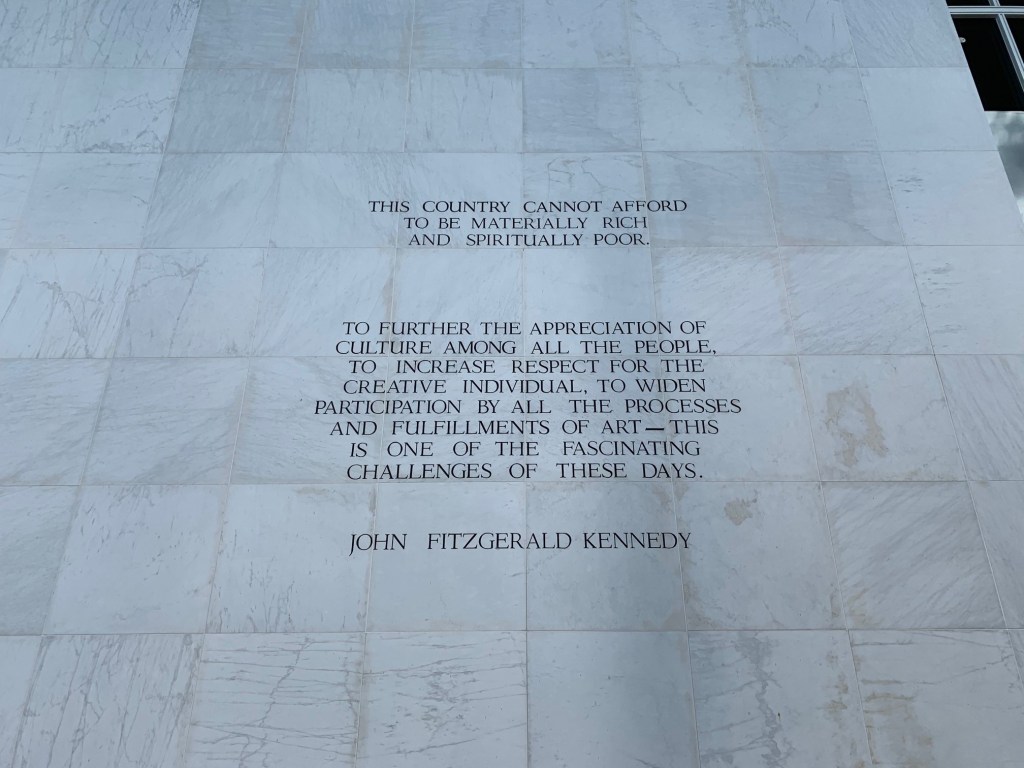
It may lean that way. Art is presumptively a refuge – in the extreme, an escape – from the drabness and misery of day-to-day life. And its premium is on beauty, which can be simplistically construed as excluding confrontations with bleak history. Further, the divergence between America’s founding idealism and the early conduct of its settlers it is so wide and the accommodation of gauzy exculpatory myths like the Lost Cause of the Confederacy and Manifest Destiny so entrenched that considerable bowdlerization is inevitable. Witness Regionalism. A political movement, party, and leadership invested in such myths, given to equating nobility with violent domination, and seemingly committed to exterminating our better angels, is for the moment ascendant and hell-bent on rolling back the social progress forged to atone for America’s original sins and stifling critical self-examination through the systematic suppression of cultural as well as other freedoms, right down to the co-optation of the Kennedy Center and the Smithsonian.
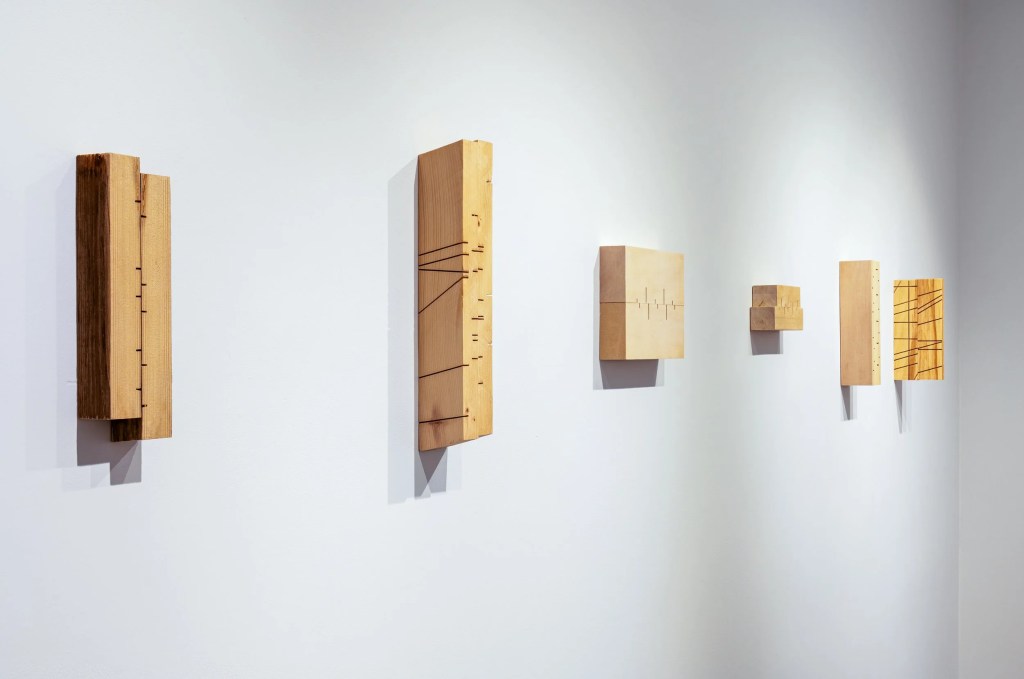
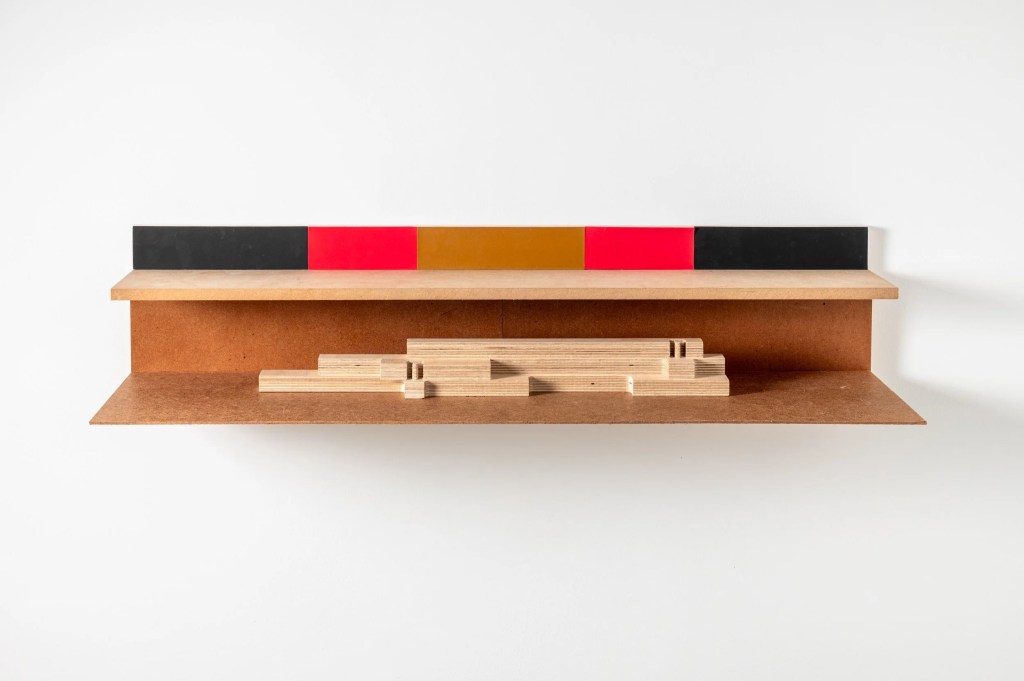
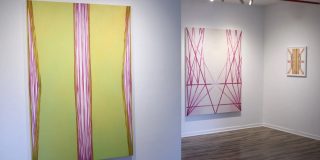
“Grow up” is too simple an imperative to apply to art. Regionalism got plenty of competition from Social Realism, Clement Greenberg’s formalism from Harold Rosenberg’s existential approach. Against willful blindness, youthful swagger can drive aesthetic revolt via identity politics, targeted polemics, and other forms of politically marshaled topicality. Some work of this ilk is too earnestly on-the-nose to constitute great art. But even the obvious isn’t worthless if you take art to be a kind of running teenage diary of a messy collective unconscious that encompasses the liminal despair of present-day America as well as mid-century Europe. Zadie Smith, in her essay “Art for Our Sakes” in The New York Review of Books, gets at something like this when she says, with impeccable ellipticality, that “art is not powerful, and it does not progress.” Art just irrepressibly is, and its crowning virtue is that “it will outlast us all,” crucially including the worst of us. In “Wooden,” a recent show at Project ARTspace, Peter Dudek seemed to contemplate that generational stamina with his small-scale, fastidious sculptures of modular structures. They allude to the immovable land art of Gordon Matta-Clark and Robert Smithson and perhaps, on the flip-side, the stark utopianism of Wright or Gropius. His minimalist “Notational” wood slab series imparts diffidence to the human compulsion to mark unspoiled material. These pieces struck me as a mordant coda on the twentieth century: it all looked and sounded so nice before certain people moved in and screwed it up.
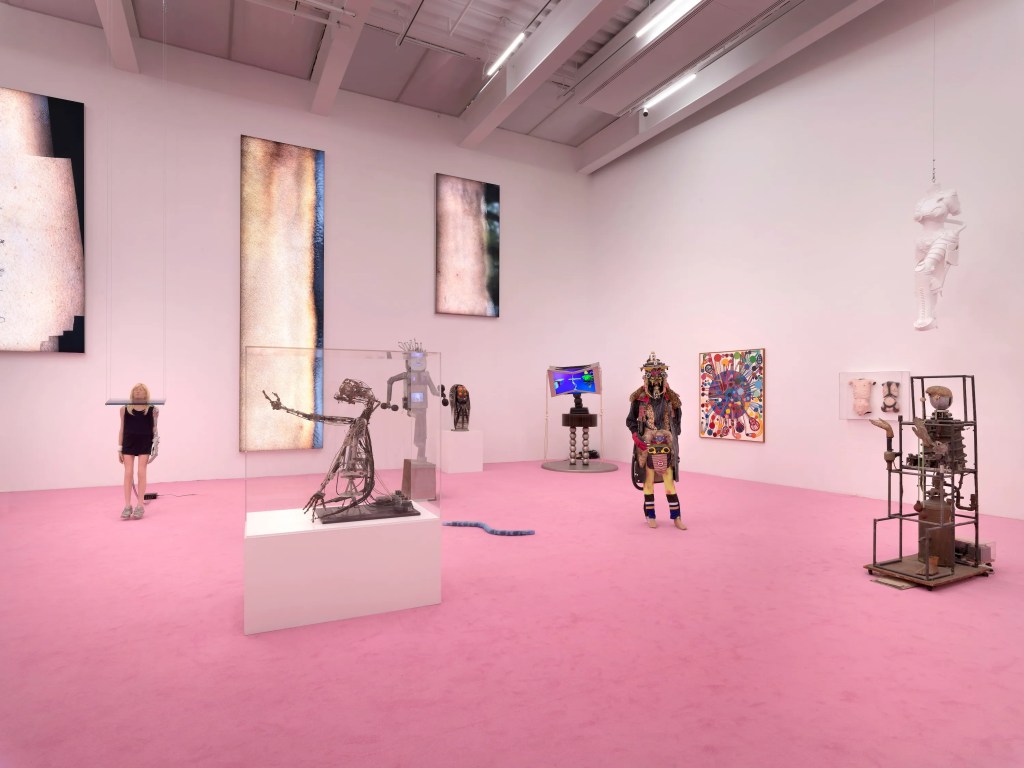
Maybe I’m overreaching. There are ways in which a mature critic or a seasoned curator can enforce greater interpretative discipline. For an art review or curatorial statement, a standard gouge is to start with a gnomic, mildly pompous set-piece declaration bounding the context, wedge the work at hand into it through well-spun description, selectively broaden out the discussion to art history customized and stove-piped to that work, and segue to a magisterial judgment on merit. We all do it, but maybe it’s too grown-up. Exhibitions like “New Humans: Memories of the Future,” the New Museum’s comeback extravaganza – occasionally shambolic but undeniably ambitious, relentlessly inclusive, and sometimes spot-on – shade the adult approach’s insular timidity and underwrite expansive, visionary humanism. Some 200 artists extrapolate the arc of our species, starting with the senselessness of the First World War and the tragedy of the Second, extending to alternately triumphalist and trepidatious redemption at mid-century, on to the paradoxical bounty and dread of the Cold War, vectoring into the digital profligacy and political degeneracy of the present, each moment turbocharged by technological advance. However sobering this message – see especially the “Hall of Robots” – it suggests that, collectively, artists don’t miss much.
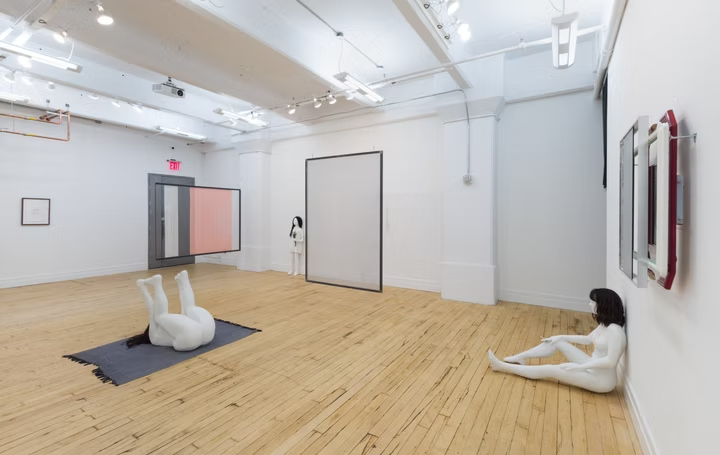
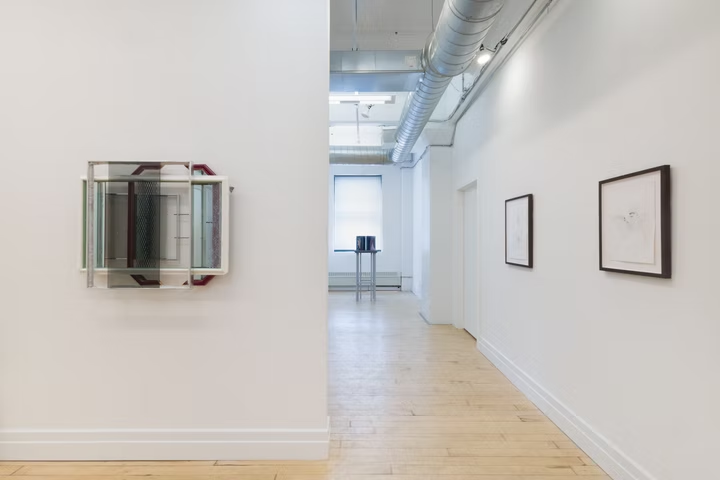
If I’m off on Dudek’s intent, he probably won’t take it personally. He’s a youthful grown-up alert to the vicissitudes of subjectivity and imagination. He will appreciate my adolescent impulse. Those sorts of reflexes remain not just a driving aesthetic force but also a durably compelling metaphor. In the two-person show “Split Impulse” at Springs Projects, Iris Bernblum presents, among other items, four plaster-based sculptures – 12, a thinly clad pubescent girl; Her, a naked young woman smoking; Happy Baby, the generic female in the same state of undress cheerfully supine with knees flexed and torso bent, fully exposed below the waist in the eponymous yoga pose; and, joltingly, Doe, a deer bestriding its own detached head. Taken as a series, a surprisingly daunting narrative emerges: we lose our innocence, we try to manage joy and indulgence, and we are not (yet) grown-up enough to take decent care of the world. Analytically, especially now, this is perhaps no great revelation. But Bernblum’s visual fable shifts the tenor from banal to lacerating. Recapitulating her civilizational frustration and disappointment are Heather Rowe’s beguiling wall pieces All the Colors of the Dark and Stacked – overlapping slats, mirrors, and louvers that look seductively tidy and technical from a distance, as an algorithm or an ideology might seem to a dazzled seventeen-year-old, but defy coherent resolution up close.
Dudek, Bernblum, and Rowe had to call on their innocence and set aside their jadedness – which might have counseled them not to bother – to produce works of candid and penetrating sardonicism. David Humphrey, who’s not lacking in that department, isolates the tension between the two qualities in his 2006 essay “Ike and Me,” which centers on his apprehension of Dwight D. Eisenhower’s resolutely insipid paintings. “My paintings treat Eisenhower’s blankness as though it were pathological,” writes Humphrey. “I, perhaps also pathologically, introduce sexual overtones and semiotic horseplay to his material, playing fast and loose with the historical record. Like an amateur, I fuck things up in my own way. Perhaps becoming President would help me relax.” Even in jest, of course, he couldn’t imagine Donald Trump.

By twenty-first century standards of digital speed and unperturbed ease, artists’ porous filters and native discursiveness are what Zadie Smith calls “inconvenient.” They do not cut to the chase, take their time getting there. They need a detour of naïve bravura to avoid succumbing to “dated cliches and earnest mistakes” (Humphrey again) and to marshal the uninhibited “pagan embrace” (Dave Hickey) required to grasp and articulate angst and joy alike with the flourish of revelation. So art has to abide, in fact treasure, childish things when they illuminate rather than obfuscate. As much as governments need normal adults like Ike in the room, art thrives on the adolescent impulse to fuck things up. Not vice-versa.
Notes:
Becca Rothfeld, “Forever Young,” The New Yorker, June 8, 2026.
Zadie Smith, “Art for Our Sakes,” New York Review of Books, June 11, 202
“Peter Dudek / Emily Feinstein: Wooden,” Project ARTspace, 99 Madison Avenue, 8th Floor, New York, NY. March 26–May 29, 2026.
“New Humans: Memories of the Future,” New Museum, 235 Bowery, New York, NY. Ongoing.
“Iris Bernblum and Heather Rowe: Split Impulse,” Springs Projects, 20 Jay Street, Suite 311B, Brooklyn, NY. Through July 31, 2026.
David Humphrey, Blind Handshake (New York: Periscope Publishing, 2009).
Dave Hickey, “American Beauty,” in The Invisible Dragon: Essays on Beauty (Chicago: University of Chicago Press, 2009).
About the author: Jonathan Stevenson is a New York-based policy analyst, editor, and writer, contributing to the New York Times, the New York Review of Books, and Politico, among other publications, and a regular contributor to Two Coats of Paint.