
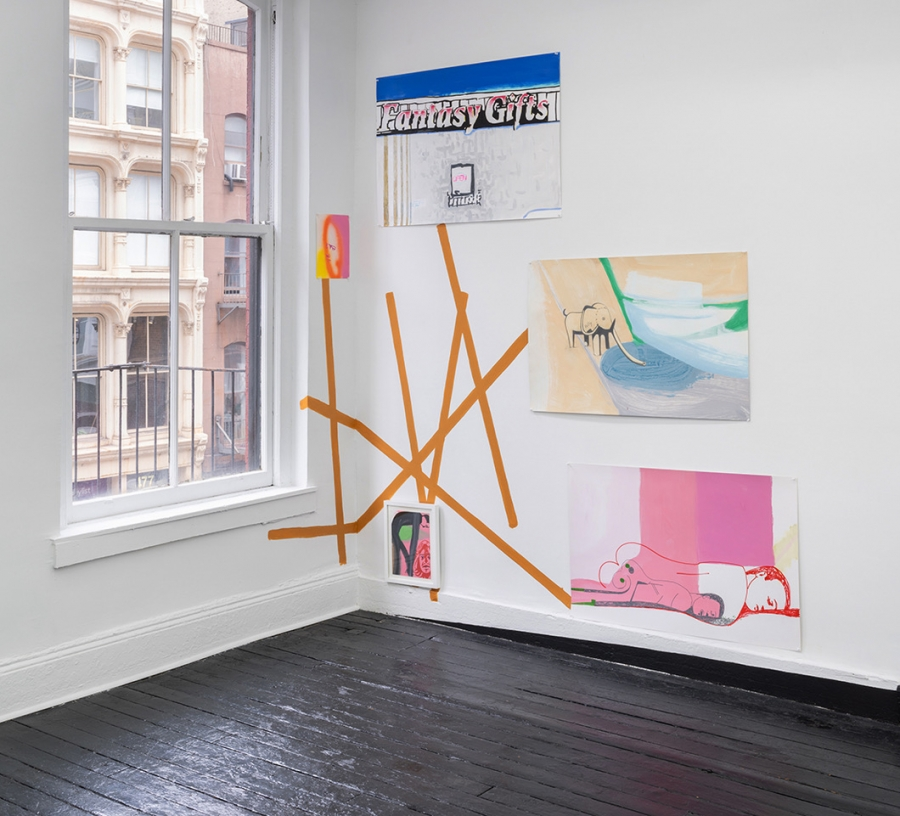
Contributed by Jonathan Stevenson / David Humphrey has accustomed his audience to acerbically penetrating representational paintings in which witty riffs resolve into considered pronouncements about the world. His 2022 painting Art Shipping – depicting a van about to bring a painting of a misogynistic act of torture from the artist’s serenely rustic home to a presumptively hermetic white-cube gallery – is a fine example of his unsparing fusion of introspection and worldly scrutiny. Whereas such trenchant paintings – and there are many – reflect Humphrey’s fully crystallized ideas, the work in “anecdote,” his current show mainly of drawings at Kate Werble Gallery, captures a number of them in intermediate stages, offering graphic insight into his thought processes.
In the drawing Hiker, the silhouette of one of two partners whose tryst the hiker interrupts blends in with the foliage, suggesting that the starker contrast in the corresponding painting is meant to amplify their substantial reality. The obscure but perceptibly human face in the drawing Plant Thoughts is pixelated in the eponymous painting, confirming that technological intervention is pressing the questions he asks in the art book anecdote released to coincide with the show: “How are thoughts like plants? Can an image make itself?”
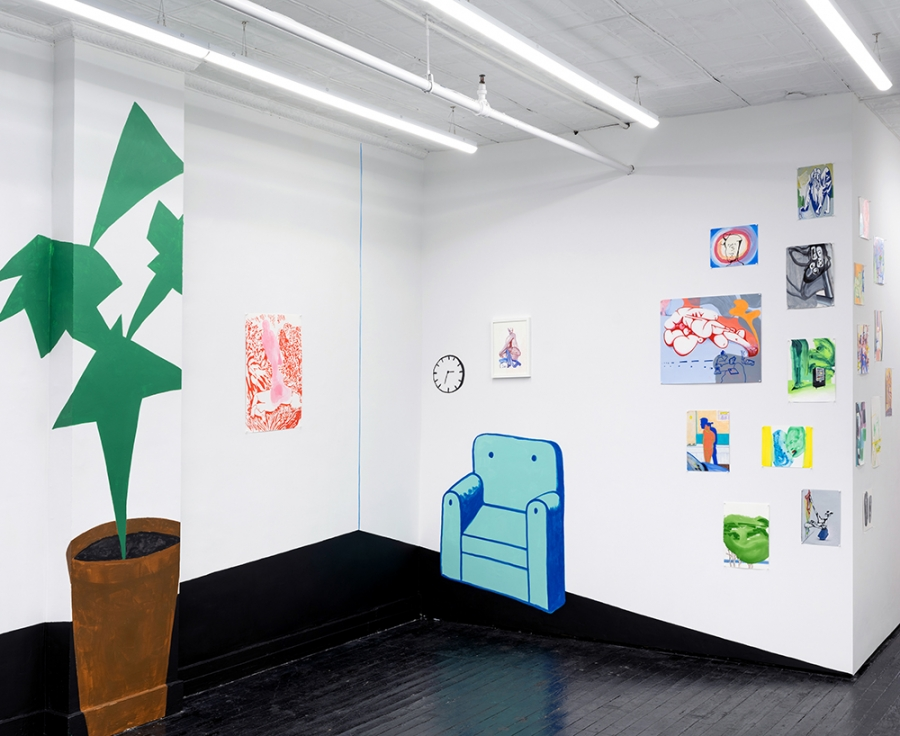
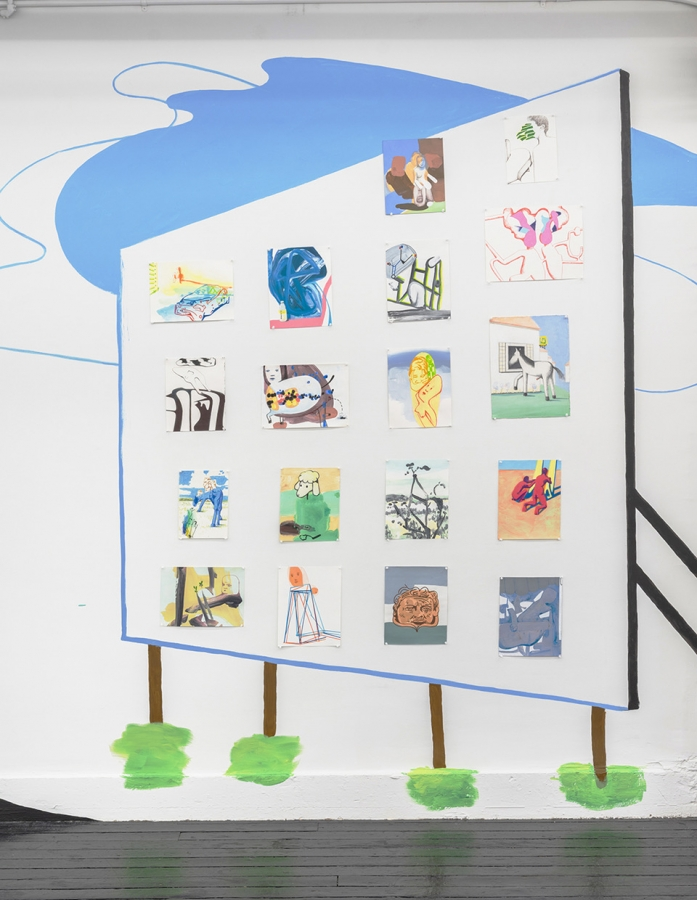
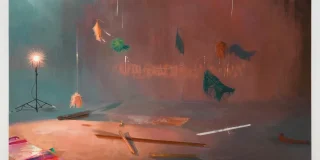
Site-specific images cue the circumstances and states of mind in which Humphrey’s work arises. An armchair inserted next to Hiker is prey to, among other drawings, those of a man under arrest, the last vending machine standing, trees engulfed by their own verdancy, a face of decaying digital bits, and an unidentifiable cluster of organisms. A notional billboard presents some of his favorite motifs: a naughty horse, a humanoid poodle, a distressed car. Between a painted-in potted plant and snack table you encounter a luncheon on a red planet and an oblivious animal escaping a bullet. He can’t elude these gnawingly bizarre constructs in the privacy of his various physical preserves – home, studio, car – and neither, of course, can they avoid his interpretation. The couple disturbs the hiker’s idyll and vice-versa. The reciprocal permeability of Humphrey’s worlds keeps him producing art.
Humphrey includes in the book the drawing Young Bob, depicting a stern figure under a florid haze, archly declaring “a young Robert Rauschenberg plots his future.” This is not quite oxymoronic: Rauschenberg was calculating when he erased that de Kooning drawing in 1953, and the fluid curves in the drawing’s red overlay hint at that very episode. This aside, though, Rauschenberg seemed relatively insusceptible to strategizing, determined to find the world without contrivance. Men plan, God laughs. Everybody has a plan until they get punched in the face. So it is with most artists. Humphrey does not downplay the precariousness of their endeavor or the exhausting grind of his own topical art-making. And he shows little sign of flagging. In Getting Old, arrayed on the billboard, the man with the mottled face maned in coiffed hair may be a lion in winter, but he’s still a lion.
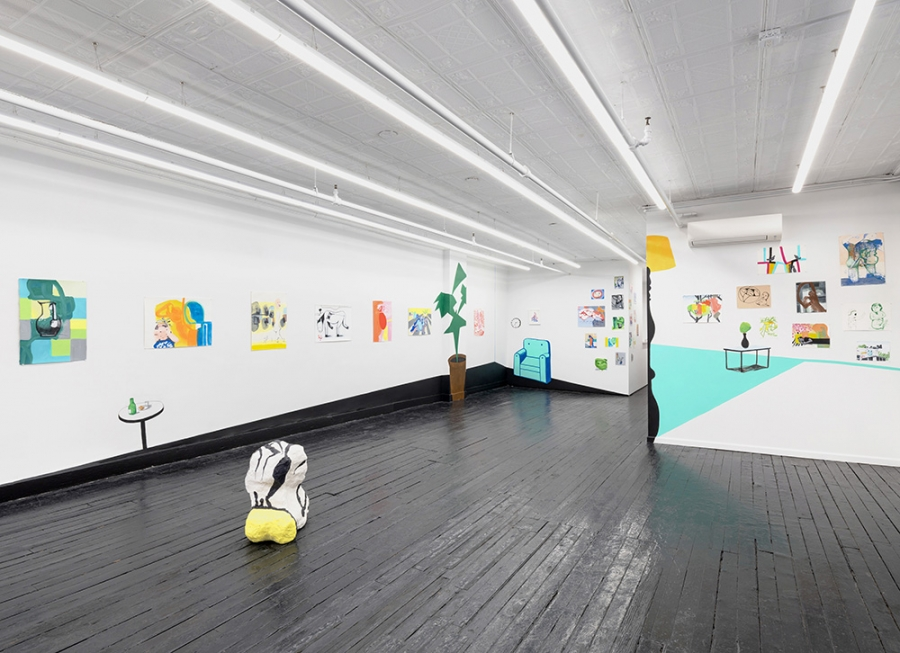
You could call Humphrey a hard-edge surrealist. His ease with color, casually gruesome imagery of discombobulated heads and faces, and clean-but-brittle line afford his work a fanciful swagger. But he also draws and paints with a kind of oracular assertiveness. Over the course of a decade and five New York solo painting exhibitions, he has churned through America’s precipitous social and political decline with searing purpose. While he seems playful, his gags bite. Ultimately, this dual capacity derives from the cold-eyed sharpness of his perceptions about cultural crosscurrents and his technical ability to compress those perceptions into elegant visual narrative. Perhaps that is broadly true of any successful objective artist. But Humphrey’s grasp so consistently equals his reach that he occupies a singular position.
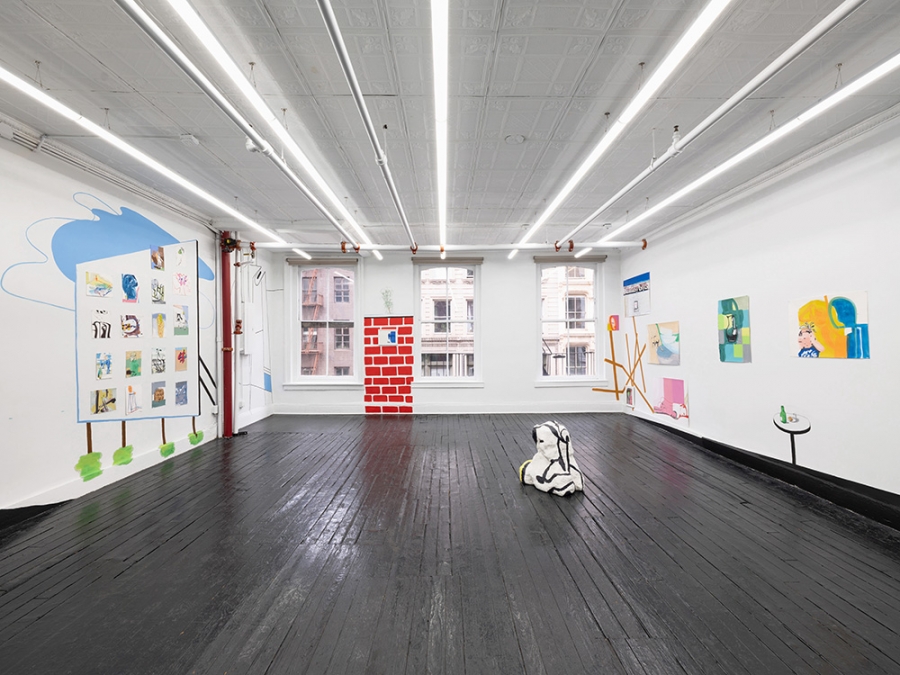
“David Humphrey: anecdote,” Kate Werble Gallery, 474 Broadway, Third Floor, New York, NY. Through June 6, 2026.
About the author: Jonathan Stevenson is a New York-based policy analyst, editor, and writer, contributing to the New York Times, the New York Review of Books, and Politico, among other publications, and a regular contributor to Two Coats of Paint.









This review captures so much of what I like about Humphrey’s work, in helpful ways: knowing but not arrogant, smart but not cynical, funny and deft. I would add that I think his space play, color, and drawing-as-painting—his concern for visuality—are all also equal partners in his convincing uncertainty.