
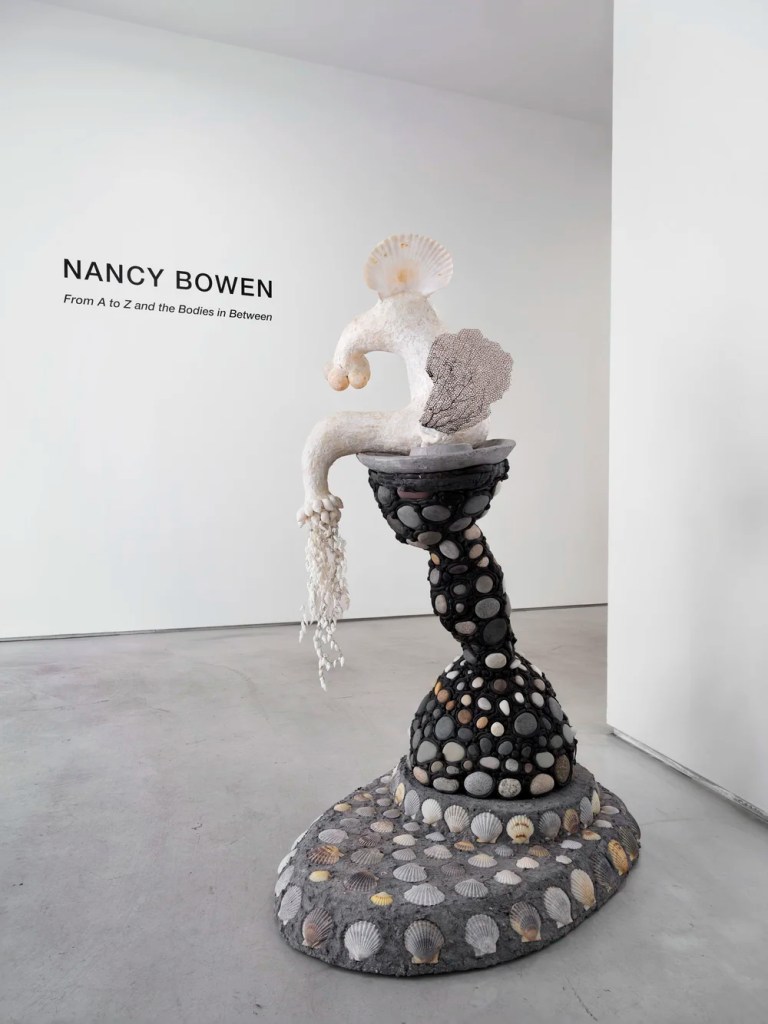
In connection with “Nancy Bowen: From A to Z and the Bodies In Between,” her solo exhibition at NUNU Fine Art, Two Coats of Paint arranged a conversation between Bowen and psychoanalyst-artist Laurence Hegarty about her practice. Approaching her work with an “artist-archaeologist” mindset, Bowen finds materials reassembles them into objects that challenge established narratives about language, the female body, traditional craft, and history. She indulges playfulness and unconscious impulses, letting social and political themes emerge in due course.
Laurence Hegarty: Can we start with your use of words and language? In the current show you have these dictionary pieces, and I remember some iteration of this from your prior show at Kentler International Drawing Space. So, can we begin by talking about these pieces, the dictionary pieces? I’m not sure if that’s the way you like them to be referred to. But it’s a starting point as I see it. I mean, first off, where? Where are they from, where did you get the dictionaries?
Nancy Bowen: I do call them the Dictionary Collages. The dictionaries came from my father’s library in which he had books from his father’s library. Originally, I was struck by the beautifully engraved illustrations in these old books. I could not bear to throw them out and no one wanted them so I decided that I would make art out of them. My father was a scientist, and his father was a historian so they had a huge collection of refence books. Most of them dated from the early 20th century and they were often quite sexist. My first book-collages were overtly feminist incursions into these patriarchal texts. They were easy and fun to make. Then I ran out of those books and turned to the dictionaries. With the dictionaries I first thought about upending the hierarchy of text presiding over images. I began by color coding the words by figures of speech and then from there I began to play with the texts. In “The Sex Which is Not One”, Luce Irigary calls for a liberated feminine discourse to disrupt the rigidity of patriarchal language. So when I string together phrases that make a tactile or sonic sense I am exploring these ideas. Often the play results in a humorous koan. My word play is a strategic disruption of the order of accepted language usage.
LH: The family history is deeper than I realized, couple of generations there of men holding the books, not to say cooking them. Despite all the politics, both family and Gender politics I’m thinking, is there also some sense of lament, mourning loss. But perhaps I’m being too sentimental!
NB: Yes, you are being sentimental! Looking back on my family history I knew that my ancestor Samuel Sewall was a judge in the Salem Witch Trials. I had accepted the horror of having a witch killer in the family, then upon further research I found out that he in fact tried to atone for his actions. Of course it was too little, too late. The accused had been killed. At least he stood up for his beliefs and apologized for his actions. Remember I was doing this work during the first Trump regime so of course lying bad men were the norm. What a balm to read about someone renouncing his mistakes and seeking redemption. So, I don’t think I was mourning but more exploring possibilities of making amends. I created a large-scale installation, and later a book, titled SPECTRAL EVIDENCE. The book was a collaboration with the poet Elizabeth Willis who is a descendant of one of the women accused of witchcraft. We thought of our collaboration as making amends in this generation for the sins of ancestors.
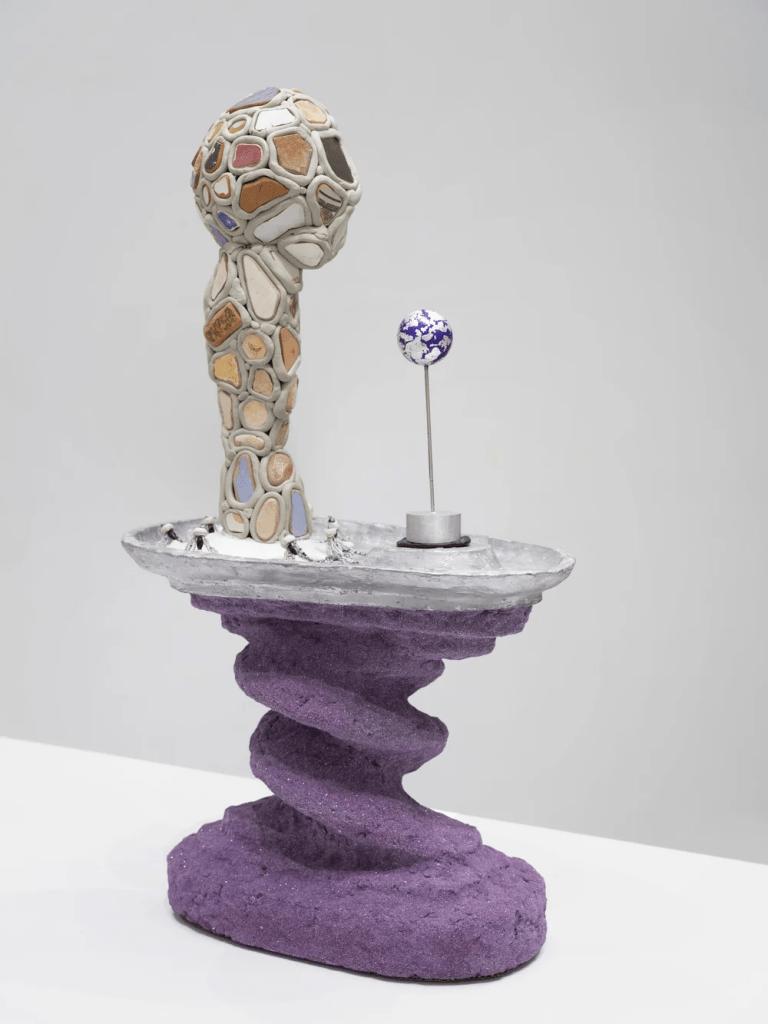
glitter, found tiles, epoxy clay, and silver leaf, 33 x 18 x 11 inches
LH: Right, I remember the book about Salem. Quite a family history to not be sentimental about. In the current show. I more fully get the sense of how you slice and dice language. I mean if the dictionary is the rule book of how to say what we know, the rule book of meaning, you are obviously undermining that knowing voice. Attacking the symbolic itself. To wit, your Irigaray reference makes a lot of sense. But of course, we still end up with meanings, it is still a message, an address to another?
NB: Yes, there is meaning but given the lack of punctuation and syntax the meaning is unstable. I embrace words that are provocative or sexual and combine them in ways that play against each other. There is meaning but it is not always easily understood, even by me.
LH: Well right, can you really degrade language to the point where it avoids meaning? Perhaps a better way to say it is you stall meaning. You stop it in its tracks and restore a regressive aspect of wordy pleasure; how nice it feels orally to say certain words. The orally erotic pleasure of mumbling and bumbling words that barely make meanings. Can you say something about how you think of this stalling of meaning, I guess, paradoxically, what it means to you?
NB: I love that you mention what it feels like to say the words. As a sculptor I think a lot about the tactility of materials and I do think that words have a tactile sense that is best experienced when spoken rather than written. And sometimes I think about words as characters that collide into each other in various ways in the same way that I think about materials butting up against each other physically. Since in both instances I am not using words as they were intended to be used, meaning as it is commonly understood is stalled. In its stead is something that evades classification.
LH: The dictionary wants words to have no context. You force the words into a rambunctious context of color and texture. I’m channeling Jean Laplanche here but I’m wondering if the spectator of an artwork like this, is similar to a child with an adult; sort of knowing there’s something there and puzzling to understand the desire of the other person through the mess of everything else that is there in the words, including as you put it the ‘tactility’. For Laplanche that is the eros of it, grasping the veiled desire of the interlocutor. Words, words in use, cannot be merely reduced to their meaning, as in a dictionary. They frame a relationship between speakers that is freighted with so much more.
NB: I absolutely agree with what you just said. Words cannot be reduced to their meaning in the dictionary. Word usage is so much messier in real life. I just finished reading a wonderful novel by Elizabeth Strout called “The Things We Never Say”. In it the protagonists were all using words to communicate and still not understanding each other. Their intimate conversations were often like ships passing in the night. So even when we think we are in control we are often not. Language is a primal tool that is sometimes very difficult to use effectively.
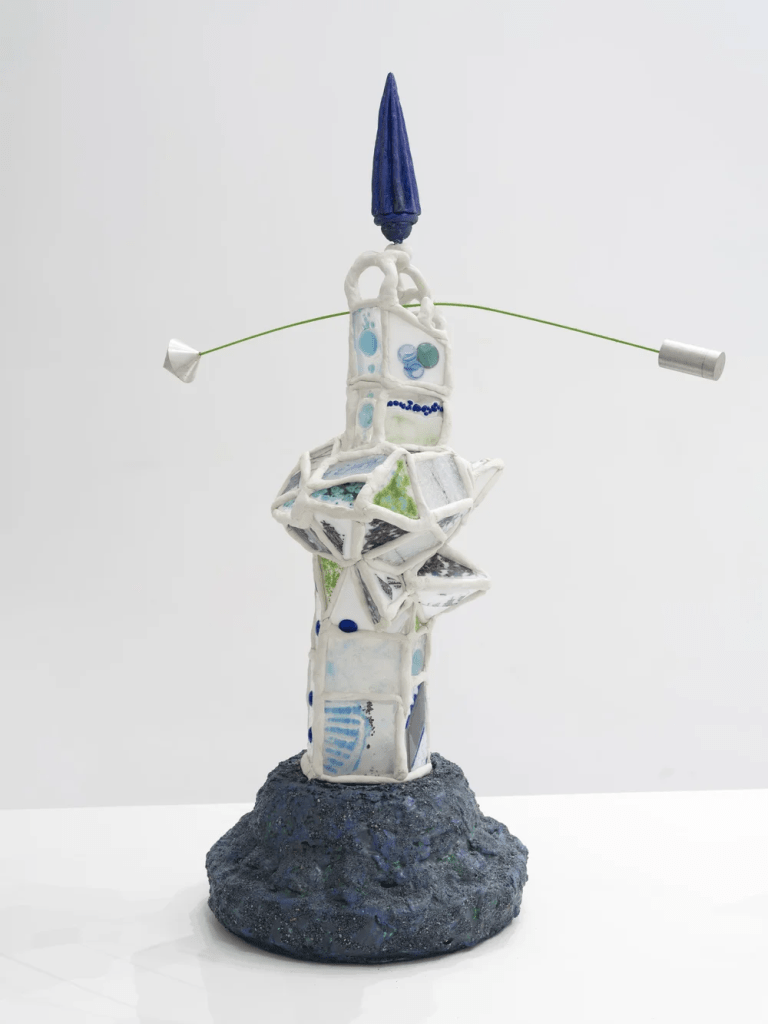
and mixed media, 35 x 25 x 10 inches

and found book pages on rice paper, 40 1/2 x 54 inches
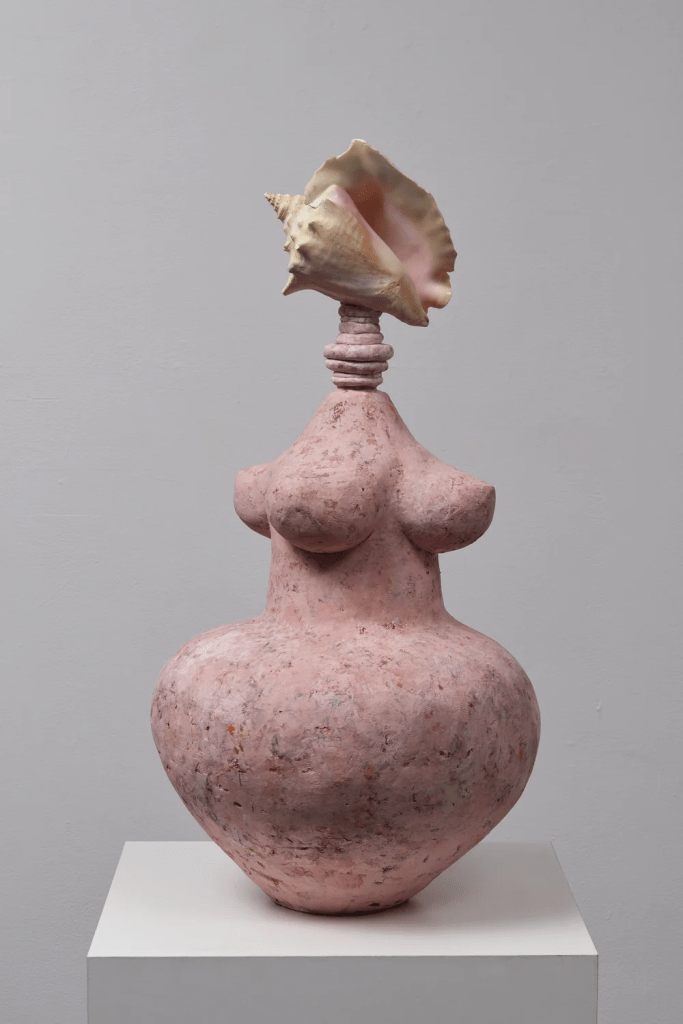
30 x 20 x 20 inches
LH: Great! An allegory of a failed analysis. Moving on! there are some great poems you come up with in these pieces, can we say something about them? “UFO vacancy wades xenocurrency yakking zag.” I don’t even know what a xenocurrency is! “A baby cabal dabbles each fabrication.” And I especially like “Angels baffle cocky dictatorial egos”
NB: I particularly like “Angels baffle cocky dictatorial egos” too. Some phrases are better than others. I made these collages during the reign of the orange one so I am extremely happy when the page gives me words that I can use to condemn or annoy him. It gives me pleasure and a certain amount of agency; I control the meaning. As to the lack of punctuation, it leaves the phrases floating in an unknown space and I like that. They are not sentences. I have been calling them koans but that is not quite right either.
LH: For me the important piece is that poetic slippages dominate instead of pronouncements of fact. Can the voice of authority, tolerate a poetic turn? Of course, I’m imagining the voice that you are most eager to stall is that of patriarchy?
NB: Yes, that is very true. Again, I could speak directly to our current regime. They are scrubbing words from government websites.
LH: Orwellian Newspeak?
NB: Right. They are condemning certain words as “woke” so I feel slightly powerful in my own mind when I can play with provocative words and place them insistently in the visual field.
LH: The world is full of language games, word games (New York Times every morning) but your word games are more subversive, I think. Again, they leave you stranded, the times just restores order (assuming you can actually win at Wordle). I think it has something to do with the board game aspect these pieces acquire, they imply a territory but leave one unoriented in it.
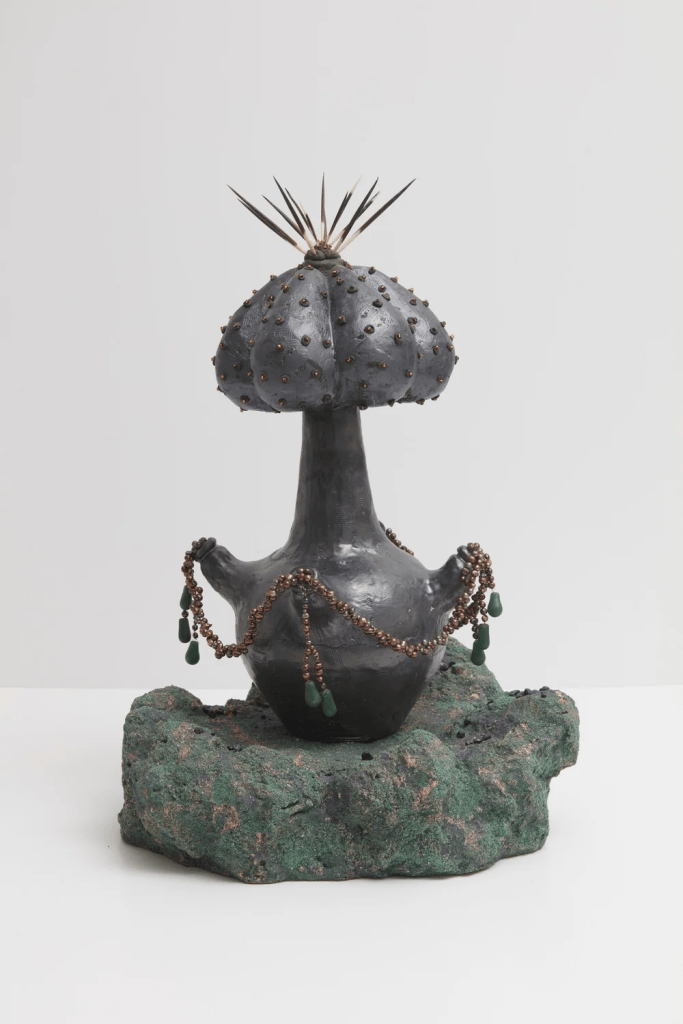
26 x 16 x 20 inches
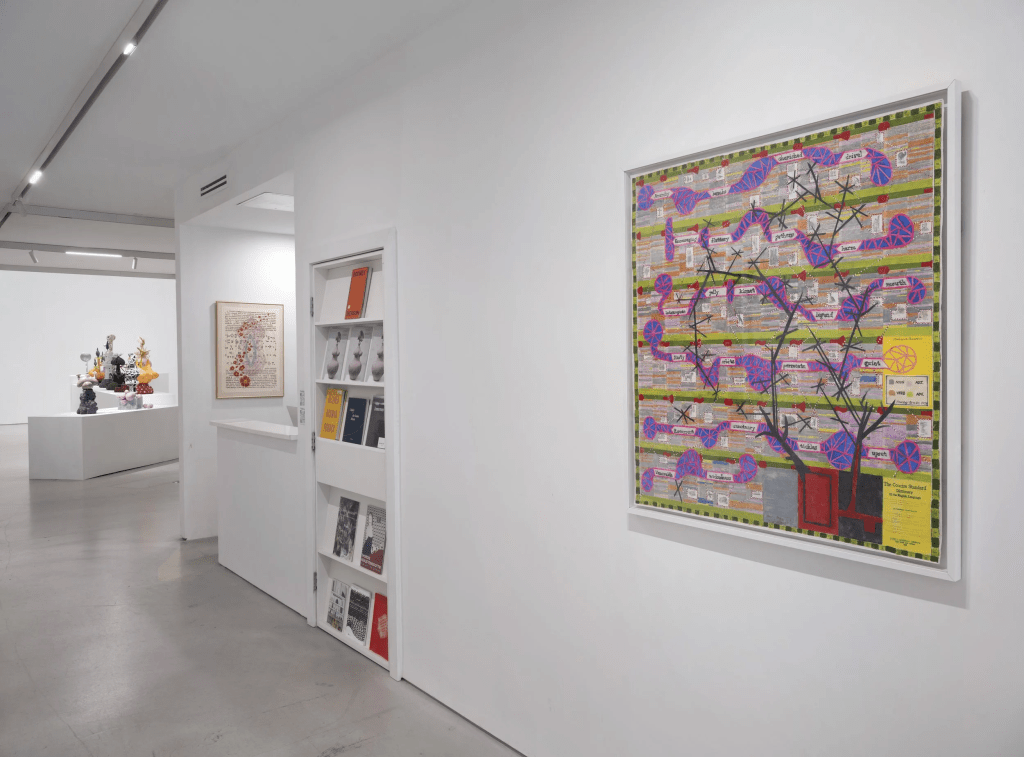
NB: But it is interesting about Wordle. I am addicted and do it every morning. I have even allowed myself to cheat!! But as to the board games feel I think that it is a visual strategy to make people feel comfortable looking at the collages. A board game is welcoming and familiar to most everyone. So, they will look and hopefully go with me to the unfamiliar parts- the disorienting territory as you put it.
LH: Cheating is important. Freud said something about the child’s first lie being a crucial developmental step; asserting psychological autonomy. Cheating is probably parallel, but with The Times it’s ideological autonomy. Turning to the sculpture it seems thinking about being disoriented is crucial. You seem to recalibrate how a woman’s body is experienced or described with these pieces. Is that what you call the objects, sculpture? Is that a retrograde notion here? I mean they are sculptures about the history of sculpture, right?
NB: yes, they are about the representation of women in sculpture. Sometimes they harken back to the history of sculpture- I quote ancient goddess sculptures, Louise Bourgeois and so on. It is important to me that I begin with a body fragment and then add to it, responding to what I think it needs. The finished sculpture is an abstraction that includes insistently corporeal portions. I want the viewer to recognize something bodily but then be confused by its attachments. I want to bring the viewer to a pleasurable state of wondering.
LH: A sense of how we come to experience bodies, our own and other’s, is at play in the work. No? Bodies are organized ideologically, ideologies of gender, of race, and all that, for sure. But they are also organized developmentally. A coherent sense of an embodied self is a developmental achievement, it builds over time, guided by processes of separation individuation and inscription of the self within dominant codes. Thus, it is of course also an ideologically determined achievement and for me this is the terrain of your sculpture.
NB: Yes, decades ago I made work that directly imagined the female body from what I considered a feminist perspective. My work was attacked as “essentialist” – a negative word at the time. I felt the need to educate myself in psychoanalytic Feminist theory. I am thinking mostly of Irigary and Cixious. For several years I made only fragments of the body or made fragments that faced the wall so that the gaze could not be returned. Prior to that time, I was making sculpture that asked what does a female body look like from a feminist point of view. After that I asked what does it feel like to be in a female body.
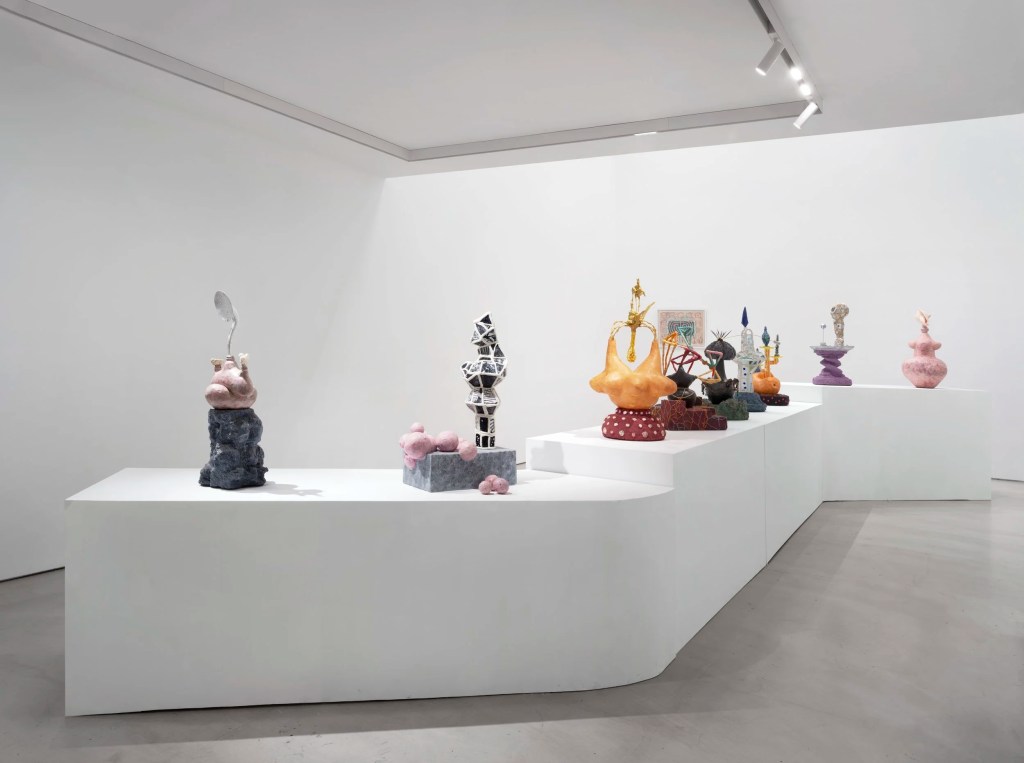
LH: Psychoanalytically you are touching on an important notion with ‘fragments;’; a body of fragments, but also the positioning of the body. How the body is oriented in social space in regard to others. The body is originally experienced by the infant, so the theory goes, as a series of sensations. Sensations at the frontiers of the body. Touch, taste, odor, that kind of stuff. In this regard, a lot of what we will come to call erotogenic zones are crucial. Yeah, all those orifices and protrusions. Orifices, bodily processes, ingestion, elimination, all that stuff is how the body developmentally becomes experienced by what we will come to call a self, and then how that self can be organized in relation to others.
NB: Good to know! I guess I let myself regress when I am working. I am aware that I am allowing myself to play. I consciously begin with a bodily fragment. Usually, I decide that I want to make something that evokes breasts or a butt or a kind of fecundity. I don’t think about what the final piece will be – I only know how to begin. Once that portion is done, hand built from clay and then fired, I then respond to what I have created. You talk about a series of sensations and you are right on. I experience that in the various materials I conjoin within one piece. Sometimes they rub up against each other smoothly and sometimes with friction. I work with a range of materials and surfaces and I assemble them until I arrive at a solution that I didn’t even know I was looking for. As I have gotten older, I have learned to trust that my hands and my unconscious know much more than “I “do. When I look at the parade of sculptures in the show I see a range of personalities, and I am delighted by the variety that I have created. I think their range speaks to something profound in the experience of women in a body with a brain.
“Nancy Bowen: From A to Z and the Bodies In Between,” NUNU Fine Art, 381 Broome St, New York, NY. Through July 25, 2026.
About the author: Laurence Hegarty is a New York-based artist and psychoanalyst.









Terrific conversation about a fascinating and brilliant exhibition. Bravo to both Nancy and Laurence !
What a wonderful dialogue about the inderpinnings and roots of Bowen’s work!
Now I’d love to read a discussion of the aesthetics of the sculpture especially, and their relationship to ancient and tribal art, totems, ideas about monuments, and so on. There’s a willingness to be “ugly” in the search for truth that makes them each so powerful and compelling!