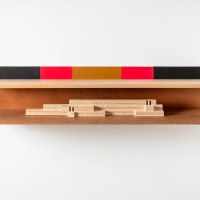
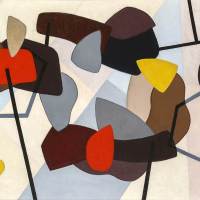
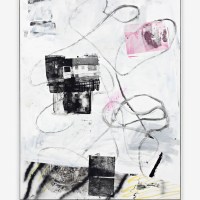
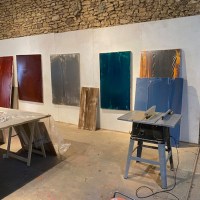
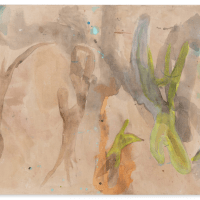
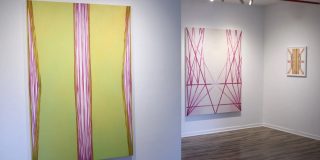
John Adams Griefen (b. Worcester, MA, 1942; d. Bergerac, France 2025) was an American artist and early Color Field painter who made important contributions to abstract art in the United States and in Europe. In his successful career as a painter he had seventeen solo exhibitions in New York City, the first at age 27. Foremost, Griefen is known for the essence of color in his paintings, and for many years, he made large, often monumental, acrylic paintings on canvas.
Tag: Clement Greenberg
Ben Shahn’s vigilance
Contributed by Margaret McCann / Ben Shahn’s lifelong advocacy against poverty, racism, and fascism is showcased in his solo exhibition “Ben Shahn and Nonconformity,” now up at the Jewish Museum. With engaging documentation, an array of global topics are addressed in printmaking, photography, commercial art, and calligraphy – and some excellent paintings.
Cora Cohen: Refusing closure
Contributed by Saul Ostrow / “A Decade: 2012–22” is the first show of Cora Cohen’s work since her death in 2023. It includes a broad range of her late paintings and drawings, which reflect what might perhaps be called her “formalism” – a term that when applied to Cohen, resists any terminal definition, promise of unity, or set of rules. Her 50-year career frustrates linear narration, but what remained consistent across her varied approaches to painting was an unwavering commitment to abstract painting as a process-driven pursuit.
Who’s afraid of the big bad idiot?
Contributed by Jacob Patrick Brooks / In “The Art Critics Who Don’t Want Good Art,” Anna Gregor describes a cultural hospice. The caretakers are a set of bad actors. They’re online critics who have replaced the labor of criticism with the catharsis of complaint, trading in “likes and clicks” for a smooth, sugary candy that requires only passivity and attention from its audience while it rots their teeth. This feedback loop, she argues, drowns true engagement and criticism in a “deluge of mediocre art.” It is a compelling diagnosis, but one delivered from the one place a critic cannot afford to be: behind a veil. Gregor deals exclusively in archetypes and generalizations while allowing the reader to “fill in the picture.” The playboi, the intellectualist, the yelper, and so on. She’s built a perfect haunted house and populated it with ghosts of her own making.
Georges Rouault: The spirit of the visual
Contributed by John Goodrich / Georges Rouault’s star has fallen considerably since 1945, the year the curator and collector James Thrall Soby dubbed him “one of few major figures in 20th century painting.” The artist’s religiosity and stained-glass-window style are not so captivating today. …The 21 paintings now on view at Shin Gallery invite a reassessment. Organized in conjunction with Skarstedt Gallery, the exhibition offers a particularly strong selection of the Rouault’s work.
Jacqueline Gourevitch: Skying abstraction
Contributed by Jason Andrew / Jacqueline Gourevitch’s resilience stems from restraint and slow observation. From her first solo exhibition in 1958 to the current striking survey of 21 cloud paintings dating from 1965–2018 at Storage Gallery in Tribeca, the nonagenarian has shown that sustained attention to a single subject can yield infinite and dynamic variations.
Inside Peter Dudek’s studio
We’re up in the Berkshires of western Massachusetts. The floor of Dudek’s studio is covered wall-to-wall with objects. One can ascertain individual sculptures, or perhaps parts of sculptures that might become sculptures one day. I ask if this is how it always is.
Call it Orphism
Contributed by Adam Simon / At a Four Walls event in Brooklyn in the early 1990s, Erik Oppenheim, at that time a young artist, stood up and said, “I’m starting an art movement. Anyone who wants to join, meet me in the back after the show.” It was a hilarious and audacious gesture, in part because no one joins an art movement on a whim, like a list-serve or an exercise class, but also because there hadn’t been any artist-initiated movements for a very long time. They proliferated in the late nineteenth and early twentieth century with the advent of Impressionism, Surrealism, Futurism, and Dada, and enjoyed something of a resurgence in the 1960s with Fluxus in the United States, Supports/Surfaces and Zero in Europe, and the Gutai Group in Japan. Most of what we consider movements were proclaimed by an outside observer, usually a critic or curator, looking to group artists who had similar concerns and made work that fit the designation. For the artists themselves to rally around a specific cause, even an aesthetic one, was not required.
Teak Ramos’s case for beauty
Contributed by Talia Shiroma / It is safe to say that beauty has become an incidental quality in visual art over the last century, taking a back seat to, among other things, art’s expanded range of aesthetic values, its social and political dimensions, and capacity for novelty. So it was surprising to find, at Teak Ramos’s solo show “In Traditional Fashion” at Ulrik Gallery, a self-conscious display of visual delight. The exhibition featured 14 panels clad in white silk and tulle, which ran along the walls like errant pearls. The works are impassive, delicate, and thoughtfully constructed. They are lovely and empty forms.
Martin Barré’s endless paintings
Contributed by David Rhodes / Matthew Marks’s current exhibition of Martin Barré’s paintings coincides with New York exhibitions of two other French painters: Alix Le Méléder at Zürcher Gallery and Simon Hantaï at Timothy Taylor Gallery. Together these shows furnish a good moment to consider the range and achievement of French postwar abstraction.
Clement Greenberg vs. Harold Rosenberg
In The New Yorker Peter Schjeldahl reports that The Jewish Museum’s chief curator, Norman L. Kleeblatt, has focussed “Action/Abstraction” on the writers, interspersing paintings and […]