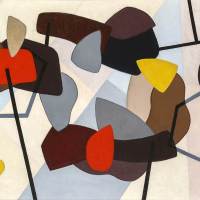
Contributed by Jacob Cartwright / In 1957, Clement Greenberg penned the essay “The Late Thirties in New York,” reflecting on years that were formative for both him and American art. He noted that during that decade “the big event, as I saw it, was the annual show of the American Abstract Artists group.” The artists who formed American Abstract Artists (AAA) first began meeting in 1936, in response to curators like MoMA director Alfred Barr, whose formulation of abstract art didn’t extend beyond the European continent. By 1937, AAA had begun organizing the regular New York City group shows that so impressed Greenberg.
Tag: American Abstract Artists
AAA at 90: Keep on looking
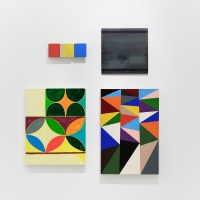
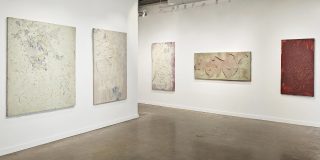
Contributed by Leslie Roberts / The exhibition “Abstract by Definition” at Art Cake celebrates the 90th anniversary of the American Abstract Artists (AAA). The show is subtitled “An Index,” but is not one in the usual sense – not, that is, an itemized set of categories, styles, intentions, or formal languages defining abstract art. Curator Saul Ostrow has instead organized groups of several works – usually four. This installation effectively highlights the particular qualities of each piece, and emphasizes the diversity of what we call contemporary abstraction.
Sharon’s Substack / May 1, 2026
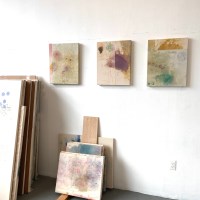
Contributed by Sharon Butler / A couple of weeks ago, I got a letter from Joy Amina Garnett, a friend, painter, and one of the earliest art bloggers. She stopped painting and left NYC in 2020, moved to LA, started writing a memoir about her family of intellectual Egyptian ancestors – now finished and forthcoming as The Bee Kingdom (Gaudy Boy, 2026)– and hasn’t looked back. She invited me to publish some images of my recent paintings in the Evergreen Review, where she has been the art editor for several years. Evergreen is a storied literary magazine founded in 1957 by…
Sharon’s Substack / April 1, 2026
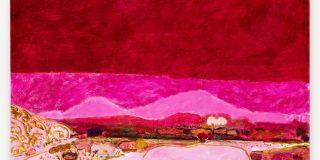
Contributed by Sharon Butler / Reading Gary Garrels’ remembrance of Brice Marden in Artforum in 2023, I encountered a Rothko quote to the effect that paintings are about basic human emotions – tragedy, ecstasy, doom, and so on. I was not inclined to think about my work in that way, so I spent some time reading about basic human emotions, which, in my placid New England family, were generally dismissed without much examination….
Rob de Oude: See what happens
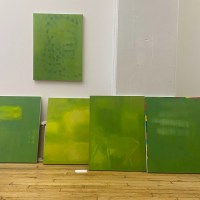
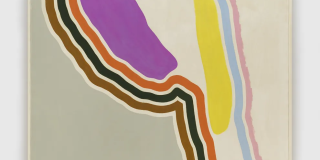
Contributed by Jacob Cartwright / It is no contradiction to observe that Rob de Oude paintings in his solo show “Rhyme and Repeat” at McKenzie Fine Art are created with an exceedingly sober methodology, yet achieve intoxicating outcomes. To make something and to see something are two different things, and revealing the interrelationship between them— as de Oude’s do— is one of the greatest pleasures that paintings can offer. While it may seem inapt to call such an exacting technician an experimental painter, the designation fits. De Oude conducts his investigations in the controlled environment of his studio, where variables are adjusted with one goal in mind: to see what happens.