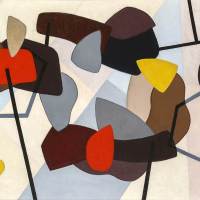
Contributed by Jacob Cartwright / In 1957, Clement Greenberg penned the essay “The Late Thirties in New York,” reflecting on years that were formative for both him and American art. He noted that during that decade “the big event, as I saw it, was the annual show of the American Abstract Artists group.” The artists who formed American Abstract Artists (AAA) first began meeting in 1936, in response to curators like MoMA director Alfred Barr, whose formulation of abstract art didn’t extend beyond the European continent. By 1937, AAA had begun organizing the regular New York City group shows that so impressed Greenberg.
Tag: New York School
Janice Biala’s epochal studio
Contributed by Jonathan Stevenson / A striking feature of the paintings and works on paper of Janice Biala (1903–2000), now on view at Berry Campbell in a show craftily curated by Jason Andrew, is their seamless reconciliation of civilizational clutter and spatial order. Fixing that notion is the earliest painting, The Studio (1946), arraying the artist’s active workspace and establishing her intent to embrace the world through it. (Coincidentally, Vera Iliatova’s “The Drawing Room” at Nathalie Karg gamely recaptures and updates kindred impulses.) Biala’s work here, spanning the immediate postwar period almost to the end of the Cold War and blending the New York School and the School of Paris – she lived in both cities – also bears the considerable weight of twentieth-century history, art and otherwise, with extraordinary grace and weightless cohesion, free of the strain of obvious contrivance.