Tag: Joan Mitchell

Solo Shows

Cora Cohen: Refusing closure

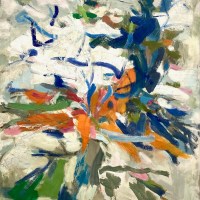
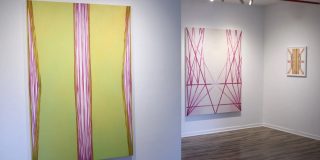
Contributed by Saul Ostrow / “A Decade: 2012–22” is the first show of Cora Cohen’s work since her death in 2023. It includes a broad range of her late paintings and drawings, which reflect what might perhaps be called her “formalism” – a term that when applied to Cohen, resists any terminal definition, promise of unity, or set of rules. Her 50-year career frustrates linear narration, but what remained consistent across her varied approaches to painting was an unwavering commitment to abstract painting as a process-driven pursuit.

Solo Shows

Cecilia Whittaker-Doe’s lush life 

Contributed by Patrick Neal / Cecilia Whittaker-Doe’s current show at the Interchurch Center on the Upper West Side, comprising close to 50 works, sheds generous light on her process, range and subject matter. The exhibition’s title, “Beneath the Trees it Rains,” conveys the dynamism of Whittaker-Doe’s landscapes, which demonstrate nature’s seasonal abundance and power.

Gallery shows

Meg Lipke and Jeff Williams: Enchantment without sublimation

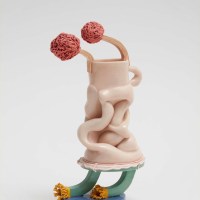
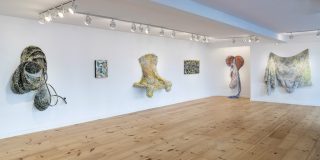
Contributed by Ben Godward / Meg Lipke and Jeff Williams seem to dance through the fledgling Roundabouts Now Gallery – once a medical office conference room in an industrial park – in Kingston, New York. The central collaboration comprises a large sewn and stuffed canvas with ruin-like drawings enveloping three deliciously odd sculptural objects. This union casts a pervasive spell. Pushing the interior accretion forms further into the unreal are surfaces that appear to be made of dust or remnants of ashes. Spectral in their essence but protected in the upholstered pool, they look as if they could dissolve into a pile if touched. 

Solo Shows

Jadé Fadojutimi’s glorious self-restraint

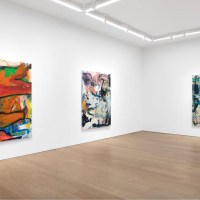
Contributed by Millree Hughes / Painters in their twenties and thirties, particularly those whose work is figuration bordering on abstraction and somewhat gestural, may be trying to do too much. Too often it features too many colors, too many forms, too much of everything. It’s hard not to sympathize. Such artists have grown up in a time when communication occurs in morphing, moving pictures at high speed, and when consumer culture assaults mass consciousness. For some, the most honest response is to be overwhelmed and paint accordingly. Jadé Fadojutimi, whose enigmatically titled solo show “Dwelve: A Goosebump in Memory” is at Gagosian, sees another way. 

Solo Shows

Morandi’s pointed timelessness

Contributed by David Carrier / Giorgio Morandi was born in 1890 and died in 1964. After the 1910s, when his art had some affinities with that of Giorgio de Chirico, he painted only still lives – bottles or flowers – and landscapes. “Time Suspended, part II” at Mattia de Luca Gallery, part I having been staged earlier in Italy, is a blessedly large presentation of 45 paintings and fifteen works on paper that reveals how little other artists or current events – indeed, anything outside of his studio life – affected his work.

Solo Shows

Melissa Meyer: Style is the answer

Contributed by Mary Shah / Time is an artist’s friend, muse, and collaborator. An artist’s style develops gradually, and the way to appreciate her work is to look at it over time. Bukowski’s words, which live rent-free in my mind, hypnotically echoed as I took in Melissa Meyer’s absorbing exhibition “Throughlines,” currently on view at Olympia. Comprising ten paintings and an artist book, the show covers the last twenty years and provides a considered, if abridged, look at the evolution of Meyer’s distinctive style up to the present day.

Catalogue Essays

Elizabeth Gilfilen: De-defining the gesture

Contributed by Vittorio Colaizzi / “I vehemently reject the claim that mark making by itself harbors any potential.” This was Isabelle Graw in conversation in 2010 with Achim Hochdörfer. The previous year, the latter had published his essay, “A Hidden Reserve”, chronicling a persistent but transformed and inquisitive use of the gesture by artists such as Joan Snyder and Simon Hantaï, after the myth of its unrestricted access to the inner self had been thoroughly critiqued by virtue of the encaustic and enamel regimentations of Jasper Johns and Frank Stella. It is not certain, however, whether mark-making can ever be “by itself,” as Graw puts it. Certainly, it carries with it endless associations and ever-shifting positions. Upon her first encounter with Abstract Expressionism, a young Louise Fishman saw in it a queer language suitable to her own alienation, in contradiction to its macho orthodoxy, while Amy Sillman similarly emphasizes painting’s potential to transgress categories. Hochdörfer’s corollary thesis, relevant to this day, is the dialectic between “literalism and transcendence,” or the acknowledgement of art’s concrete materiality versus the expectation and oft-reported experience of transformation, metaphor, or perceptual intensification. 

Museum Exhibitions

Sensing Joan Mitchell

Contributed by Barry Nemett / With squiggly marks and brilliant colors bringing the bucolic outdoors indoors, the exhibit Joan Mitchell is a sensual delight. What a treat to feel, smell, and hear the French countryside’s springtime breezes and see its glorious summer’s colors in Baltimore.