Contributed by David Carrier / Ernst Gombrich’s The Story of Art opens with a surprising juxtaposition of two drawings. One portrays Rubens’ handsome little son, the other Dürer’s aged mother. Of the latter Gombrich says: “His truthful study of careworn old age may give us a shock which makes us turn away from it – and yet, if we fight against our first repugnance we may be richly rewarded, for Dürer’s drawing in its tremendous sincerity is a great work.” Gombrich was, to be sure, a conceptually conservative art historian. But this declaration is a perfect introduction to the once iconoclastic Joan Semmel’s “In the Flesh,” now on view at the Jewish Museum.
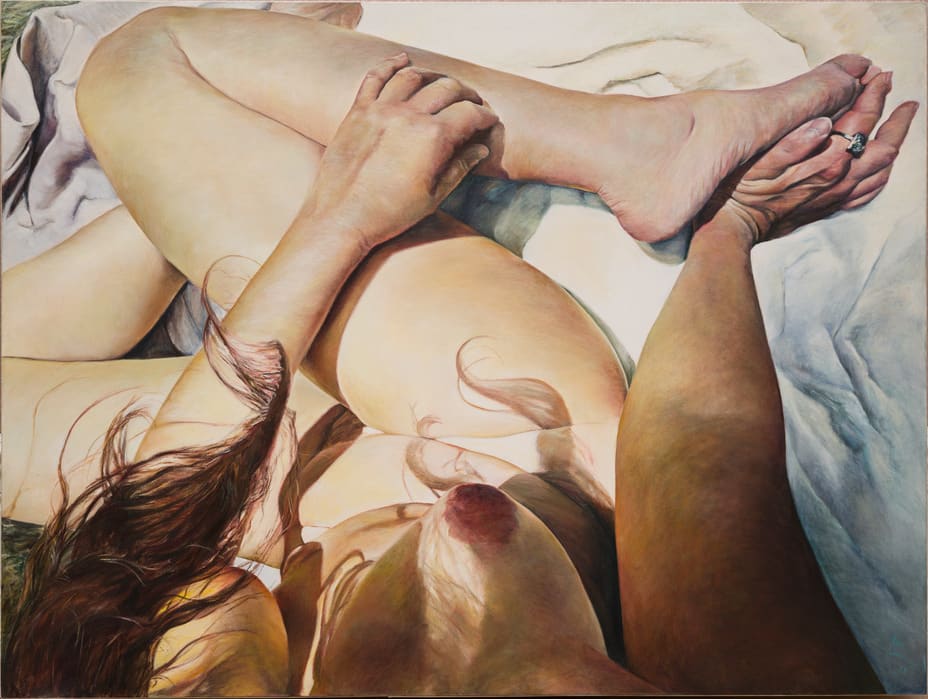
After starting out an Abstract Expressionist, Semmel (born 1932) turned to doing unclichéd images of female nudes. “I used myself as a model,” she has said, “as you might use any model who is a stranger. I didn’t want to objectify anybody else.” The 16 large paintings in the show offer a welcome survey, selectively spanning her long career. We are accustomed to seeing nudes as viewed from some distance. But what happens, she asks, if a painter assumes a very close vantage, as in Through the Object’s Eye, looking at a woman’s body from the position of her head? In Sunlight (1978), a similarly confrontational sunlit female, leg bent so that the sole of her foot touches her hand, fills the space. Then, in a marvelously disarming triptych, Mythologies and Me, she depicts three figures – one in the style of pornography on the left, one like Willem de Kooning’s female nudes on the right, and a realistic figure in the center. In Transitions (2012), five images of a nude figure make it turn before us.
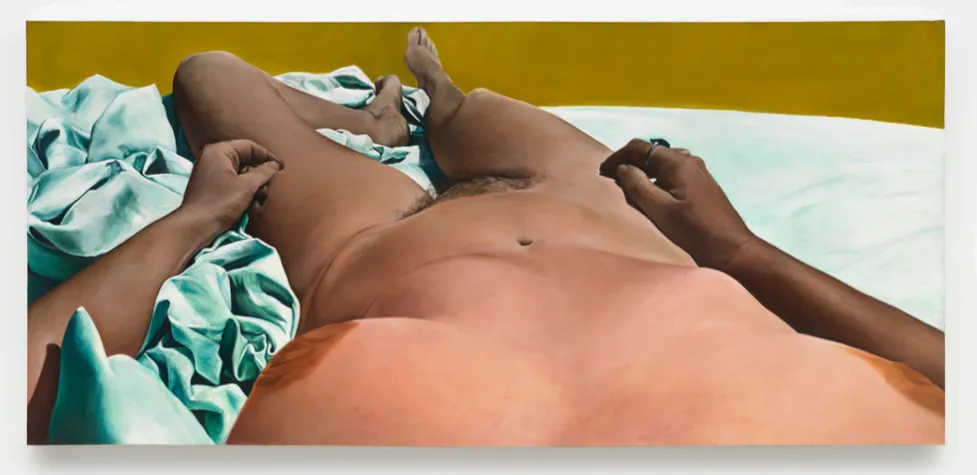


In our patriarchal visual culture, no subject is more controversial than the female body, especially as it ages. Semmel shows how unexpectedly wondrous – therefore strange – that body can look. They are often strikingly original, the colors spellbinding. Thus, she qualifies as an astonishingly bold and gifted political artist. Yet her images are also invariably true to everyday experience, which only bolsters her credibility. To enhance the exhibition, Semmel herself chose from the Museum’s collection 50 artworks by Ida Applebroog, Marc Chagall, Nan Goldin, David Levinthal, Alice Neel, Man Ray, Larry Rivers, Laurie Simmons, Joan Snyder, Nancy Spero, and Hannah Wilke. The contrast between her work and theirs highlights just how distinctive Semmel’s paintings are.
For quite a while, the art world was not interested in her work. In the 1970s, she had difficulty attracting galleries, so she rented space near her studio and showed it herself. But her moment has now arrived. Semmel’s women are neither pointedly grotesque nor fatuously idealized; they are simply truthful. In our neuralgic and neurotic culture, attaining that deceptively simple goal is a great achievement, showcased in a liberating and improbably joyful exhibition.
“Joan Semmel: In the Flesh,” Jewish Museum, 1109 Fifth Avenue at 92nd Street, New York, NY. Through May 31, 2026.
About the author: David Carrier is a former professor at Carnegie Mellon University; Getty Scholar; and Clark Fellow. He has lectured in China, Europe, India, Japan, New Zealand, and North America. He has published catalogue essays for many museums and art criticism for Apollo, artcritical, Artforum, Artus, and Burlington Magazine. He has also been a guest editor for The Brooklyn Rail and is a regular contributor to Two Coats of Paint.