“All the guilty people,” he said
They’ve all seen the stain
On their daily bread
On their christian names
I cleared myself
I sacrificed my blues
And you could complete me
I’d complete you
– Joni Mitchell, Court and Spark
Contributed by Natasha Sweeten / Maureen Dougherty brings her paintings to life with quiet assurance. For “The Completionists,” her current exhibition at Mendes Wood DM in Germantown, she presents portraits of solitary collectors showcasing their collections in muted yet elegant tones not unlike Luc Tuymans’, with dabs of paint nestled into shadows and on tips of asparagus. Objects such as dog figurines, serving dishes, Picasso’s ceramics, skulls, and books are dutifully balanced on horizontal bands of shelving stretching across the picture plane, providing a fixed compositional framework. Perhaps Dougherty’s years of working in abstraction cultivated the acuity and freedom in her brushstroke. Nearly every one of the nine paintings on view fills the expanse of canvas as if to suggest that we’ve zoomed in on a larger presentation, singling out this particular person with this particular array of belongings while also understanding the moment as memory.
A traditional portrait offers not only a visual likeness but an interpretation of who the subject was. We decode bits of information through their expression, pose, outfit, and surroundings, in how the paint is handled, and in the chosen palette. But Dougherty keeps us guessing. In Mustard Collector, a seated, dark-haired woman nonchalantly stares out towards us. Her blue chinoiserie-like dress is dotted with red at the neck and cuffs, her wrists crossed and hands resting on her lap. Behind her, five gray shelves hold several yellow, white, and peach-colored jars, some with recognizably shaped labels. Did she acquire them through travel? Is she a chef or a storeowner? Her stylish dress and crimson lipstick – the contrast with her pale skin recalls early Elizabeth Peyton – suggest she’s headed out for the evening, yet the setting feels like a gloomy pantry.

30 x 40 inches
We catch the soft-faced Asparagus Dish Collector seemingly unawares, his eyes drifting in contemplation. Blond curls frame his forehead, mimicking the ceramic tubes of bundled asparagus loosely painted behind him. This young man’s earnest distraction belies the humor inherent in the collected objects. He could be displaying an inheritance; serveware crafted to resemble vegetables was a 19th-century trend. From the bottom, a patch of unpainted linen begins to creep upward and swallow him, lending a sense of vulnerability or temporality.
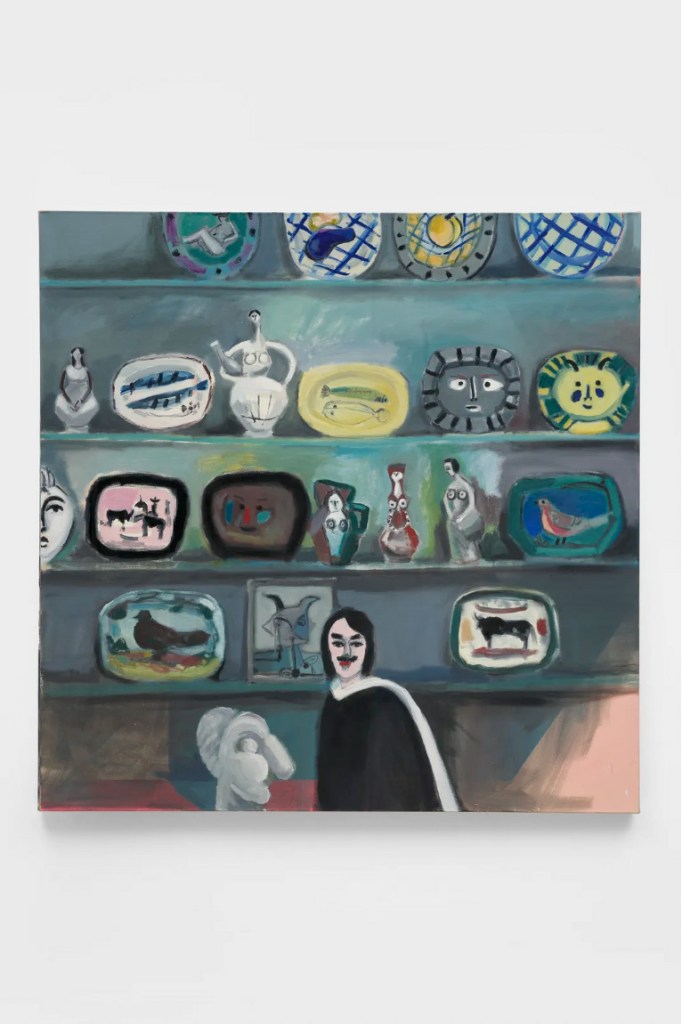
The two paintings hanging in the renovated barn – separate from the main gallery – I thought were the most successful, capturing a specific mood and intuitive sensuality and benefitting from their sequestration. In the nearly six-foot-square Picasso Collector, an Anthony van Dyck-like character, drolly mustachioed and donning a long white scarf, poses with his collection of painted ceramic plates, female figurines, and one sculpted head, all supposedly by Picasso. Though dwarfed by sprawling objects and shelves, his gaze is resolutely fixed on us, his pride evident. The colorful palette and variety of plate designs add a sense of playfulness, the animals and figurines nearly twinkling.
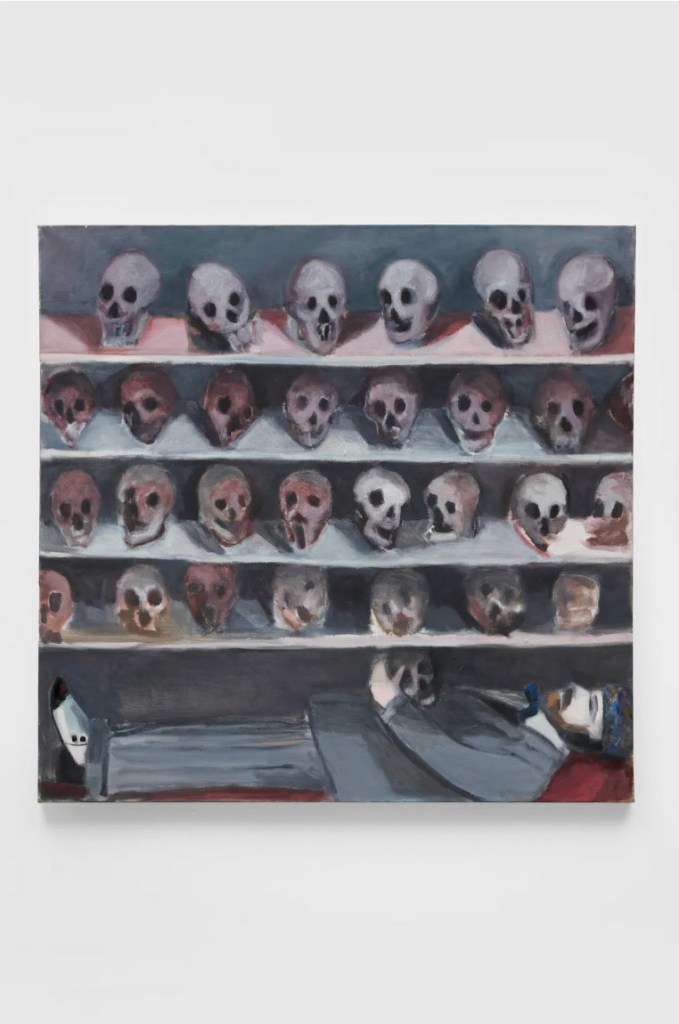
The nearly five-foot-square Crypt Collector is divided into five horizontal sections. The top four hold a couple dozen skulls, positioned frontally, while a gray-suited man sporting black-and-white dress shoes, a blue bowtie, and a colorful turban-like hat lies in repose in the bottom slot. A soft red light falls from above while a red blanket hugs the painting’s edge. The man grasps a skull atop his belly, his eyes closed. Is he sleeping or…? The painting’s vantage point, noticeably high, throws the upper shelves on the verge of spilling their contents. Despite the sepulchral atmosphere, the skulls, gesturally painted, seem to be chattering with one another and at times even smiling. This is more a portrait of conspiring skulls than of the reclining man.
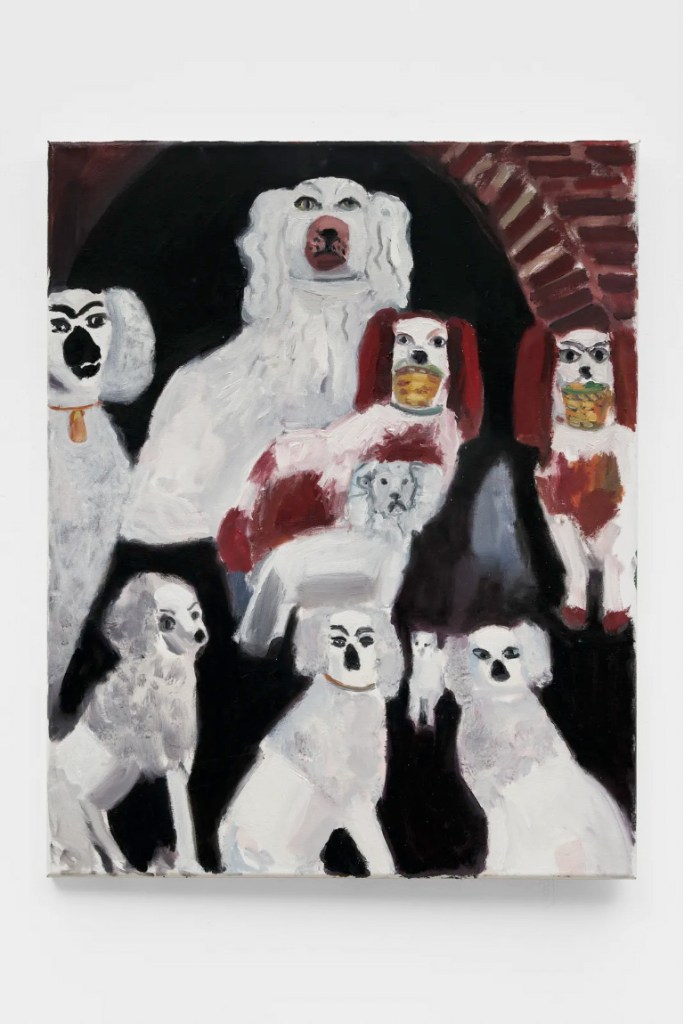

Americans are often obsessed with material things and a desire for more, more, more. Dougherty’s subjects constrain that impulse with thoughtfully curated accumulations. Anchored by a human presence, each collection tells a story, much the way Egyptian tombs hold the histories of their dead. Who is to say which completes which?
“Maureen Dougherty: The Completionists,” Mendes Wood DM, 10 Church Avenue, Germantown, NY. Through June 14, 2026.
About the author: Natasha Sweeten, a painter, lives and works upstate. “Springtime,” a four-person show that will feature her work and that of Elena Sisto, Mara Held, and Sue Havens, opens on May 9 at Art Sales & Research, Clinton Corners, NY. She will take part in Upstate Art Weekend Open Studios on May 16–17.