Tag: Bill Arning

Solo Shows

Henry Klimowicz: Marvelous and nearly impossible

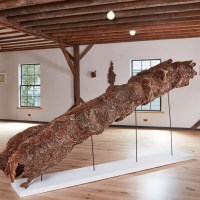
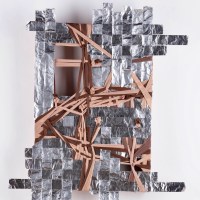
Contributed by Bill Arning / Ascending the stairs in Geary’s new space in Salisbury, Connecticut – a tastefully renovated suburban house – one anticipates modestly scaled artworks in small, semi-domestic rooms, perhaps featuring prints of duck hunts. Yet at the top of the stairs is a cavernous exhibition chamber, with rough-hewn columns of dark wood better suited to a pioneer cabin. While heavy structural beams that look hacked from timber with an axe are surprising, they seem a logical complement to Henry Klimowicz’s new work in “Methods of Proceeding.” They actually hold the roof up. Klimowicz’s monumental sculptures are all illusion, made from lightweight recycled cardboard, sliced into thin strips, and laboriously rejoined with hot glue and obsessive perseverance. Though they are dark and brooding, we can see through them. Daylight appears through gaps, as if to illustrate a fundamental principle of atomic theory: matter is largely space and only appears solid.

Solo Shows

Melora Kuhn: Refreshing myth 

Contributed by Bill Arning / Museums and theaters are hard-pressed to introduce younger audiences to canonical works whose titles contain the word “rape.” Art history, drawn largely from the Bible and Greco-Roman mythology, is filled with images far more disturbing than most contemporary films. Renaissance works, for example, depict the Massacre of the Innocents: screaming infants being slaughtered in sprawling spectacles. Such works were intended to bring scripture vividly to life for largely illiterate audiences while satisfying the appetite for grand drama before cinema. Today, however, the digital world censors language in ways that often flatten historical nuance. Social-media algorithms routinely block “rape,” making it increasingly difficult to illuminate works such as Benjamin Britten’s opera The Rape of Lucretia, which accords the heroine profound dignity and moral courage. Contemporary audiences are shielded not only from discomfiting language but also from the complicated history it describes.

Solo Shows

Todd Stong: Probing art history

Contributed by Bill Arning / Philadelphia is having a moment as a city where artists can still afford to live and work. In an essay for the journal October, conceptual sculptor Josh Kline argued exhaustively that anyone hoping to sustain a creative life should give up on paying New York rents and move to Philly. It was a provocative suggestion. Philadelphia is close enough to Tribeca to spend an evening at an opening there and still be home in time to walk the dog, and the city offers teaching jobs and a far lower cost of living. The online debate was revealing: many commentators preferred the romance of sharing an apartment in Ridgewood to easy access to the Liberty Bell, Marcel Duchamp, and cheesesteaks.

Solo Shows Upstate Art Weekend

Matthew Gilbert: Pick-up trucks, no pink carnations

Contributed by Bill Arning / Plunked in the middle of Matthew Gilbert’s solo exhibition “Pretend Till It Hurts” at Jane St. Art is a five-foot-tall steel construction crane buckling under the weight of a rented bouncy castle. Titled Until the Whole City Falls Over, the sculpture turns an ordinary suburban party rental into something strangely unsettling. Inflatable castles felt perfectly natural at children’s birthdays until Gilbert reminded us what castles actually are: military edifices built to withstand siege and slaughter.

Solo Shows Upstate Art Weekend

David Fix, Jr.’s existential retrenchment

Contributed by Bill Arning / Comments at openings such as, “I just can’t look at another painting by a hot young artist showing off a dreamy life in Fire Island Pines” are all too familiar – “hot” referring to both the bronzed, gym-sculpted bodies on display and the artists’ meteoric careers. The field has become crowded enough that it now seems nearly impossible for a young gay painter, even one emerging from a prestigious MFA program, to develop a genuinely distinctive visual language. That is why David Fix, Jr.’s first solo exhibition, “The Cusp of Magic” at The Fireplace Project, is such a welcome surprise.

Solo Shows

David Gilbert’s fugitive miracles

Contributed by Bill Arning / With the photographs of Los Angeles–based artist David Gilbert, whose show “Stationary” is now up at Klaus von Nichtssagend Gallery, one repeatedly asks: where exactly is the art occurring? He has found a way to destabilize the exact moment when ordinary objects shift into Fine Art with a capital A. At first glance, these works can appear almost incidental – serene accounts of light falling across a studio wall, with scraps of paper, drawings, and pinned objects casually arranged. They masquerade as found images, random moments merely “noticed” by a wandering photographer with a point-and-shoot camera. The spaces are shallow and flat; the compositions initially seem haphazard.

Solo Shows

Katherine Umsted: Anything but seamless

Contributed by Bill Arning / Sometimes the architecture of an exhibition space draws out qualities in an artist’s work that might remain latent elsewhere. Katherine Umsted is a familiar presence in the Hudson Valley art scene, known for an overflowing aesthetic of massive, boat-like vessels on the verge of collapse, constructed from rough-and-ready materials that could evidence a 2026 reincarnation of Arte Povera. It is hard to imagine a less suitable setting for such work than…

Museum Exhibitions

Folk Art’s faux-ish innocence

Contributed by Bill Arning / “Self Made: A Century of Inventing,” now on view at the American Folk Art Museum, asks a thorny question: Why does the descriptive term “self-taught” continue to resonate so strongly with dedicated fans of folk and outsider art? At its most basic, the term describes artists who did not attend traditional art schools. To be sure, these institutions embody uneasy contradictions. Tasked with encouraging free expression, they simultaneously prepare artists to attract patronage by targeting the moneyed class. But at their best, they embed young artists in an ongoing, object-based cultural conversation. So why are we so drawn to work that emerges outside their influence?

Museum Exhibitions

Valerie Hegarty: Enlivening Emily Cole

Contributed by Bill Arning / The Thomas Cole National Historic Site in Catskill presents a conspicuous curatorial challenge. It no longer owns any of Cole’s major paintings and relies heavily on devoted visitors remembering his masterpieces sufficiently that encountering the rooms where they were conceived will hold interest. Given this, its single-artist focus, and fixed historical narrative, the museum also often invites contemporary artists to enliven the experience it offers. This approach can fail because if the living artist is reduced to little more than an interpretive prompt to appreciating a familiar figure. But Valerie Hegarty, with her devotion to an aesthetic of destruction infused with autobiographical trauma, is a truly provocative foil for the works of Emily Cole, Thomas Cole’s daughter. 

Museum Exhibitions

Kathy Butterly’s small-scale magnitude

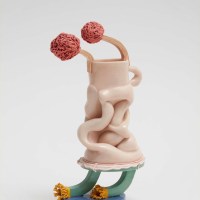
Contributed by Bill Arning / Kathy Butterly’s largest survey to date could, in theory, be boring. Thirty-five years of work in the same medium – highly glazed porcelain and earthenware – always at conspicuously small-scale, from four to 14 inches, might sound stultifying. You could perhaps imagine some visitors, having glanced at a sea of colored dots arranged on three massive irregular platforms in roughly chronological order, anticipating a hard slog and a rapid escape.

Solo Shows

Felix Beaudry’s malleable boys

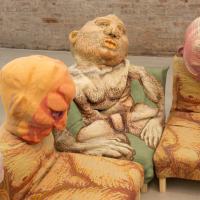
Contributed by Bill Arning / There is something wildly compelling when an installation flips on you—reversing itself in meaning and affect if you linger more than five minutes. Felix Beaudry’s “Malleable Boys” at Situations is one of those shows. On first entry, oversized, lumpy, monstrous heads loom and encircle you like funhouse demons. They feel nightmarish—deformed, melting, mid-metamorphosis into dangerous humanoid creatures. But stay a beat longer and the menace softens. They become almost cute, like huggable, overgrown Cabbage Patch Kids—less terrifying than misunderstood.

Gallery Guides NYC Gallery Guide

NYC Selected Gallery Guide, February 2026

Contributed by Sharon Butler / It’s February and my head is already spinning. I saw a few shows yesterday and recommend a trip to 15 Orient on 72 Walker Street (enter on Cortlandt Alley) to see Mitchell Kehe’s show “Bonded by the Spirit of Doubt,” in which enigmatic composition seems to affirm and concretize the pit I feel in my stomach. If narrative is more your jam, stop by LUNCH, a pop-up space downstairs from NADA headquarters at 311 East Broadway. Bill Arning has curated a show called “Ambiguous Storytellers” featuring Hannah Barrett, Tyler Brandon, Ario Elami, Matthew Gilbert, T.J. Griffin, Paula Hayes, Brian Kenny, Phil Knoll, Steven Lack, Jean Paul Mallozzi, Daniel Morowitz, Donna Moylan, Rajab Ali Sayed, and Erik Daniel White. Don’t miss Hilary Harnischfeger’s “Song for Clouds,” the artist’s fifth exhibition at Uffner & Liu. She crafts handmade objects that uncannily reflect the geological processes of tectonic pressure, sediment layering, and mineral buildup. Two Coats fave Alex Kwartler returns to Magenta Plains with “Off-Peak,” a solo show in which he presents “an inventory of passing attentions” that perfectly capture this age of distraction.

Solo Shows

John Kelly: The body is never abstract

Contributed by Bill Arning / In the mid-1980s, great art experiences of every conceivable stripe seemed to bloom prodigiously and organically from a single club on Avenue A called the Pyramid. Out of this dark, sticky-floored dive came a motley congregation of artists, musicians, drag queens, filmmakers, and poets who launched shockingly original cultural provocations that still reverberate globally, even though relatively few people witnessed them at the time.

Solo Shows

Kylie Heidenheimer’s ecstatic dissonances

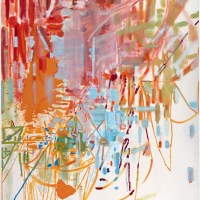
Contributed by Bill Arning / Private Public Gallery has earned its reputation for mounting deeply considered exhibitions of painting that honor artists who have spent decades refining their own private grammars of mark and color. Entered through a small garden – an architectural prelude that feels almost ceremonial – the gallery offers a perfect threshold for work that rewards slow, attentive looking. “Here, Elsewhere,” Kylie Heidenheimer’s first solo exhibition there, is fully in that lineage.

Solo Shows

Richard Bosman at Headstone Gallery

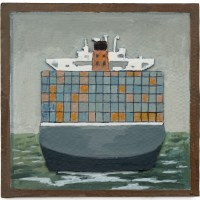
Contributed by Bill Arning / Long-time Bosman watchers often recall his work as a firehose of imagery—gunfights and car chases, sinking ships, kidnappings, and robberies pouring out in rapid succession. Fans might therefore be surprised when entering his first solo show at Kingston’s beloved Headstone Gallery, a venue known for its ambitious program of younger artists. In inviting an older master like Bosman, the gallery has delightfully broadened its scope.