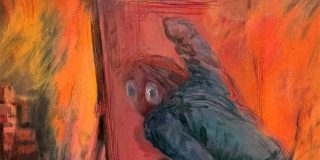
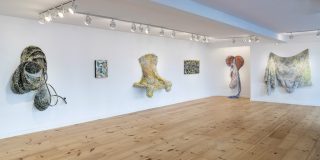
Contributed by Laurence Hegarty / Daniel Wiener’s naming system for his own work is quite precise. On his website, he states of the piece titled Clutching: “Genre: Sculpture | Like: Bowl | Placed: On A Shelf. ” Most would recognize that it is, well, a sculpture like a bowl, wherever it is placed. Wiener’s work dallies on a threshold between aesthetic bliss and mundane function. Into his semi functional world Wiener has smuggled images of faces: toothy grins, mouths agape, and wide-awake eyes returning the viewer’s gaze. In his current show at Satchel Projects, “Out in Front of the Back of Beyond,” the faces have migrated and are now sculptural objects. The viewer is placed in a direct encounter with a face. For Wiener, this shift is vital and intentional, as “the space of intimacy” – “two beings face-to-face in close proximity” – is the subject of his work.
Tag: Satchel Projects
Laura Newman: Flatness and the illusion of depth
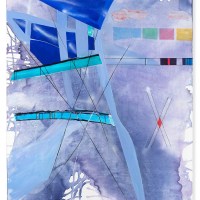
Contributed by Adam Simon / A photographer friend once asked me why painters are always talking about the space in a painting. He wanted to know what this term “space” meant. I talked about the different ways paint on a flat surface could be made to suggest depth, and how the challenge for modern painters was to create depth while also reaffirming the flatness of the support. I probably referred to the elusive concept of the “picture plane” and how simultaneously maintaining mutually exclusive ideas – flatness and depth – could produce a poetic or even a mystical dimension in visual art. Most abstract paintings present shallow space, keeping depth to a minimum. This type of painting is usually non-hierarchical; nothing feels more essential than anything else. The viewer’s eye tends to scan. If you want to both represent depth and reaffirm flatness, shallow space is going to be easier to handle than deep space.
Rick Briggs’s compositional irreverence
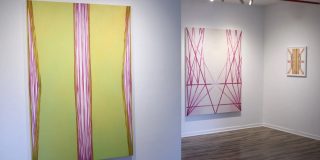
Contributed by Jason Andrew / It’s refreshing and a little humbling to walk into a gallery and be blitzed by art that’s cleverly derived from years of play, probing, and practice. Rick Briggs’s solo show at Satchel Projects shows us how open-ended and liberating painting can be.