Tag: Jonathan Stevenson

Group Shows Studio Visit

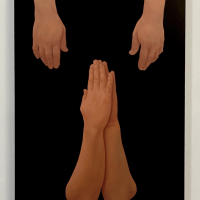
Matthew Miller: Hand to a humble god

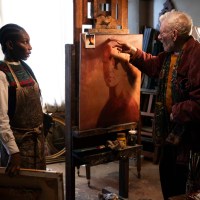
Contributed by Jonathan Stevenson / For over twenty years, Matthew Miller rendered arduously meticulous yet mysteriously otherworldly portraits, mainly of himself as subject and almost always against a maximally opaque black background betraying no brushstrokes, evidently free of human imperfection.

Solo Shows

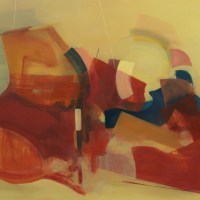
Stephanie Deady and the structure of intimacy

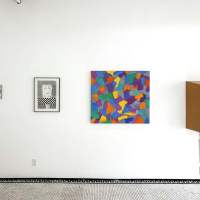
Contributed by Jonathan Stevenson / Stephanie Deady’s coolly seductive oil-on-birchwood paintings now on display at Kevin Kavanagh Gallery in Dublin – all archly titled, like the show itself, Emotional Calculus – draw you in like mirages of serenity. For that purpose, they incisively deploy beauty: tawny, fluid backgrounds envelop rhythmically interacting shapes of red, blue, or white, lending each package of images visual harmony and compositional stability. In due course, the paintings reveal deeper intent, which is to complicate and enrich your ultimate apprehension of the presumptively simple life.

Solo Shows

Shirin Mirjamali’s exquisite intensity

Contributed by Jonathan Stevenson / The Iranian government has looked askance at political assertiveness and social progressivism since the revolution of 1979. The pressure under which women operate is especially heavy. Political protest, however, cannot be a way of life. Day to day, Iranians are compelled to avoid confrontations that could place them in jeopardy, discreetly acknowledging anguish and resolving to sublimate it. Shirin Mirjamali, whose exquisitely intense works on paper are now on display in her solo show “Hidden Longing” at Anita Rogers Gallery, exemplifies this essentially pensive disposition.

Group Shows

Spring Projects’ epic subway series

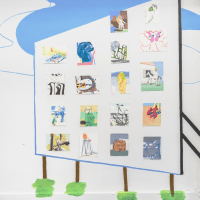
Contributed by Jonathan Stevenson / Most New Yorkers couldn’t live without the subway. It is their savior if occasionally their oppressor. They love it so much that they hate it when it lets them down, but the opprobrium is often oddly affectionate. Barroom arguments have fulminated and flourished over which subway line is worse – the F or the 7, the 2 or the L. Patronizing the subway can be a point of gritty cosmopolitan pride: real New Yorkers don’t use Uber. And it’s a great social equalizer, as reflected in Ralph Fasanella’s 1950 folk-art painting Subway Riders, now ensconced in the wall of 53rd Street/Fifth Avenue Station and as idealistic as ever. “Subway Riders” the group show is now up at Springs Projects. It keenly captures the subway’s pervasive, multivalent thrum through New York life with work by over 100 artists and a few eager amateurs (one is me).

Screens

Paul Thomas Anderson: Raised on promises

Contributed by Jonathan Stevenson/ Among the syndromes that make the current American moment so vexing is a liberal contingent duly alarmed but bereft and flummoxed in the face of unprecedentedly heedless and unrestrained illiberal forces. Concerned citizens – including elected officials – don’t know what to do, and they are clamoring for a sensibly energized way forward. Movies can reflect the zeitgeist quite resonantly and animate civic discourse. Lately, though, they have tended to divert to smaller-bore social issues and wistfulness for Americana or the counterculture without confronting what could happen to the country overall, Alex Garland’s Civil War excepted. Last week, however, Paul Thomas Anderson’s One Battle After Another landed. It is a fully sussed cri de coeur of liberal conscience, resistance, and resilience inspired by Thomas Pynchon’s novel Vineland, and the first great political movie of the Trump era.

Solo Shows

Robert Yoder: The gravity of modesty

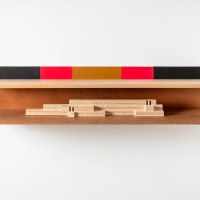
Contributed by Jonathan Stevenson / If On Kawara’s monumentally quotidian work was about the objective significance of the simple passage of time, Robert Yoder’s may be, in turn, about the subjective importance of each passing moment however uneventful. “I Was the Other Conversation,” his solo exhibition of untitled paintings (and one beguiling wooden carving) now up at Frosch & Co., continues his discerning visual exploration of how, psychically, people live.

Gallery shows

A Golden year: Art amid iniquity

Contributed by Jonathan Stevenson / For a group show keyed to current events, the trick is to balance political messaging with the stream of life, achieving provocative encapsulation without preachiness. “Made in Paint, Twelve” at the Sam & Adele Golden Gallery of Art, situated in the legendary Golden Artist Colors paint factory in New Berlin, New York, pulls this off with style and heart.

Solo Shows

Lina McGinn’s whimsical gravitas

Contributed by Jonathan Stevenson / “Dear John” – Lina McGinn’s absorbing and ostensibly playful solo show of sculptures at the expansive Europa Gallery in the Two Bridges neighborhood – manifests fine technique and a conceptual sensibility deeper than it might first appear. Using fiberglass resin and polymerized gypsum to isolate and fix discarded and distressed cardboard boxes in a range of anthropomorphic poses, she achieves something quite familiar in art – the personification of inanimate objects – in a singularly inventive way. 

Studio Visit

Tommy White: Dark victory

Contributed by Jonathan Stevenson / Entering Tommy White’s cave-like Crown Heights studio, you’re struck by the fathomless matte black on his canvases, fate knocking at the door. It can serve both to seduce and to dare, drawing you in and pushing you out.

Solo Shows

Hope Gangloff: Dashing preconceptions

Contributed by Jonathan Stevenson / At first blush, Hope Gangloff’s remarkable new paintings, on view at Susan Inglett Gallery and largely set in a notional rustic retreat, could be mistaken for blown-up greeting cards for vacationing hipsters, perhaps with a sly nod to David Hockney. Pristinely applying acrylic paint, she crafts them like illustrations, and they are unabashedly luminous. But the ecstatic vibe that characteristically radiates from that quality, though present, is winkingly deceptive. While Gangloff paints friends and actively cherishes the intimate golden moment, existential concerns burn through her work.

Catalogue Essays

Daina Higgins: At Home with Discord

Contributed by Jonathan Stevenson / Daina Higgins began her vocation as an artist in the 1990s as a quintessential outsider: she was not only a graffiti artist in her native Columbus but also one of the few young women then so engaged there. Her noirish attraction to the oblique angles and ominous shadows of a presumptively benighted urban landscape in the Rust Belt has never flagged. At the same time, her paintings and drawings have acquired the existential gravitas that comes, if an artist has the requisite talent and mind, with the travails of life, the burden of lineage, and the compulsion to reflect on them.

Museum Exhibitions

Jack Whitten at MoMA: Indelible

Contributed by Jonathan Stevenson / “The Messenger,” Jack Whitten’s momentous and flawlessly curated exhibition at the Museum of Modern Art, is a signal event not just in American art history but, arguably, in American history simpliciter. To be sure, it showcases an art polymath who broke and cultivated important ground across a broad swath of artistic endeavor. But its timing as a socio-political statement seems perhaps singularly important.

Solo Shows

Gerri Rachins’ raptorial abstractions

Contributed by Jonathan Stevenson / While some art pulls you in gently, Gerri Rachins’ paintings, now on display at The Painting Center, grab you like a raptor. Though unequivocally abstract, their affect, as it were, is prehensile. They seem to guard the walls, flexing with taut line and pulsing color, at once opaque and fluid.

Screens

Cinema 2024: A tight dozen

Contributed by Jonathan Stevenson / For better or worse, directly or inferentially, movies reflect the zeitgeist. This year, they predominantly resonated dread or resignation, and even those focused on personal endeavor had a political tinge. With humanity’s and especially America’s scabrous underbelly fully exposed, both idealism and irony seem to be taking a break, leaving something in between that doesn’t quite amount to earnestness. It’s not the nineties or even the seventies, though the occasional and fleeting nostalgic nod to better days lightened things up. Here’s one (alphabetical) list of the year’s notable movies, with the usual acknowledgement of idiosyncrasy and incompleteness.

Studio Visit

Studio Visit: Robert Armstrong’s uncanny cohesiveness

Contributed by Jonathan Stevenson / When the distinguished contemporary Irish painter Robert Armstrong first occupied his space on the third floor of Temple Bar Studios in Dublin 40 years ago, as a co-founder of the complex, the area was subdued and undeveloped, like Soho in the 1970s or Tribeca in the 1980s. Now his studio overlooks a bustling courtyard in what has become a magnet for visitors to the city. In turn, Armstrong himself seems to embrace Ireland’s deep and introverted rootedness as well as its exalted and extroverted role in Western culture while also reaching liberally into other worlds – he has traveled all over, with art in mind, and eagerly plumbed art history – in fluid and delicately gestural canvases that at once fasten onto familiar visual tropes and depart for murkier and more speculative realms. How he manages this tension is, by general description, unsurprising: he makes resolutely abstract paintings that remain firmly underpinned by landscape in line and allusion. He strikes this balance, easier said than done, and even more remarkably sustains it, reflecting a thorough but unobtrusive understanding that, as Colm Toibin puts it in an eloquent essay for a book of Armstrong’s work, “nothing … is free of association.”