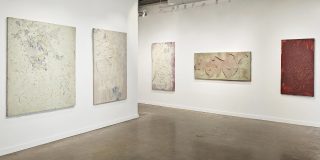
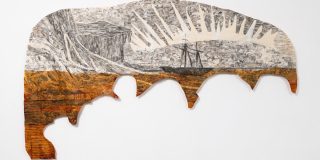
Contributed by Jonathan Stevenson / If On Kawara’s monumentally quotidian work was about the objective significance of the simple passage of time, Robert Yoder’s may be, in turn, about the subjective importance of each passing moment however uneventful. “I Was the Other Conversation,” his solo exhibition of untitled paintings (and one beguiling wooden carving) now up at Frosch & Co., continues his discerning visual exploration of how, psychically, people live. It features abstractions of varying degrees of allusiveness, each with two main elements: a relatively quiet background and a boldly superimposed graphic symbol. The first is usually white and staticky with muted emotion, the second carefully wrought in red or black. The sense of these pieces, made on repurposed materials from newspaper to tape to terrycloth, is that the artist is seeking to enshrine an impulse to resist conspicuousness – to fade while staying present. It’s a paradoxical endeavor that Yoder pulls off with elegant style, muted force, and impressive coherence. His pieces are as moving in parallel as Kawara’s time-stamped records are in series.

Yoder’s work is a catalogue of what catches in the aesthetic drain of an artist disposed to, as he himself puts it, “absorb information rather than provide it quickly.” For this purpose, abstraction, in its capacity to subdue, defer, deflect, and sublimate the literal, would seem obligatory; certainly, it is invaluable. That said, there is plenty of obliquely inferable content in his work, and it is existentially rich, ranging from interior intimacy to geographic and architectural spectacle. A Yoder piece could bring to mind a bent wrist, drapery occluding a doorway, a grand piano in a shabby drawing room, or a spartan workshop, yet also a brutalist building, a locomotive steaming cross-country, a totemic statue rising from a plain, or a bridge arching over a river. The towel painting – the largest in the show – features a distinctly letter-like shape whose apparent serif could signify a streetlamp extending from a post or merely function as ellipses, connecting Yoder to painters as divergent as Edward Hopper and Viennese minimalist Florian Pumhösl.


The works most directly and intensely evocative of Yoder’s contradictory compulsions to resist expression and chronicle what he sees – and not coincidentally the least referential – may be the three parsimonious paintings that incorporate unfinished swatches of gray inside faintly drawn lines, seemingly in limbo between temporal erasure and effortful reconstitution, against stark white. Which process prevails remains unclear, but at least the object depicting the two in tension endures. Maybe the larger point is an essentially Cartesian one: harboring perceptions affirms that one is real and recording them asserts it. At the same time, the title of the show suggests that Yoder’s version – his vision – of the artist is a modest, ever-receding figure, ideally remembered but rarely central. Thus consigned to the margins and afforded the perspicacity of remove, he paints, sculpts, or draws. Indelibly, there’s that.


“Robert Yoder: I Was the Other Conversation,” Frosch & Co., 34 East Broadway, New York, NY. Through October 12, 2025.
About the author: Jonathan Stevenson is a New York-based policy analyst, editor, and writer, contributing to the New York Times, the New York Review of Books, and Politico, among other publications, and a regular contributor to Two Coats of Paint.