Contributed by Jonathan Stevenson / For a group show keyed to current events, the trick is to balance political messaging with the stream of life, achieving provocative encapsulation without preachiness. “Made in Paint, Twelve” at the Sam & Adele Golden Gallery of Art, situated in the legendary Golden Artist Colors paint factory in New Berlin, New York, pulls this off with style and heart. The exhibition is distinguished by a measured coolness, serving diversity by example rather than bald assertion with a set of works that is gracefully integrated but not overbearingly contrived. The 18 artists represented – all participants in the twelfth iteration of the Golden Foundation’s uniquely intense and hands-on painting residency program – span a wide range of backgrounds and approaches and, to their considerable credit, tend to prioritize visual impact above overt narrative density.
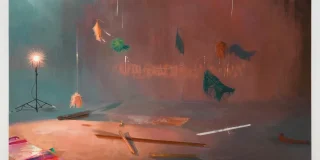
Leading off the array is Kirk Maynard’s Serenity Series (Unequal), an oil painting depicting a young Black man in profile with a backpack. The radial design in the calm green background could reference the celebration of a life unfolding – or a target on his back. Judging by his thousand-yard stare, he knows that for him hope is inseparable from jeopardy. Antonius-Tin Bui’s site-specific dispersion of torn fragments of a painting, busily titled me, this body, the same weight of disappearance, same weight of fortune, gets at a similar dualism with pronounced tactility. In turn, Jordan Ann Craig’s slyly phlegmatic minimalist abstraction Sharp Tongue/Shiner captures the entrenched notion of ritualized punishment for emphatic self-respect. Like most of the pieces in this deftly calibrated grouping, these three operate osmotically rather than didactically.


The natural world cannot avoid attention, and here it comes from different angles. Anna Ortiz’s Biznaga en Pabellón – “Cactus Pavilion” – presents cactus flowers baled like hay, dotingly painted in a dreamy green: an exotic source of comfort. Three intimately cropped hyperrealist paintings of gardens by Jess Lincoln– two with human hands – register the delicate but still gratifying state of nature. Of similar spirit but elegiac in tenor is Wanda Raimundi-Ortiz’s uncannily spectral …at the feet of a 400-year old Ceiba #6. The two men in the grass in JD Raenbeau’s Held may have simply found a safe space. Preethika Rajgariah enlists novel supports and surfaces to ground and humanize big ideas about the fate of the earth, her elegant figurative diptych the creation of a thousand forests is in one acorn proceeding on a pair of yoga mats. Massiel Mafes looks sardonically to second-hand clothes in constructing her linear fabric painting Oranges.


Several works address the now universal theme of home and displacement. In David Najib Kasir’s The π of Tremors and Missed Homes, a thick mesh of Stars of David encroaches on shattered dwellings. The piece is hardly subtle, but there’s no denying the force of the sprawling shaped panel embodying both offense and grievance. Henry Morales, whose Guatemalan American Still Life #1 incorporates dirt from his front yard in Las Vegas, lays bare his ambivalent struggle for a new nationality. In Ernest Shaw Jr.’s portrait Unhoused, an incongruously dignified man appears haunted by otherness and judgment. Leavening the angst, Amra Fatima Khan’s mischievously majestic Rani Baylee Raj Karay Gee, Lilian Martinez’s jaunty Cactus Fruit and Roma, and Hans Gindlesberger’s enigmatically historical King Gojong with Draw Downs stand as less freighted and more cheerful, but still perhaps wistful, celebrations of culture. Regina Durante Jestrow, in her purposefully asymmetric textile piece Fluorescent Pink and Silver 1, projects the ongoing activity of staking a claim in a place or object.


In an era of unprecedented discord and instability, it’s tempting to default to the view that art is a gratuitous indulgence, better left for easier times. The stock rejoinder is that art is a psychic retreat from wider troubles. Both ends of this dialogue are too easy. Political art can be one form of John Lewis’s “good trouble,” crystallizing the moment for posterity as well as for current examination and critique, sometimes bolting art’s standard confines directly to political discourse. Witness, recently, the Smithsonian’s rejection of Amy Sherald’s Trans Forming Liberty and her subsequent rejection of the Smithsonian. At the same time, pastoral or contemplative work can provide the refuge needed for focused consideration of what ails us – in a word, sanity.

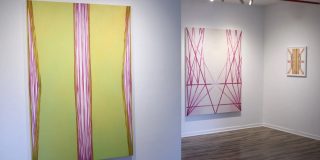
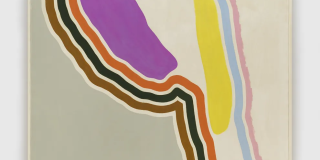
This show makes both the extroverted case and the introverted one, visually distilled in Omar Rodriguez-Graham’s two captivating, tonally complementary abstractions. As Mark Golden, president of the Golden Foundation, puts it in his catalogue essay, artists “allow us to see the unseen or the world we want to close our eyes to.” And decline or decadence, of course, can produce great art and insight. Among the wittiest and most mordantly effective pieces on view is Inez de Brauw’s painting The Viewing Rooms – View of the Salon Carré, in which the iconic Louvre space appears as a distressed, dourly colored chamber kitschily recalling Miss Havisham’s banquet hall. You could read it as a grim meta-comment on the irrelevance of art amid iniquity and chaos. Yet its very eloquence – and that of “Made in Paint, Twelve” overall – renders any such interpretation reassuringly ironic.
“Made in Paint, Twelve,” The Sam & Adele Golden Gallery, 188 Bell Road, New Berlin, NY. Through August 29, 2025. Artists: Antonius-Tin Bui, Jordan Ann Craig, Inez de Brauw, Hans Gindlesberger, Regina Durante Jestrow, David Najib Kasir, Amra Fatima Khan, Jess Lincoln, Massiel Mafes, Lilian Martinez, Kirk Maynard, Henry Morales, Anna Ortiz, Preetika Rajgariah, Ernest Shaw, JD Raenbeau, Wanda Raimundi-Ortiz, and Omar Rodriguez-Graham.
About the author: Jonathan Stevenson is a New York-based policy analyst, editor, and writer, contributing to the New York Times, the New York Review of Books, and Politico, among other publications, and a regular contributor to Two Coats of Paint.