Contributed by Jonathan Stevenson / The phenomenon of the selfie, an artifact of the smart phone, is a supreme irony. The act itself suggests a narcissistic preoccupation with recording one’s presence, but its frequency and ubiquity indicates that it doesn’t matter much what person or place gets that honor. Warhol’s fleeting fifteen minutes is compressed into a pandering fraction of a second. I was here; please care. The only auto-photographers who really seem to get durably noticed are the Darwin Award winners whose acrobatic exertions towards drama topple them into the lethal maw of treacherous vistas. Lost in the scree of evanescent look-at-me images is the self in full social and political context, and it’s not in plain sight. There are few painters better suited for excavating it than David Humphrey, as he demonstrates in “porTraits,” his formidable solo exhibition now up at Fredericks & Freiser. Humphrey’s crowning gift – born of comprehensive technical and aesthetic command, a uniquely graphic allusive approach, sardonic wit, and an irrepressible narrative impulse – is to coordinate the nuances of disparate visual elements so finely as to render the busiest of paintings piercingly, disturbingly coherent.
Tag: Jonathan Stevenson
Gary Stephan’s steadfast modernism
Contributed by Jonathan Stevenson / Gary Stephan has been an abstract painter for over fifty years. His command of that vocation – touch, line, color, concept – is duly acknowledged. But he is far from content. Stephan came of age at what was arguably the extended peak of modernism, when creative people across the board presumed to tackle existential problems for the ages.
A group apart at Springs Projects
Contributed by Jonathan Stevenson / There are a fair few viable organizing concepts for group art exhibitions. One particularly challenging one is to present viewers with a tour d’horizon of emotions and attitudes that seem to prevail at a given historical moment. The key to optimal execution, of course, is to avoid both the obvious and the obscure. In “Each Own” at Springs Projects, curators and gallery co-founders Cate Holt and Tommy White strike the right balance, strategically deploying the work of six exceptional…
Matthew Lusk: Offhand dystopia at Elijah Wheat
Contributed by Jonathan Stevenson / Located in rough-and-tumble Newburgh beyond the pale of riverfront commercial development on a piece of land just yards from the Hudson and insouciantly flush with its waterline, Carolina Wheat and Liz Nielsen’s grandly unvarnished Elijah Wheat Showroom has the Bunyanesque vibe of a frontier museum. Then it suavely wrongfoots its patrons with the fearlessly avant-garde attitude of 1970s Soho. Matthew Lusk’s deviously clever sculptures and installations exploit and reinforce both attributes…
Certain women, 2024
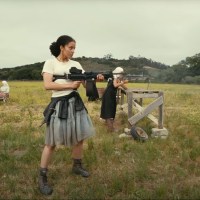
Contributed by Jonathan Stevenson / Eight years ago, Kelly Reichardt’s exquisitely penetrating Certain Women appeared. A singularly nuanced and resolutely independent filmmaker, she patrols the interstices of American history and contemporary society. In this movie, she presented several game female Montanans who couldn’t afford to have feminism on their minds and nonetheless lived reckonable lives – a perspective that she had established sharply in Wendy and Lucy (2008) and reiterated softly in Showing Up (2022). Judging by several recent independent films, Reichardt’s subtle perspective has had lasting influence in framing the quandary of how women establish agency in a society that still – or at least again – often militates against them.
Lisa Hoke’s visual rodeo
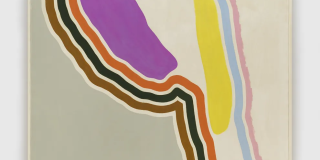
Contributed by Jonathan Stevenson / Information overload has understandably been a popular theme for artists, and many have explored it poignantly….Lisa Hoke is one – a game and capable bull rider in a visual rodeo. In her solo show “Relative Uncertainty” at Kathryn Markel Fine Arts, she meets the challenge with consummate skill, persistent wit, and, not least, a kind of stoical grit that firmly rebuffs any attempt to cast her outwardly joyful approach as sheltered or clueless, utopian or oblivious.
Whitney Claflin: Forever young
Contributed by Jonathan Stevenson / Whitney Claflin’s work, now on view in her solo exhibition “Pinky’s Where” at Derosia, is winningly deceptive, like the title’s double-entendre. Consider the paintings Emma in Tarzana and Mr. Triste. At first blush, they seem nonchalantly wise-ass and a little frustrating, the first an offhand quip about internet celebrity and influencer supreme Emma Chamberlain, and the second…
Adam Simon: Jostle, flux, and instability
Contributed by Jonathan Stevenson / Brooklyn-based conceptual painter Adam Simon is known for his cagey synthesis of the graphic symbols and tropes of commerce and civic life into elegant visual statements about the zeitgeist and, more grandly, the world as a whole. He can use text to penetrating effect, as in the small paintings he made a few years ago superimposing the edict “STEAL THIS ART” on the vintage silhouette of a policeman. In one not-quite-Hoffman-esque line and an evocative image, he captured the ambivalence and limbo of the art world between the establishment and the counterculture, having himself cultivated a live community in that space by organizing, with several other artists, the collaborative “Four Walls” events in Hoboken in the 1980s and Williamsburg in the 1990s. In “Great Figures,” his solo show now up at Osmos, he has continued in a searchingly ironic vein, now with a bemused fretfulness that affords it epochal resonance.
Mark Fingerhut and the sneaky internet
Contributed by Jonathan Stevenson / Burgeoning technological innovation over generations has brought out the millennial optimist in many, but, especially outside the bubble of the tendentious capitalists eager to cash in on their investments, it may have unloosed the Luddite paranoiac in more. “Goings On,” a pastiche of Mark Fingerhut’s cheerfully invasive videos deftly curated by Lonesome Dove and recently screened at Springs Projects in Dumbo, speaks to both – the one in knowing condescension, the other in sardonic affirmation. Blasts of images that rankle sometimes owing to their content, sometimes because of their staccato presentation and creepily fluid mutability, make a case for the digital matrix’s weird agency and, beyond that, its insidious seductiveness.
Chromatic propulsion at Frosch & Co.
Contributed by Jonathan Stevenson / “Out of the Blue” at Frosch & Co boasts a tight concept and adds real snap to the conversation presumed suspended until after Labor Day. The idea is to explore how the color blue ramifies through the lenses of different painters. That might seem like a merely modular survey, since other colors too have distinct connotations. But blue’s, as the gallery’s press statement notes, seem to swing more dramatically – between cool and warm, masculine and feminine, obscene and pure, barbaric and royal, stormy and serene. This quality makes for an unusually rich array.
Fists or knives? Jeff Nichols and the irrepressible biker myth
Contributed by Jonathan Stevenson / To add up, any contemporary movie about a motorcycle club needs to be deconstructive as well as elegiac. Jeff Nichols […]
Kim Uchiyama: Life in space
Contributed by Jonathan Stevenson / A great asset of abstract art is its capacity to accommodate in a single picture phenomena that don’t readily fit together in real life and make some kind of sense out of them. There are as many ways to exploit that capacity as there are artists. In her solo show “Loggia” now on view at Helm Contemporary, comprising three large pieces and several smaller ones, Kim Uchiyama distills visual tropes of nature – water, shoreline, forest, desert, and more – into configurations of color that project an idealized but grounded spatial relationship between outside and inside, broadly construed. It’s a quietly ambitious agenda, and she is successful in no small part because her brand of geometric abstraction is so egalitarian: no single element seems more or less important than another.
Catherine Haggarty and Dan Gunn: Cerebrally humble and vice-versa
Contributed by Jonathan Stevenson / The direct and unpretentious title of Brooklyn artist Catherine Haggarty’s solo show “Just Drawing,” now up at Geary in Millerton, NY, conveys modest intent: to record on paper the inertial power of everyday life without much prior conceptual mediation. Just draw it. Cats by turns prowling a pyramid and emulating sphynxes on a starry night feature in a couple of drawings, which are meticulous without being fussy, and two others unobtrusively reference Haggarty’s art practice. Together these works and others essay a day in a life grounded by a comforting pet, reveries of icons, an enduring vocation, a familiar room, and scrappy clothing – nothing inherently grand, perhaps, but nothing remotely dismissible, either.
The ringing in Leslie Wayne’s head
Contributed by Jonathan Stevenson / Despite the still breathtaking majesty of the physical world, human machinations are undermining its habitability. The United States is more starkly and toxically divided than it has been since the Civil War, and some Americans claim, contra Woody Guthrie, that “This Land” – the title of Leslie Wayne’s cogent new exhibition at Jack Shainman Gallery – was made only for them and not for other Americans. This existential double-whammy leaves artists with something of a conundrum: how to honor and present beauty robustly without seeming cluelessly disengaged. Wayne finds the sweet spot.
Jennifer Coates: Edgy indeed
Contributed by Jonathan Stevenson / Several notable painters – Julie Heffernan, Jules de Balincourt, and Alexis Rockman, among them – have seized on the perils of climate change. In Jennifer Coates’s new solo show “Edge Effects,” jointly mounted at Chart Gallery and High Noon Gallery, she drills deeply into the subject and emerges with work that dazzles to engage, and vice-versa. The show’s title is an ecological term for what happens when one habitat impinges on another, which climate change is accelerating and amplifying. The phenomenon implies crowding, ergo potential conflict and trouble, and Coates’s canvases are appropriately busy and calculatedly unnerving. Bacchanal, a large painting, depicts the jangled co-location of lush plant life, bemused animals, and humans naked but often distressed. No doubt intentionally, it’s a far cry from Nicolas Poussin’s eponymous seventeenth-century study ingenuously celebrating sensuality. For Coates, the title sharply intimates collective hedonism gone awry. Touché.