
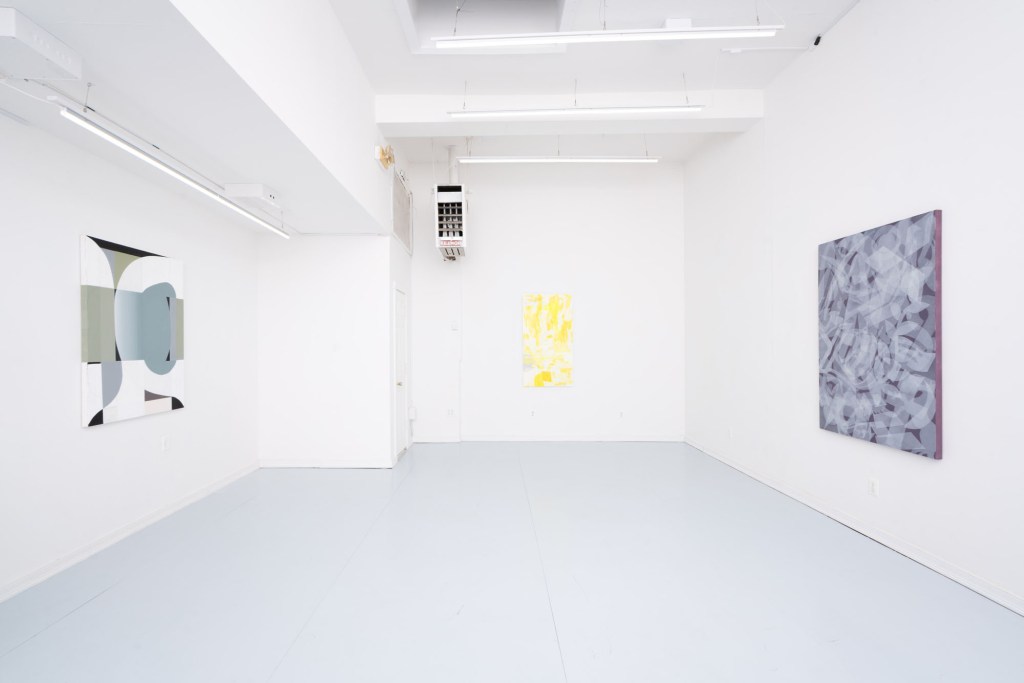
On the occasion of their exhibition, “Artist Panel,” at Ptolemy, Two Coats of Paint invited Michele Araujo, Larry Greenberg, and Adam Simon to share part of their conversation with gallery owner Pat Reynolds.The following transcript has been edited for length and clarity, but the full conversation will be playing at the gallery through March 15, 2025.
Michele Araujo: I thought the show ended up being really interesting, and for two reasons. One was the fact that there’s only one painting from each of us, and the way abstraction functions in each of our work is a little bit different. And also because I really dislike when somebody asks me what kind of painting I do. I don’t really want to say abstract painting; I don’t know, it doesn’t mean that much to me. But when I stop to think about the difference in how we all use abstraction, it’s fantastic.
The other thing is that having only one piece meant that at the opening, people really kind of spoke about each of the paintings. And, so it was a really great setup.
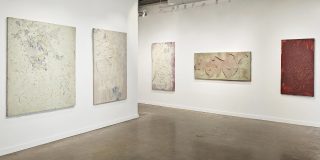
Pat Reynolds: Well, one of your friends at the opening asked me how I came to know all of you guys and how the show came about. And, you know, this is sort of the first time that it’s just artists who I’ve met organically through the gallery and done studio visits with and gotten to know on an individual level. And it’s interesting, because I do think that all three of you approach abstraction in very different but equally considered ways. And yet, when the work shares the space like this, especially where it’s just a single piece from each of you, they coexist in this very natural way. And I think that there’s just a really beautiful harmony between the paintings. So I was thinking maybe we could talk a little bit about how each of you approach abstraction and use it in your work as a good starting point. I mean, obviously, Michele, you’ve already talked about it a little bit.
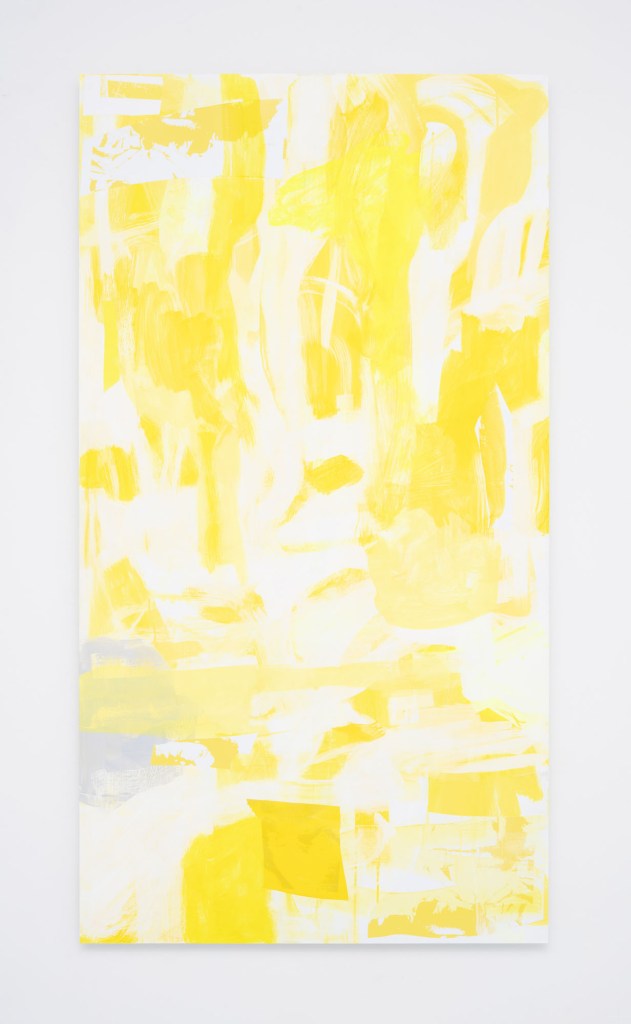

Larry Greenberg: I have a question about what Michele is doing. A thing that’s really interesting about Michele’s work is the photographs that are embedded in it, which I would love for you to talk about.
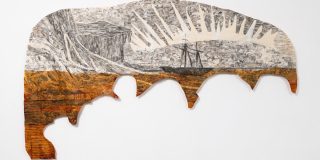
MA: Well, with the collage, at some point I didn’t want to make what I would think of as purely abstract paintings, even though, like I said, I hate the phrase. And those images—I don’t know if they ended up coming in because I felt a connection to the images, or I wanted to do the collage. They’re both kind of important to me. I love the fact that the images are in the collage, but they don’t really have to be readable. The collage in relation to the kind of painterliness that’s on the aluminum, it’s a dynamic. It’s a contradiction.
LG: Yeah.
MA: And I guess I really like that. You know, I have a very defiant nature, and it was a great solution.
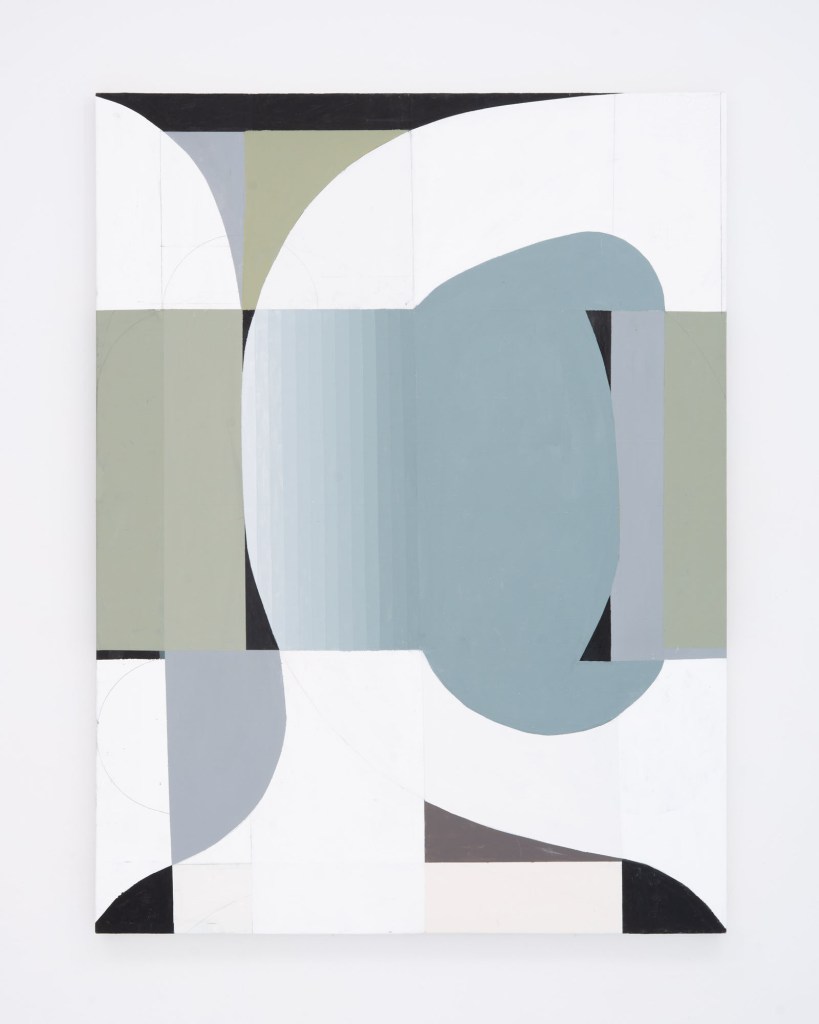
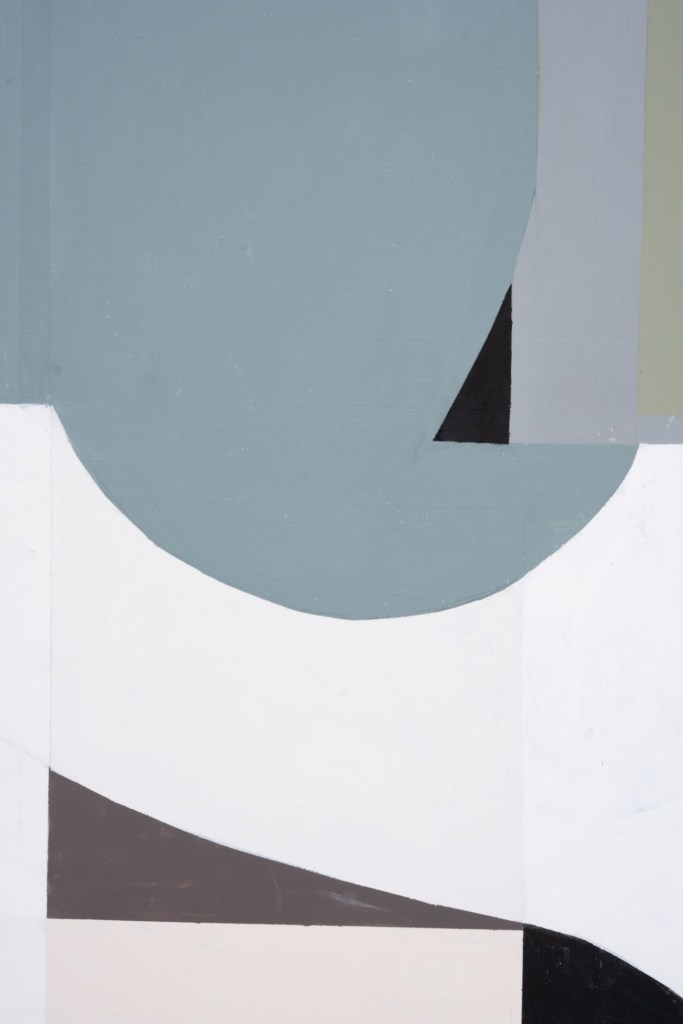
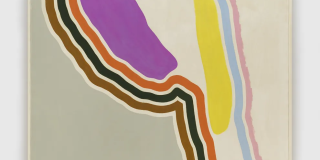
LG: Well, I always look at my paintings being like a puzzle and putting it together. So when I start, I just start drawing on the canvas directly to allow things to start to occur. And it starts to get edited down, and I end up with whatever forms I can get. It’s not necessarily intentional. I think we might all have that in common, except maybe Adam is more programmatic, perhaps, because he has certain images that he uses. So I think of it as, you know, just trying to look at some kind of harmony in the abstraction.
Adam Simon: So you start with just all pencil line.
LG: Pretty much. I start with a pencil.
AS: You start finding things that you want to basically paint in?
LG: Or explore and bring out. I like the idea of leaving pencil in, because drawing to me is very important—the edges, and the way that the colors meet and the way they define the space.
PR: You’re kind of undergoing this process of transforming a drawing into a painting.
LG: You could say, yeah.
AS: This one, more than I think anything else of yours that I’ve seen, feels like what Patrick just described.
LG: Yeah, well, lately I’ve done paintings that are totally about drawing, and they don’t have any color. I mean, they have some black in them to accentuate the line, but basically they’re just drawings.
AS: Larry and I were both at the studio school when we were teens, and the emphasis there was totally on drawing and “creating space.” The whole gestalt of making space on a flat surface.
LG: Yeah, right. Not rendering space, but making.
AS: Like articulating it somehow. And this painting of yours feels like it’s more about that than most of your work, I think.
LG: This is a bit of an outlier in that sense. Yeah.
PR: Adam, your paintings often use these overlapping images and icons. At what point have they accumulated enough for you, would you say?
AS: Oh, that’s a very good question, which should be said in every interview.
PR: It’s good to butter up your interviewer. Yeah.
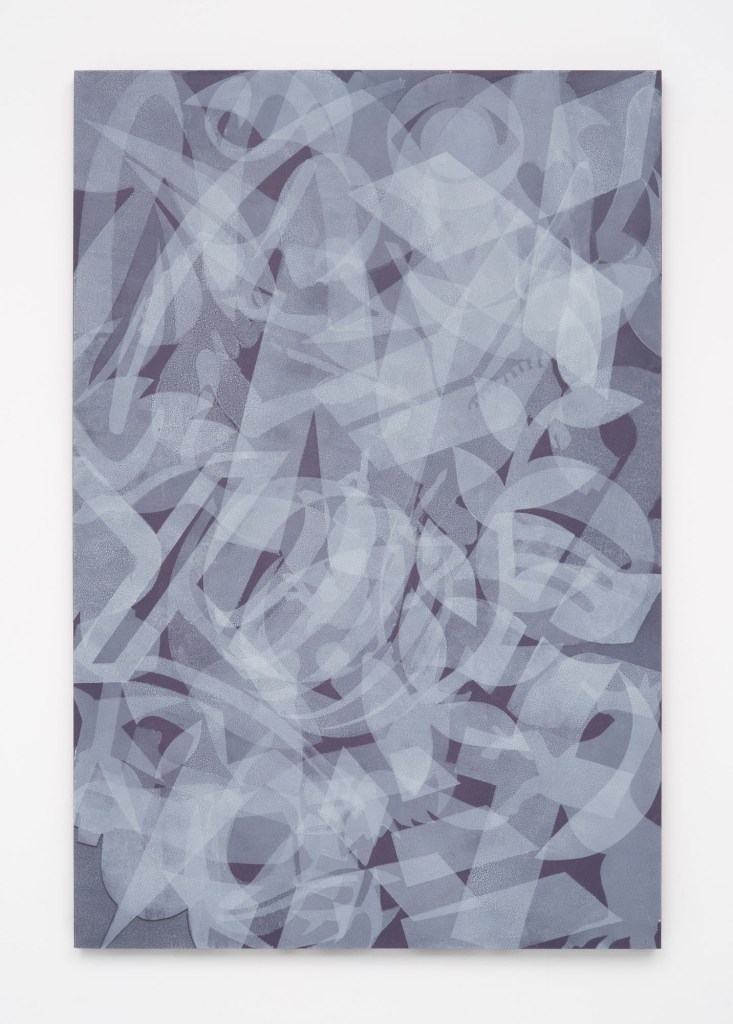
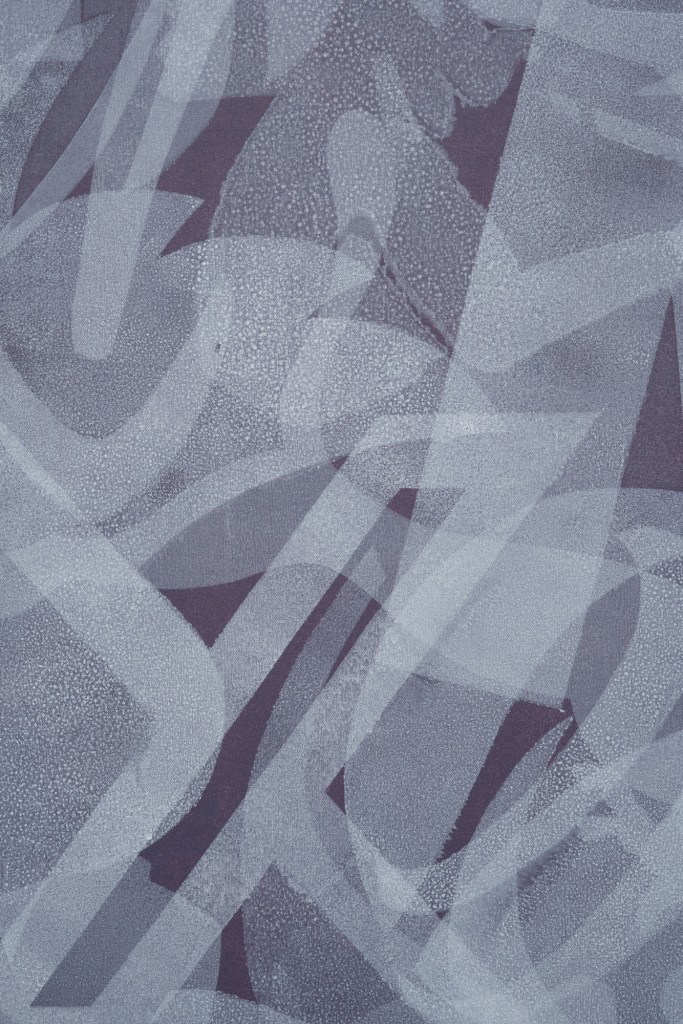
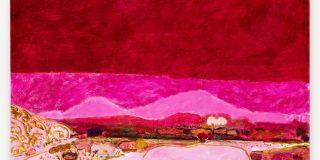
AS: But first I just wanted to say I’m always curious when my work is referred to as abstract, which it has been already. Because, there’s actually nothing in this painting that is pure form—every inch of the painting is something. Well, not every inch, but everything that’s visible as something in the painting is something that exists in the world. I’ve thought of these paintings as landscape paintings; Tom Micchelli talked about my early paintings using corporate logos as a kind of landscape. And so it’s somewhat of a subliminal landscape. It’s a world that I think of us all as inhabiting. It’s a kind of universal language.Another way that I’ve started thinking of my paintings is as history paintings, because this painting spans, like, 50 years of logos.
None of this is getting to the question that you just asked me, about the overlay. The answer to your question is that is that there’s a point at which I can start overlaying things where it just gets really fucked up.
LG: Things disappear.
AS: Yeah—everything becomes indecipherable. And, what I wanted with something like this painting is that everything be visible, even if it’s not immediately decipherable. There’s a general level of visibility that’s consistent.
LG: So you can read every logo that’s in there.
AS: Well, I can.
LG: Well at the opening, there’s always like, people trying to suss things out.
AS: The Where’s Waldo? phenomenon. Yeah, I joked with Larry at the opening that this is how you get people to spend time looking at your painting, because they’re trying to figure out what everything is. But yes, in terms of the overlay, it can be taken too far. And in this painting, I wanted the background color to be able to assert itself in a way that doesn’t prevent the eye from scanning. So there’s not a real sense of background, but there are these interstices. The spaces in between the forms play a significant role.
“Michele Araujo, Larry Greenberg, Adam Simon: Artist Panel”, Ptolemy, 6733 Central Ave, Glendale, NY, 11385. Through Mar 15, 2026.



I hope the entire conversation will be on the gallery website – I’m so sorry to have missed it. The show is a jewelbox, the artists and Patrick are clear-thinking and smart with a great sense of humor. My bad.