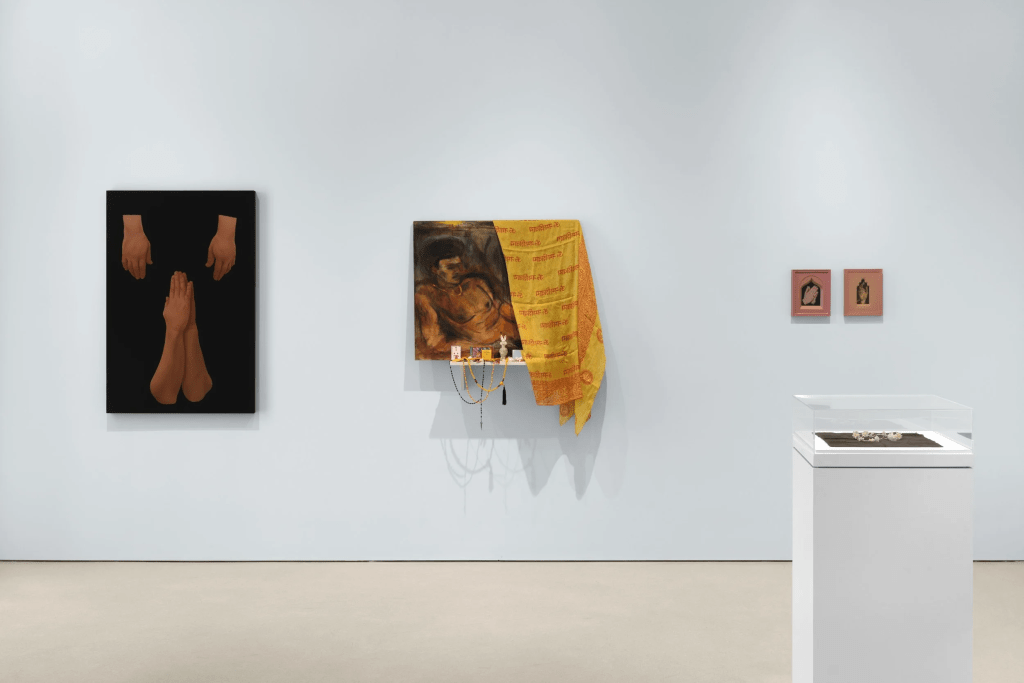
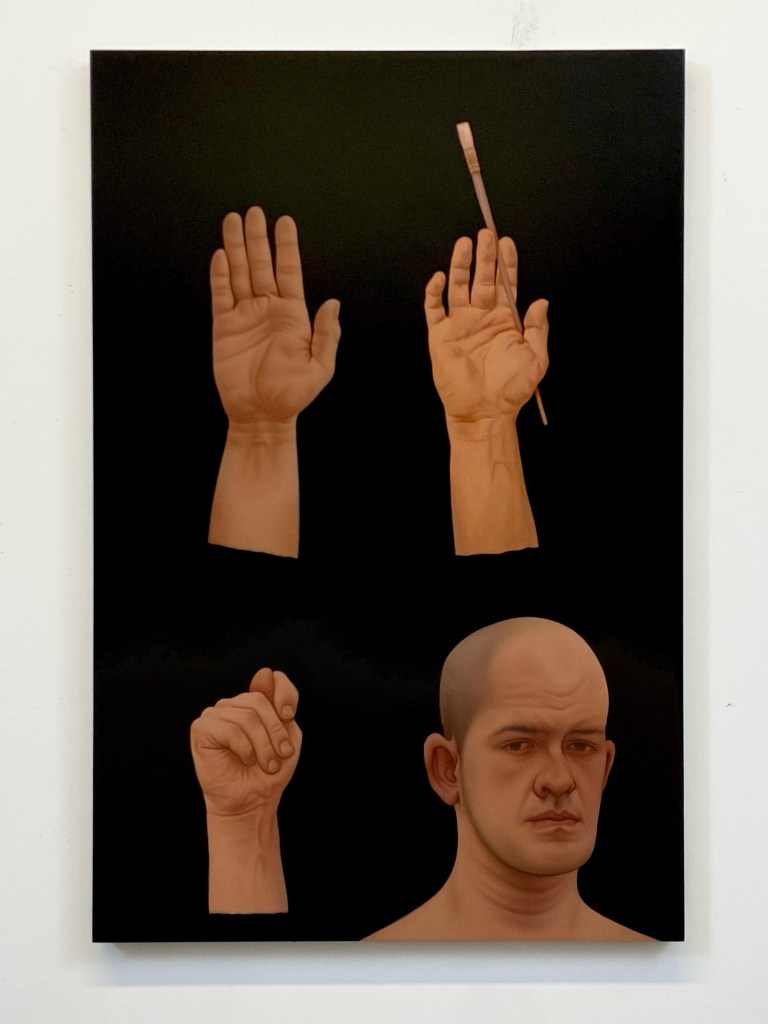
Contributed by Jonathan Stevenson / For over twenty years, Matthew Miller rendered arduously meticulous yet mysteriously otherworldly portraits, mainly of himself as subject and almost always against a maximally opaque black background betraying no brushstrokes, evidently free of human imperfection. His work is resolutely, even proudly, enigmatic, and, consequently, wide open to interpretation. But his thickly flawless application of paint on wood panel and purgation of stray mark-making do plant one unequivocal Heideggerian effect: that of a person, in the moment, not merely outlining but anchoring a place in the world, unsatisfied with a mere silhouette and resolved to plumb the figure’s existential outline to the core of the earth. In his new paintings, one of which – Painter’s Hands (After Marsden Hartley) – is on display in The FLAG Art Foundation’s group show “As Above, So Below,” the subject is not heads but hands, inspired by a one-off 1940 Marsden Hartley painting called Hands owned by Alex Katz, another denizen of Maine, that Miller saw at a 2019 Hartley retrospective at the Louisiana Museum of Modern Art. While the familiar heads still pop into some of Miller’s works for a sideline visit, hands are given pride of place in the picture plane. This seems a progression rather than a radical departure. They articulate the reach into, and back from, depths that have long intrigued Miller. For him, intentionality is everywhere.
Please click here to contribute to the Two Coats of Paint year-end fund drive

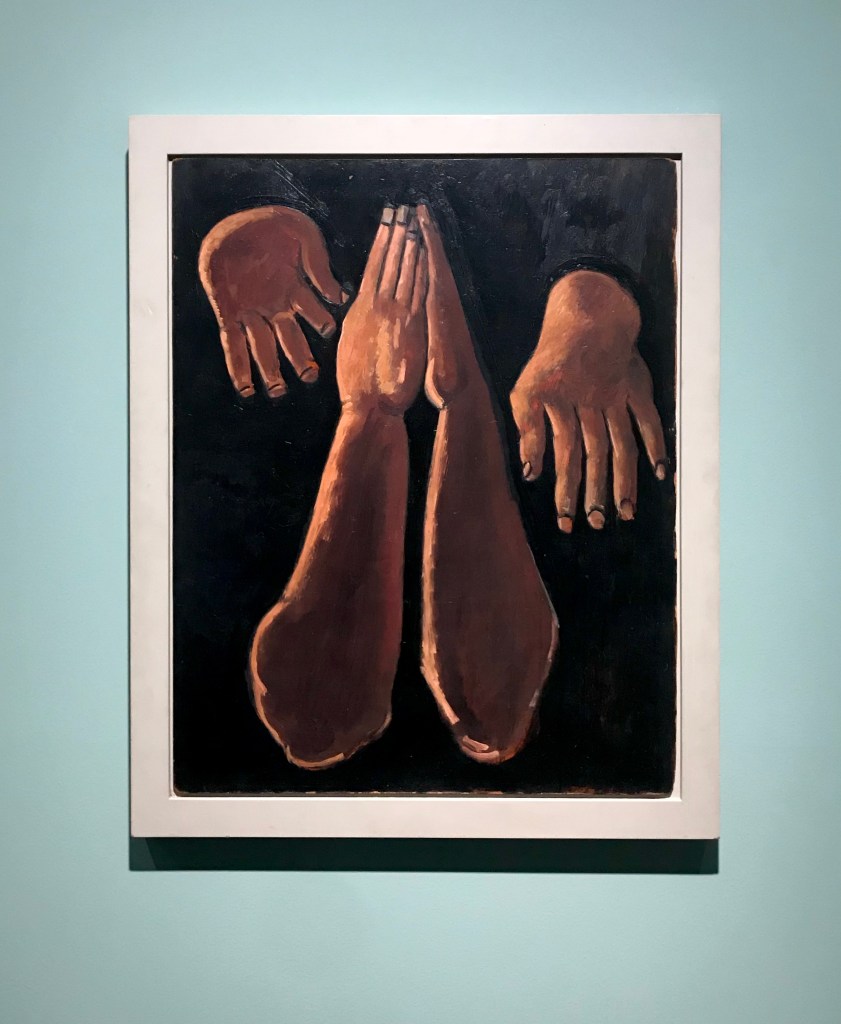

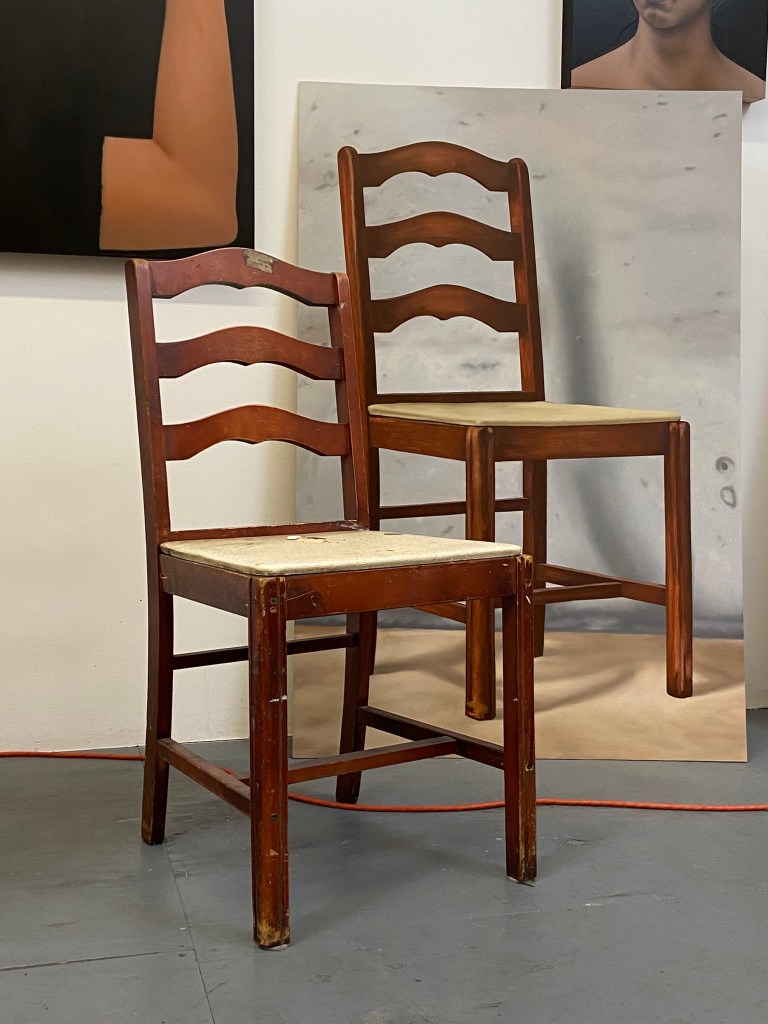
The kinship with Hartley is not random or casual. Miller’s small, votive portrait of the artist graces his Bushwick studio, and the two artists share a trace regionalist sensibility – Hartley’s territory being northern Maine, Miller’s central Pennsylvania. It is manifested in an insistent visual severity resonant of America writ large and a native brand of lonely individualism. What offers relief, in Miller’s case, is tenderly acknowledging others. He has ventured forth with portraits of his wife Claire, and of friends. A work-in-progress depicts one person’s hands washing another’s feet – a custom in the Mennonite Church, in which Miller was raised – in emulation of Christ’s selfless bathing of the disciples’ feet after The Last Supper in the New Testament’s Book of John. The Mennonite faith is one of dignified reserve, and the key factor here is not piety, earnest or otherwise, but sentiment. In particular, Miller’s edges are notably softer, bringing emotion to the surface. With a discreet nod to folk art, another evolving painting is of a simple, mid-century chair: take a load off. In earlier incarnations, Miller seemed almost classically constrained. New warmth and expansiveness have now entered his work.

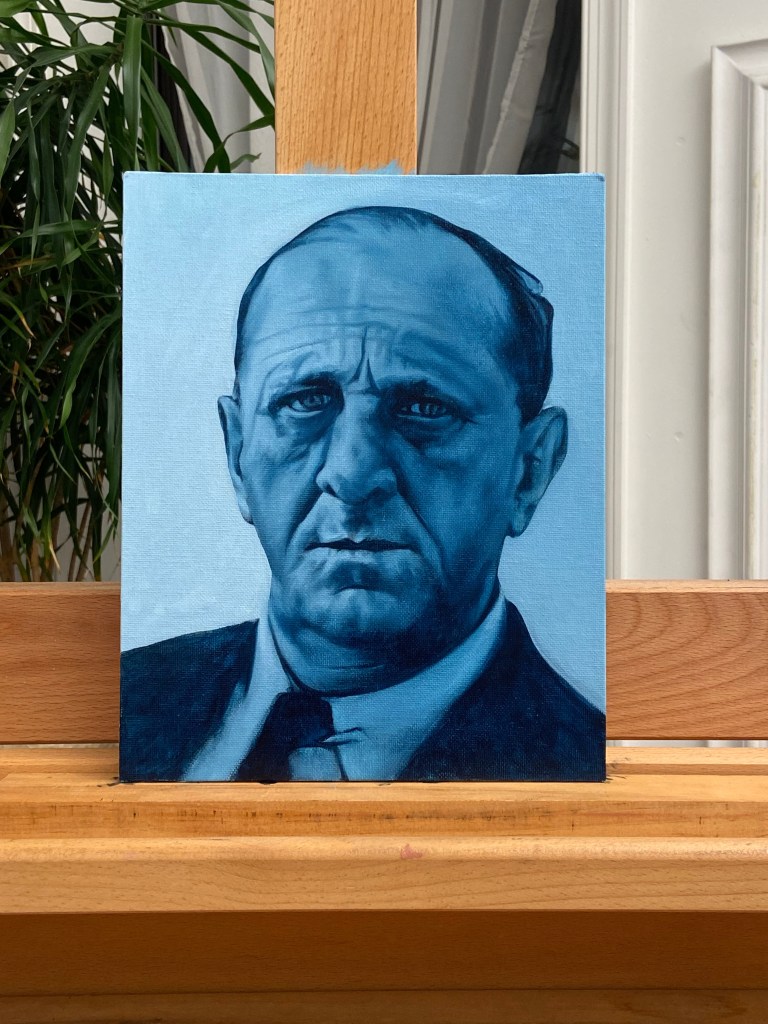
The other small portrait watching over Miller’s workspace is that of the French philosopher Maurice Merleau-Ponty, who famously argued for “the primacy of perception” and cast doubt on the stark Cartesian distinction between subject and object, mind and body. His phenomenology too adds up in the wider context of Miller’s work. If there’s a membrane between the black surface of one of his paintings and whatever he’s looking for behind the barn door, as he put it in titling a 2011 show, it is a permeable one that allows seeking hands to reciprocate. Tempting as it may be to call this concept surrealist, there is too much comfort and logic in the idea of mutual access between the sentient world and the one just beyond its grasp to warrant the label. Miller may be moving towards illuminating some notoriously arcane twentieth-century philosophical principles – extending a hand, as it were, to some humble god in the not unreasonable hope for help or assurance in return. Combining quiet heart with a subdued but committed sense that there is something more to tap into, he declines to relinquish the search.
“As Above, So Below,” The FLAG Art Foundation, 545 West 25th Street, 9th Floor, New York, NY. Through January 17, 2026.
About the author: Jonathan Stevenson is a New York-based policy analyst, editor, and writer, contributing to the New York Times, the New York Review of Books, and Politico, among other publications, and a regular contributor to Two Coats of Paint.
Please click here to contribute to the Two Coats of Paint year-end fund drive