

Contributed by David Carrier / For a long time, I have always thought of Richard Diebenkorn as a great painter. A couple of his paintings were in my local museum, the Carnegie Museum of Art in Pittsburgh, where I treasured seeing them. But he was, so I believed, someone whose development was straightforward, even a little boring. His long career had three discrete stages: the early abstractions followed by Matissian figurative works and then the great Ocean Park work. I can remember vividly seeing his retrospective at the Whitney when it was uptown. Each Ocean Park work seen alone is marvelous, but that grouping of them was emphatically less than the sum of the parts. It sequentially traced Diebenkorn skillfully developing every possible variation on his basic theme, and the dense record of his virtuosity, however thorough and authoritative, was distinctly unexciting. By the time I left, I felt exhausted and not terribly thankful for having seen the sausage made, as it were.
Please click here to contribute to the Two Coats of Paint year-end fund drive

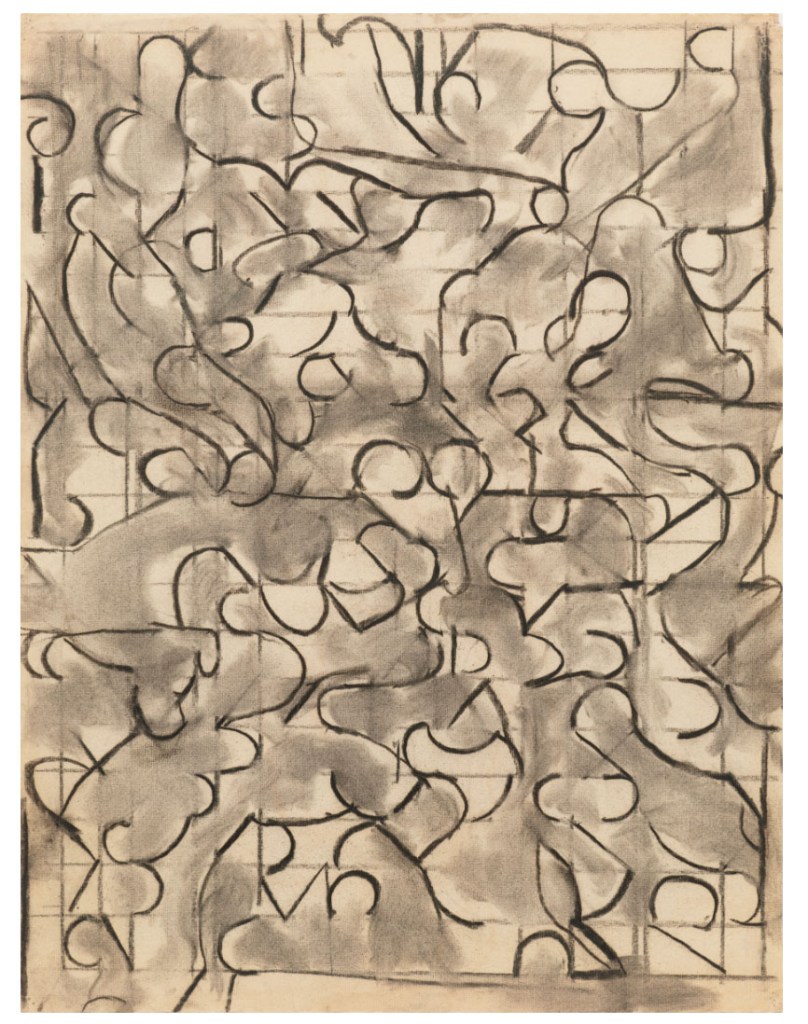
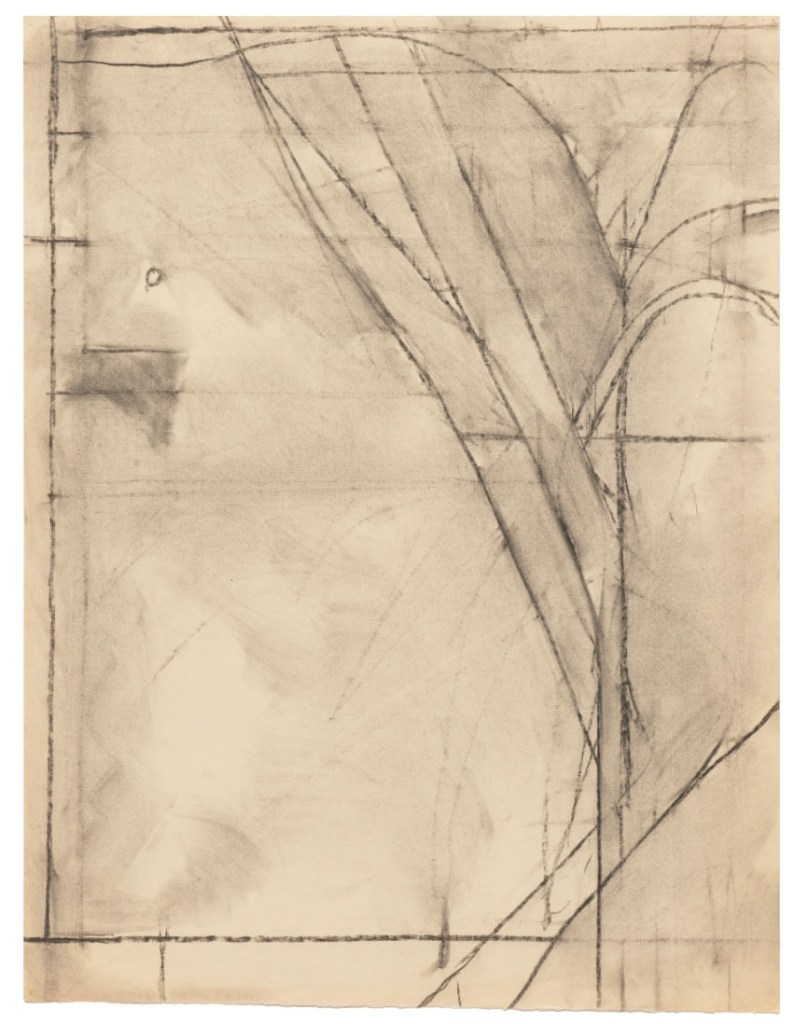
Owing to that somewhat flattening memory, I arrived at Gagosian’s large upstairs gallery on Madison Avenue with low expectations of a thick array of Diebenkorns in that one room. Maybe it had been a mistake, inspired by misguided nostalgia, to take on this assignment. In the event, the exhibition was revelatory, holding me spellbound. This is one reason why I love being an art critic – the surprise. Starting on the left, turning clockwise at the entrance wall, I started with the untitled drawing of a man contemplating a blank panel. This motif was not, so far as I know, further developed by Diebenkorn. Then came four drawings of scissors. Next, on the north wall, are an abstract gouache and a drawing of plants. Farther to the right on that wall is a mysterious untitled drawing of fragments of straight-edge figures, unlike his other figurative drawings.
On the east wall facing the entrance is Ocean Park work, for which Diebenkorn is best known – here, a painting and eleven small drawings, some abstract and some figurative. One is an early watercolor of suburban houses. Finally, on the south wall and the wall to the right of the entrance are small works covering his entire career. The absence of wall labels encourages apprehending this exhibition as a total work of art. Which was the best way to look – clockwise or counterclockwise? Maybe start from the center on the east wall and work outwards. There’s obviously no right answer. The more I looked, first moving clockwise and then counterclockwise, the more there was to see.
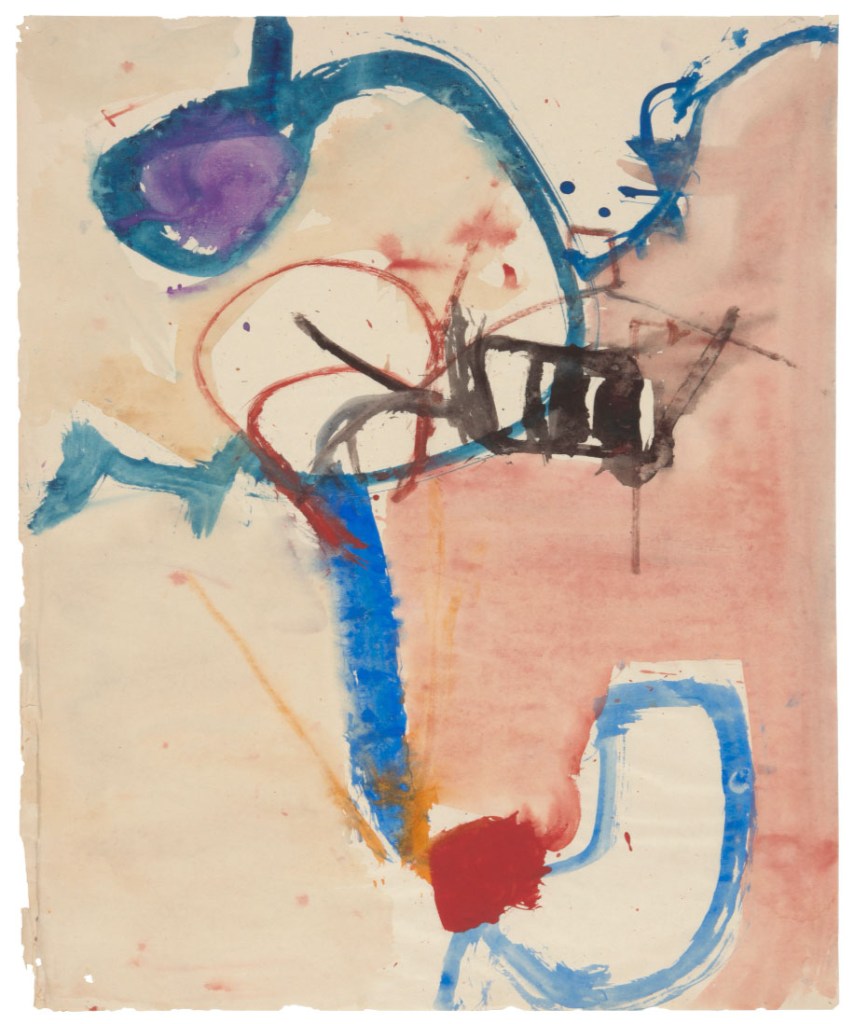


When I began writing criticism, a couple of generations ago, developmental narratives were still in fashion. Recently, however, both MoMA and the Metropolitan Museum of Art have rehung their permanent collections in ways that systematically undercut such linear histories. This splendid gallery show is a response. Alternating between figurative art and abstraction, between works in color and black-and-white, between small and large art, the exhibition simulates the exhilarating sweep of Diebenkorn’s creative processes. Recentering his early development, which now tends to be deconstructed, the show renders him infinitely more varied and challenging than he appeared in the Whitney show. What we see, laid out in an ostensibly atemporal format, is a composite of decades of his creative activity. This is a remarkable curatorial accomplishment.

Searching for words adequate to the experience, I recalled Virginia Woolf’s wondrous description of Roger Fry’s Cézanne: A Study of his Development. “Every element is distinguished and shown to have its necessary part,” she wrote, ‘bringing together from chaos and disorder … the parts that are necessary to the whole.” Her words furnish a sense of what it was like to view the holistic work of art embodied by the 42 Diebenkorns in this display. In an ideal world, a museum would simply purchase the entire installation and display it permanently.
“Richard Diebenkorn,” Gagosian, 980 Madison Avenue, New York, NY. Through December 20, 2025.
About the author: David Carrier is a former professor at Carnegie Mellon University; Getty Scholar; and Clark Fellow. He has lectured in China, Europe, India, Japan, New Zealand, and North America, written catalogue essays for many museums, and published art criticism in Apollo, artcritical, Artforum, Artus, and Burlington Magazine. He has also been a guest editor for The Brooklyn Rail and is a regular contributor to Two Coats of Paint.
Please click here to contribute to the Two Coats of Paint year-end fund drive







Diebenkorn who lived not too far from me in northern California in his later years was “next level”. A friend took one of his courses at UCLA back in the day and she said he did not really expound too much but would look at her work and suggest something”over here” and then the painting popped. There is definitely synergy when his work from different parts of his output is hung together.
Thank you for reporting about the progression of Diebenkorns work. I have been missing it since the show at the Whitney many moons ago.