
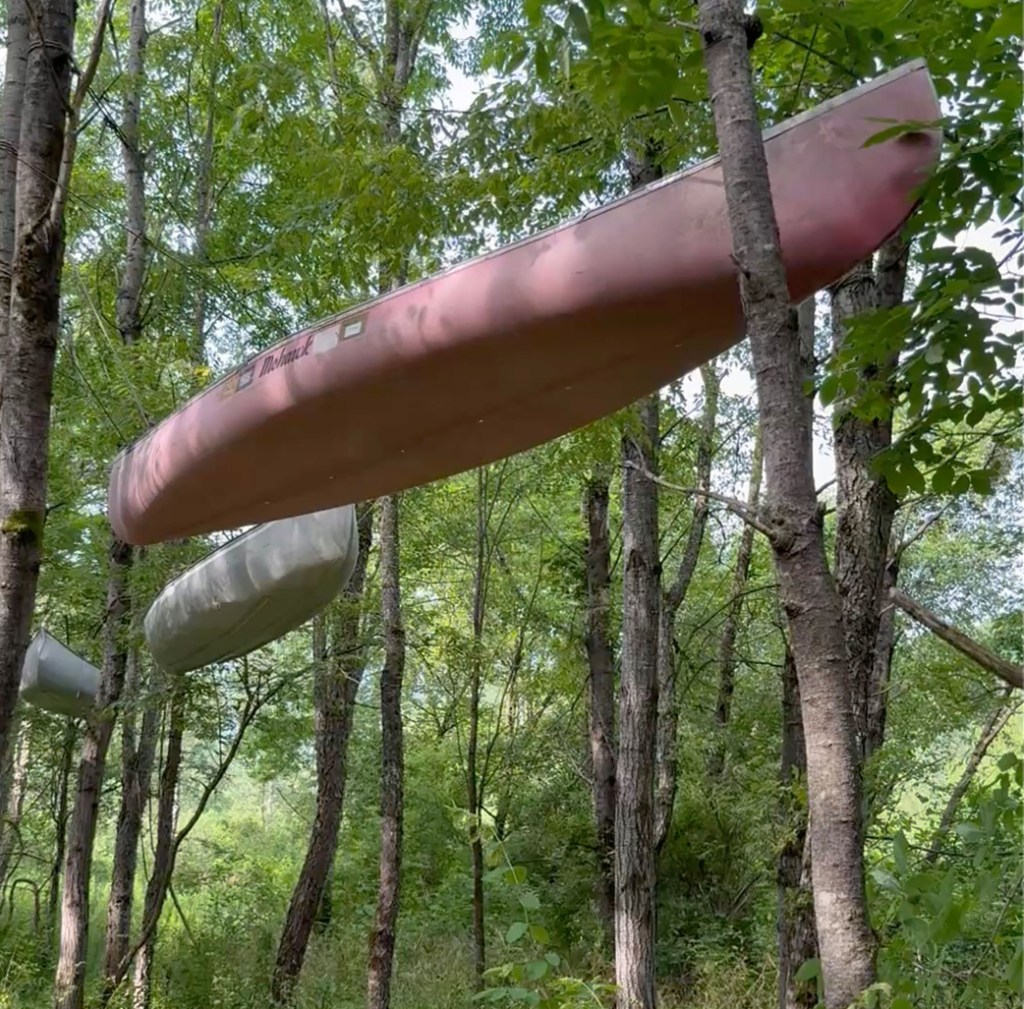
Contributed by Adam Simon / One of the most evocative and lyrical artworks I’ve experienced recently was not located in a gallery or museum, but in the woods on the western edge of the Catskills, behind the Catskill Water Discovery Center in Arkville, New York. To be clear, mine was not the ideal encounter. I was aware of the project, “Headwaters,” and set out to find it. I envy the person who happens upon it while strolling the trail loop created by the Catskill Water Discovery Center which oversaw the installation of “Headwaters”. For that person, I imagine the encounter to be dreamlike, a rift in the fabric of reality.
Adam Simon: I know that Lisa and Bob have collaborated on public projects for many years, but I think of Liza as a painter. How did the three of you decide to team up? Was this an open call put out by the Nature Conservancy?
Liza Phillips: Lisa and Bob had been invited to submit a proposal for the newly designated wetland nature trail at the Catskill Water Discovery Center. They had done another project in 2024 with Brent Rumage, the curator who is on the board of CWDC. My husband Francis Cape had also been asked to submit a proposal, so a site visit was planned. As a painter of wetlands among other things, I thought the visit might at least inspire some new paintings, so I tagged along. We thought we might all submit separate proposals at one point, but after lots of talk about the site, and the presence of an old, damaged canoe lying around behind my barn, our thinking came together. It seemed to me that we teamed up without even planning to. I’ve admired Lisa and Bob’s projects for years, so I relished the opportunity.


AS: I’m assuming that Liza’s damaged canoe is in the installation and that it sort of set the palette. This is one of the things I love about the piece, the muted greys and pale yellow and pink of the canoes among the trees. It would have been very different with the strong greens, reds, blues that are common with canoes. Was that a decision that involved much discussion? Also, were all the canoes donated?
Lisa Hein: Nice phantom palette, isn’t it? Pure luck. Liza lives upstate and solicited donations through a regional network. Two were battered aluminum, one cream fiberglass stained by decades in a tannic pond.
After we assembled them, our little fish school needed a minnow. So, we went on Facebook Marketplace for a 14-footer across the river in Pennsylvania. Never seen a faded pink canoe before, but this small fry ended up leading our pack.
AS: Maybe not luck. That faded pink might once have been red, and all the canoes have the patina of years of use. Once you’re going for throwaways, out of necessity, there’s an aesthetic that tags along. That same kind of serendipity seems to apply to the name of the locale, Arkville.
LH: Good point Adam, we didn’t think of that! I’d like to run the Ark, with its pairs of animals, parallel to the spawning runs of fish in the waters beneath. While the mammals survive to breed in their prime, for the fish, it might be the last thing they do. These battered boats are like salmon a thousand miles upriver. Perhaps an image for doing art at an advanced age! The boats are so old they were made in the era before graphics covered every surface of sporting goods. The flat blankness reads as eerie now, a lack of detail we sometimes associate with monumentality. A strange quality to find on a group of discards.
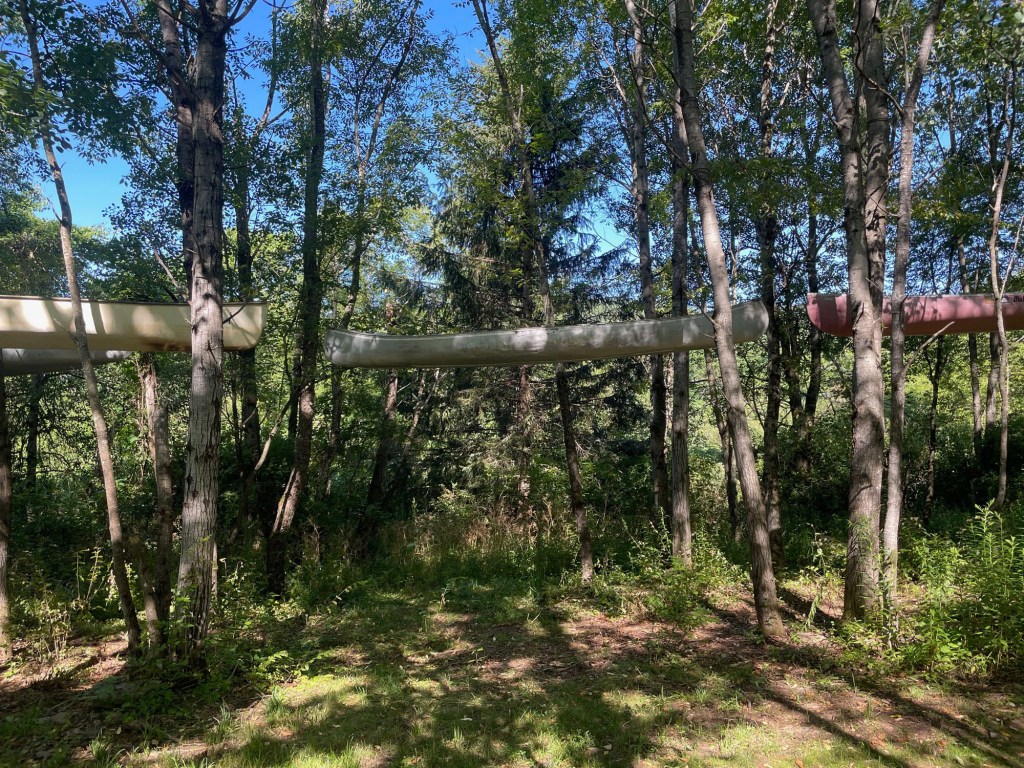
Bob Seng: Adam, as these projects with Lisa and I typically evolve, one person spouts out an idea, then the other responds, adds or subtracts to it, edits, and pushes it around. On the initial site visit I think it was me who suggested to Ed Wood, one of the board members, that I could see empty canoes floating at the level of the last big flood to remind people of the power and levels of what a flood could do. Liza immediately suggested that she had an old canoe she would donate to the cause, and that’s what initially drew her in, plus she was able to assemble most of our little flotilla through her connections.
Floods are the serious take for this project. While we didn’t set out with the Mafia sense of “sleeping with the fishes”, people have since remarked on “Headwaters’” funerary aspect. Hundreds drowned along the Guadalupe River in Texas before we even installed. But after these were up, we realized we were also swimming with a school of fish heading upstream to spawn, which lightens up the tone of things. So, we love many levels of interpretation.
AS: This brings up an interesting point. Even collaborative projects like this start with one person having an idea. But then hopefully a transformation happens, and it becomes a shared non-hierarchical endeavor. At least that’s been my experience and I wonder if that rings true for the three of you. Fred Moten and Stefano Harney have written several books together and I’ve heard Moten say that it makes no difference who wrote what. The four-person lesbian collective, fierce pussy, has designated fierce pussy as a fifth artist making their own decisions. But, just to muddy the waters, someone I met recently, Marc Gloede, sent me an essay he had written on the complicated power dynamics of collective art endeavors. You seem to work in a way that stays straightforward and relatively simple which I imagine cuts through a lot of that complexity. BTW, I love thinking of the canoes as a school of fish, particularly since the viewer’s perspective is the view that fish generally have of canoes, making us the fish. As for the timeliness, connecting to the tragedy of the flooding in Texas, the problem with all topicality is that it aborts the experience, becoming art that is ‘about’ for people searching for a way to understand what they are looking at. Are the canoes at a height that flood waters from the nearby East Branch of the Deleware River have reached in the past?
LP: Yes, for me the chemistry of collaboration took over, and we were all swimming and sweating together. The canoes may not represent a historic high-water mark, but they found their own level, and for me there is an epic quality to the silence they project. I didn’t expect that.

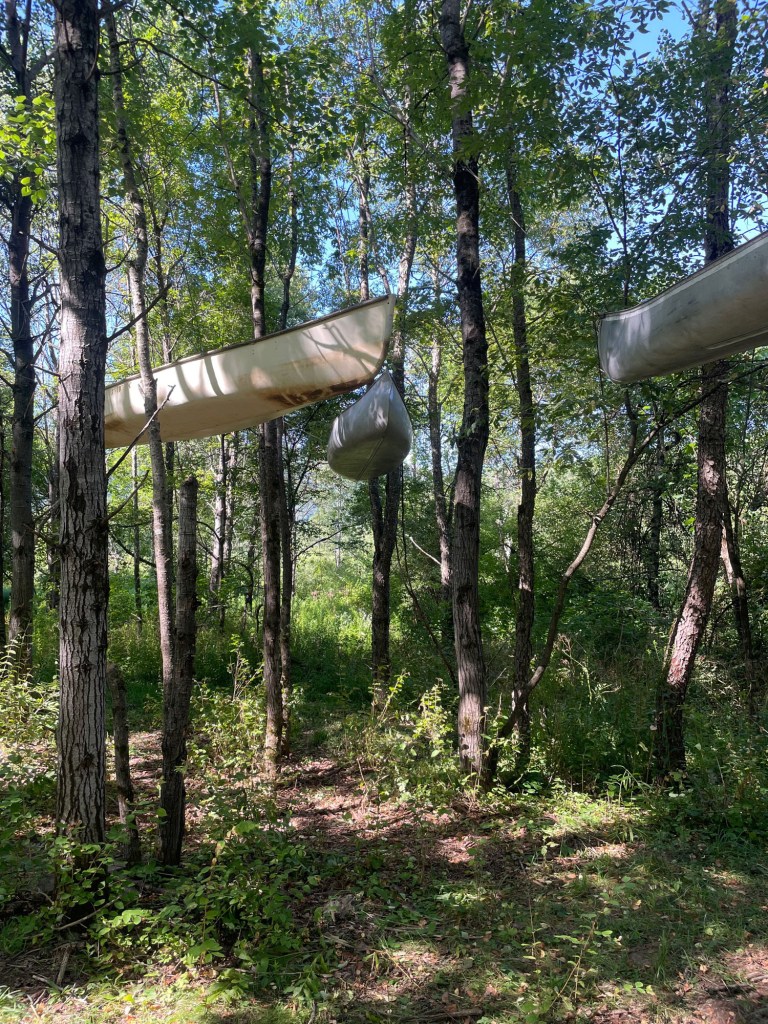
“Headwaters,” Lisa Hein, Liza Phillips, and Bob Seng. Sponsored by the East Branch Nature Preserve under the Catskill Water Discovery Center, 669 County Highway 38, Arkville, NY. Through Sept. 30, 2025, weather permitting.
About the author: Adam Simon is a New York artist and writer. His most recent solo painting show was at OSMOS in 2024.











Incredible, love this, thank you for transporting me.
Great interview Adam, Liza, Lisa and Bob!!
Very interesting thoughts swimming in these trees. Loved seeing this work at the opening.
Overheard Adam’s first comment about the palette on that Saturday.
These canoes have memories.
Great! Timeless and completely of our time! What more could you want! Congratulations you three!
Lisa. Liza and I are delighted to have worked so well together.
It took real focus and strength to get those canoes up in the trees.
And we want to thank Adam and Sharon at TCP for adding another ripple to the piece.
Bob and Lisa NEVER fail to astound us with their uber-ambitious art installation projects! This is one of the best yet and so timely, prescient and poetic. Schools of Silver fish above our heads. Congrats!
Beautifully realized ! And terrific repurposing and it brings enchantment to the Wet Lands.
Congratulations all
Powerful, epic past and present mashup!
Into the forest. Wonderful, playful, dreamlike, inexplicable, sweaty, a fairytale.
love this Headwaters installation; so very Lisa Hein. No one else could dream of this, and then make it come true!
I have enjoyed Lisa’s innovative art since 1975 when we took sculpture class together at
Yale School of Art. Teacher Winifred Lutz encouraged alternative design. Lisa and I both had pieces in the
Yale Art Show. I lived in a cottage in Bethany on the property her parents owned. I ran into Lisa two more times including once at 8,000. ft in the High Sierra when she visited the Mammoth Lakes area where I was living and working for the US Forest Service. I love seeing Lisa’s recent Headwaters Piece. Hope she gets this message!