Tag: Adam Simon

Solo Shows

Christopher Wool’s winning gambit

Contributed by Adam Simon / I’ve known Christopher Wool for a long time, since we were both teenage students at the New York Studio School in the 1970s. Philip Guston made annual visits and I remember his indignation at being asked to look at Christopher’s work. I believe he said that Wool’s all-over paintings should have been shown to someone like Larry Poons, not to him. In retrospect, Guston’s dismay seems to have been prescient and a little ironic. Wool’s breakout text paintings in the 1980s produced a similar response among painters as Guston’s cartoonish figure paintings had a decade earlier. Both overturned current orthodoxies. 

Solo Shows

Carey Young’s visual jurisprudence

Contributed by Adam Simon / Carey Young’s exhibition “Appearance” at Paula Cooper is the latest installment of her more than 20-year artistic examination of the law as an institution. She is a leading progenitor of a growing cohort of artists who use research and analysis of institutions and systems in their work. In a video on the gallery website, Young states, “Law is too important to be left to lawyers… There are many ways to talk about it that haven’t been addressed.” Other reviews have focused on the information transmitted through the photos and video in the show. There remains the fundamental question of how, or if, an art exhibition can talk about a subject as prosaic as law in a constructively different way than a written or spoken medium. Does the language of visual art engage thought differently?

Solo Shows

David Rhodes: Reconfiguring the authorship of a painting

Contributed by Adam Simon / One could be forgiven for mistaking the paintings of David Rhodes at High Noon Gallery for samples of high-end décor, with black fabric punctuated by parallel diagonal stripes stretched over variously sized frames. Whether or not Rhodes anticipates that his work might elicit this response, for me it provided a hurdle, a momentary deflection, suspending my usual mode of engaging with art. I’m glad I had this moment of puzzlement, wondering what in fact I was looking at, before the significance of Rhodes’ achievement sank in.

Ideas about Painting

A (mostly appreciative) response to Saul Ostrow

Contributed by Adam Simon / I was struck by the last two sentences of Saul Ostrow’s essay, “Painting simulacra: Brice Marden, David Reed, and Gerhard Richter.” He writes: “Marden, Reed, and Richter have sustained abstract painting’s aesthetic and cultural value as a mode of resistive thinking. In most cases, though, this has been misread or at least subsumed by its own model, thereby giving rise to the kind of acritical aestheticism and nostalgia that bolsters painters who promote gestural abstraction as a genre or motif rather than a mode of inquiry.” It took a minute to unpack this statement and allow it to sink in. Ostrow’s critique is dense, and appears to implicate most contemporary gestural abstract painters as well as contemporary criticism that dismisses the possibility of radical formalism.

Solo Shows

David Diao: Impeccable touch

Contributed by Adam Simon / Sometime in the early 1980s, a mural appeared on West Broadway between Spring and Broome streets in New York City, declaring in multi-colored capital letters, “I Am The Best Artist” signed, René. This, and other versions of the mural, were generally considered an embarrassment in the local artist community. I thought the mural, by René Moncada, was an interestingly unsubtle parody of artists’ competition and quest for uniqueness. I thought of this mural while viewing David Diao’s solo exhibition, On Barnett Newman, 1991-2023, on view at Greene Naftali. The exhibition comprises twelve paintings dedicated to the work of another painter, including works that look like an archivist’s inventory.

Solo Shows

Marcy Rosenblat’s exquisite balance

Contributed by Adam Simon / In a November 2022 article titled “Between Abstraction and Representation” in the New York Review of Books, Jed Perl lamented the equivocating position that many contemporary painters take in relation to abstraction and figuration. In his view, what was once a philosophical battleground, with two strongly held opposing positions, was now seen as merely a choice of equally viable means. His article focused on two artists, Julie Mehretu and Gerhardt Richter – Mehretu for inserting representational imagery in what appear as abstract paintings and Richter for ping-ponging between figuration and abstraction. What Perl doesn’t mention is the rich terrain of indeterminacy that results when artwork hovers between abstraction and figuration. Marcy Rosenblat’s solo show “Undercover,” now up at 490 Atlantic Gallery in Brooklyn, is a particularly successful example.

Solo Shows

Tom McGlynn: Meta-minimalist-abstraction

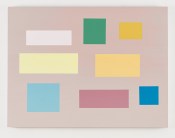
Contributed by Adam Simon / At first glance, Tom McGlynn’s paintings, on display at his solo show “What Gives” at Rick Wester Fine Art, seem to be examples of minimalist abstraction, free of narrative, subject, or anything associative. His arrangements of rectangles of solid color on a monochromatic field evoke modernism’s utopian origins: Mondrian, Van Doesburg, De Stijl, Neo-plasticism, painting purged of anything that could be thought extraneous. For contemporary abstract painters, however, these basic shapes are historically weighted signifiers, no longer free of association. One cannot now make a geometric abstract painting without it also being a depiction of a geometric abstract painting. McGlynn is fully aware of this doubling. For him, it isn’t a quandary as much as a defining characteristic of his work. What is remarkable is that, out of such seemingly depleted soil, he can conjure such visual richness.

Artist's Notebook

The Exhibit: Just another gig

Contributed by Adam Simon / I only watched parts of The Exhibit: Finding the Next Great Artist – the six-episode MTV/Smithsonian Channel reality show in which seven artists compete for an exhibition at the Hirshhorn Museum and $100k in prize money. Not having an MTV account, my viewing was repeatedly interrupted by ads, and I bailed after watching a few episodes. I was sorry to bail in a way because there were things I liked about The Exhibit. The artists were impressive as thinking, creative individuals and I was taken with how supportive they appeared of each other, remarkable given the stakes. If there were times of cutthroat competition, they were carefully edited out, happened off camera, or just weren’t in the bits that I saw. I’m guessing the comradery I witnessed was genuine. That said, there is a striking degree to which The Exhibit, as a reality TV show, resembles any other reality TV show, whether it’s American Idol, The Apprentice, or Top Chef. A quick scan shows over 400 reality TV shows listed on Wikipedia, dating back to my favorite, the British Up series in 1964.] 

Solo Shows

Paul Pagk: Pure painting revealed

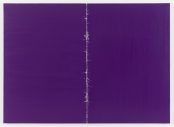
Contributed by Adam Simon / I almost decided not to write about Paul Pagk’s first solo exhibition at Miguel Abreu on the Lower East Side after reading Raphael Rubinstein’s eloquent press statement. Rubinstein articulated so much of what struck me about the exhibition that I wondered what I could add. One thing Rubinstein alludes to but doesn’t explore in depth is the chasm that separates an initial glance at a Pagk painting from longer consideration of his work in person. For viewers not attuned to the ways painters glean meaning from forms and materials, these paintings might appear overly reductive, mere diagrams on fields of monochrome. You tend to take in a Pagk canvas quickly, as a one-to-one relationship of image to ground without a lot of interacting parts. It’s easy to miss the many ways in which his false starts, reiterations, miscues, and reworkings belie his apparent minimalism and austerity.

Solo Shows

Don Dudley’s pure authenticity

Contributed by Adam Simon / Don Dudley’s minimalism has always had a West Coast flavor, more concerned with perception than objecthood. Like many artists of his generation, he has steered clear of expressionism, or anything that shifted attention from the object to the artist. His focus has been on the purely visual.

Solo Shows

Joy Episalla’s radical photography

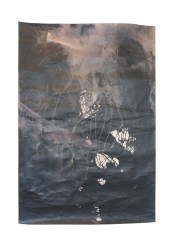
Contributed by Adam Simon / Lately I find myself wondering what impact the ubiquity of cellphone cameras is having on the practice of fine-art photography. As frustrating as it might be for the serious photographer to see everyone and their cousin constantly taking and posting pictures, one salient effect could be a rising inclination to explore the limits of what defines a photograph. There has been a resurgence of interest in photograms and camera obscura for some time now, and Joy Episalla’s current show of works labelled ‘foldtograms’ on view at Tibor de Nagy are even further removed from the idea of capturing an image.

Solo Shows

Maureen McQuillan: Beauty in rigor

Contributed by Adam Simon / In the neighborhood of abstract painting, Maureen McQuillan’s backyard – reflected by works on view at McKenzie Fine Art until May 15 – features process-based or system-based painting. Loosely defined, this is painting for which the process of its making is its primary subject and the finished painting is understood as evidence of that process.

Solo Shows

Russell Maltz: Radical thrift

Contributed by Adam Simon / One of Russell Maltz’s singular achievements is to demonstrate how easily utilitarian objects and materials can be transported, Cinderella-like, into the alchemical realm of fine art. This is partly a property of the materials themselves: the symmetry, weightiness, and economy of products meant for construction. “Russell Maltz: Painted/Stacked/Site” on view at Minus Space in Dumbo, through July 30, with an additional nearby storefront installation and a slide show depicting found sites of construction material.