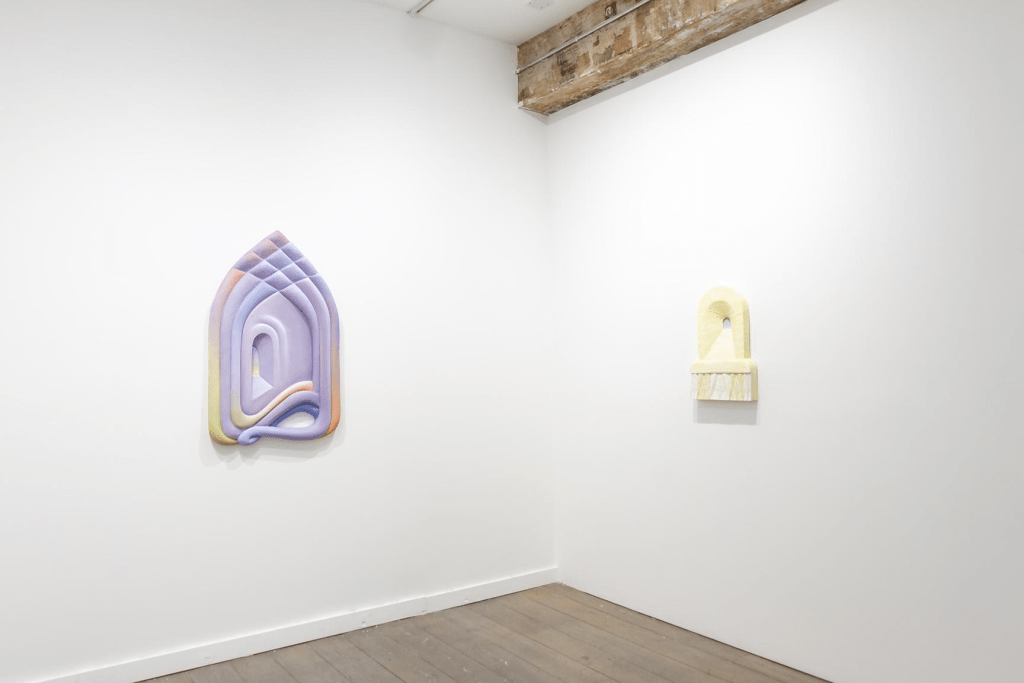
Contributed by Will Kaplan / In her solo show “Solarium” at Picture Theory, Lauren Clay compresses different scales of time into tight, enchanting wall sculptures. In modernizing the timeless form of the archway, her work reflects the structure’s progression from functional to aesthetic. The series of torso-sized works foster an intimate viewing experience, comparable to an altarpiece. Traditionally, altarpieces hover behind the altar itself. The faithful kneel beneath them for their sacraments, like the Eucharistic transformation of wine into blood. By presenting Jesus and his deeds within a frame that resembles the house of worship, an altarpiece offers a condensed view of the entire Christian faith. Similarly, the shrines of “Solarium” embody a metaphysical connection between nature, art, history, and craft.
Please click here to contribute to the Two Coats of Paint year-end fund drive
Where Renaissance artists used church walls to paint illusionistically receding frescoes, Clay’s sculptures emerge from the wall to frame a calming interior space. Within these fabricated apses, Clay uses the Renaissance’s orthogonal lines to create a forced perspective. Sill’s sharp angles, for example, makethe window-frame appear far deeper than the piece’s two-inch thickness.
Other pieces recall Modernism’s mediated view of the natural world. The coral burst of Throne Room Vision reboots the Art Deco love affair with Gothic ornament for the computer age. These thick, tubular forms read with the streamlined immediacy of a digital icon. While the visual pleasure clicks immediately, the exhibition’s deeper meanings unfurl more slowly.
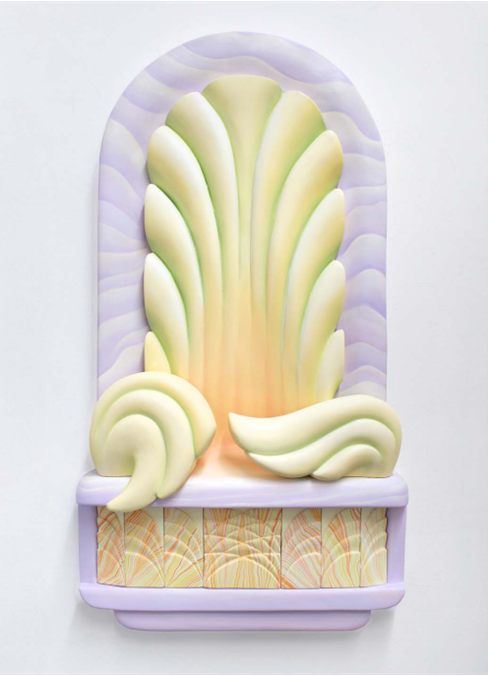
The white-to-blue calla lily swoops of Scriptorium channel Georgia O’Keeffe’s floral gradients and offer the same sense of organic sanctum. Clay completes the arch by inverting the flowers, suggesting a waterfall cascading over marble. In “Solarium,” the change between liquid and solid emerges as a spiritual theme, especially when Clay imitates marble, which manifests geological time. Over millions of years, under the weight of the earth’s crust, limestone transforms in molten heat. Water seeps through the viscous rock, depositing minerals that streak through the stone like veins. Since the Renaissance, there’s been a demand for the craft of faux-marbling. With trompe l’oeil painting, Clay achieves the signature grain in a much shorter time. To pattern some pieces, she uses an Ottoman-era marbling technique traditionally used for decorating paper by suspending liquid dyes in oil and water, creating emulsified film. Clay dunks the entire sculpture into this bath, letting the diffusing liquids cling to the solid: a baptism to stain not purify. Clay thus distills liquid motion in momentary and eonic timeframes at once.
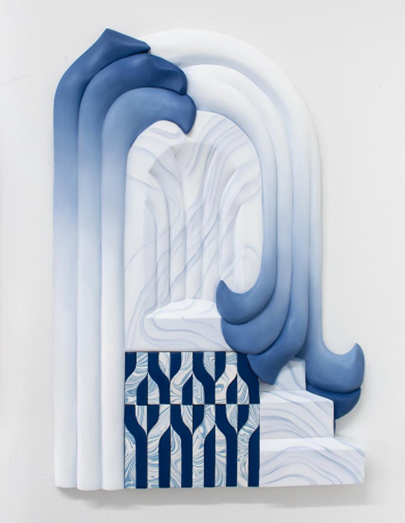
Ephemerality resonates in works like Sill and Tracery Window, where receding windows capture a sky in dawn or twilight. The soft pearlescence appears across the entire show. While the artist hand-painted the facades, this soft rainbow spectrum recalls a digital color selector, or, more suspiciously, the sleek aura of millennial graphic design. Digital templates and app logos of the 2010s relied on such vibrant ombré to package utopian promises of creativity and connection. Even today, the Instagram icon features a glowing fusion of purple and orange. It’s obvious that the devices that present these seductive color schemes are our closest facsimiles to an altarpiece. Where else do we submissively commune with a greater power if not on laptops, phones, and tablets?
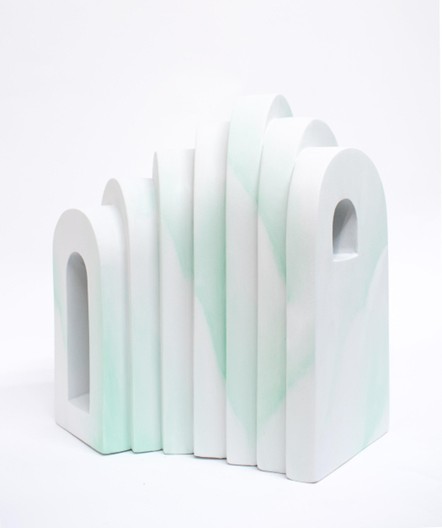
Real-life art offers an alternative. From the digital, we return through the arch, which announces the possibility of movement and transition. Reconstructor, a freestanding sculpture and a stirring summary of Clay’s essential content, exalts the form. Brushed with a cloudy seafoam green, seven archways fused together make a gently curved tunnel that starts in a large entryway and ends in a small window. Neither opening, only the inner midpoint, is visible from the other side. Denied an omnipotent view of the miniature, we are forced to imagine the passageway without seeing it in full. This deft provocation fulfills a function of great art: guiding the viewer to an act of faith.
“Lauren Clay: Solarium,” Picture Theory 548 West 28th Street, Suite 238, New York, NY. Through December 20, 2025.
About the author: Will Kaplan is a Queens-based artist and writer. His work has been shown at the Spring/Break Art Fair and Pete’s Candy Store, and on Governors Island. He currently has a solo show titled “Respawn” at D.D.D.D. His writing can be found in Artspiel, Copy, and Passing Notes.
Please click here to contribute to the Two Coats of Paint year-end fund drive