Search Results for "label/Art on Paper"

Museum Exhibitions

Paul Klee, degenerate for the ages

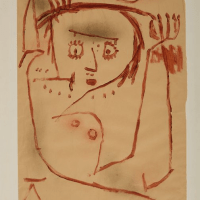
Contributed by Jonathan Stevenson / Branded a degenerate artist for his “insane childish scrawling” by the Nazis, Paul Klee, once anointed at the Bauhaus, left Germany for Switzerland in 1933. Scleroderma was already affecting his will and ability to paint, and his theretofore prodigious output waned. But as Germany’s onslaught in Europe effloresced into World War II, he regained purpose and productivity, yielding over 1,250 works in 1939, the year before his death. During this period, he downplayed his signature sublimation via color in favor of succinct line to expose the toxicity of fascism. Everything that concerned him as a citizen of the world seemed to catch light in his art. This valedictory turn is the subject of “Other Possible Worlds,” the Jewish Museum’s superbly curated show, uniquely centered on his final decade. 
Solo Shows

Richard Bosman at Headstone Gallery

Contributed by Bill Arning / Long-time Bosman watchers often recall his work as a firehose of imagery—gunfights and car chases, sinking ships, kidnappings, and robberies pouring out in rapid succession. Fans might therefore be surprised when entering his first solo show at Kingston’s beloved Headstone Gallery, a venue known for its ambitious program of younger artists. In inviting an older master like Bosman, the gallery has delightfully broadened its scope.

Solo Shows

Diebenkorn at Gagosian: A remarkable curatorial accomplishment 

Contributed by David Carrier / For a long time, I have always thought of Richard Diebenkorn as a great painter. A couple of his paintings were in my local museum, the Carnegie Museum of Art in Pittsburgh, where I treasured seeing them. But he was, so I believed, someone whose development was straightforward, even a little boring. I arrived at Gagosian’s large upstairs gallery on Madison Avenue with low expectations of a thick array of Diebenkorns in that one room. Maybe it had been a mistake, inspired by misguided nostalgia, to take on this assignment. In the event, the exhibition was revelatory, holding me spellbound. This is one reason why I love being an art critic – the surprise.

Solo Shows

Ted Stamm’s conceptual adventurism

Contributed by Saul Ostrow / When Ted Stamm’s career was cut short by his death at age 39 in 1984, he had already begun to attract attention in the United States and internationally. Critics including Edit deAk, Peter Frank, Robert Morgan, and Kay Larson recognized Stamm’s ability to bridge formal rigor with playful urban references. In 1975, deAk wrote in Artforum that “Stamm’s work confounds its own apparent simplicity; the shape’s tense complexity and stubborn definition of itself make it totally the artist’s like an insignia. The color is equally personal, and the painting’s presence is quietly assertive. This is certainly not the elegant nihilism of reductive solutions.” Conceptual endeavors were central to his ambition of making the border between art and everyday life porous.

Solo Shows

Beatrice Caracciolo: Exquisitely stealthy

Contributed by David Carrier / What does it mean for a contemporary artist to be inspired by an older text or artwork? The Gospel of Matthew 15:14 says: “If the blind lead the blind, both shall fall into the ditch.” Moved by those words in 1568, Pieter Bruegel the Elder painted The Blind Leading the Blind, which hangs in Museo di Capodimonte in Naples. Now stirred by that picture, Beatrice Caracciolo, a young artist who grew up in that city, has drawn The Blind 16: one large image of the blind beggars and several smaller details also derived from the Bruegel. Between Matthew and Bruegel and then Bruegel and Caracciolo, there’s a kind of creative slippage whereby the meaning of the prior statement is transformed. At each stage, Matthew’s basic conception is partly preserved while something is added or subtracted. He doesn’t specify, for instance, that there are six blind men. Caracciolo shows his entire work, but without color, in grisaille. In smaller rectangular works on paper, she focuses on the trees and on some of the individual blind men.

MFA POV

Trade secrets: How much should a painter reveal?

Contributed by Bonnie Morano / I consider myself an open book. The secret ingredient to my zesty salad dressing is cumin. Avoiding parking tickets in NYC involves a finely worded note on the windshield. But ask me how I get my oil paint to stay so shiny when dry, I hesitate….In this social media age of oversharing, does the aura of the heroic painter today rest on magic and mystery or up front transparency?

Gallery shows

Past, present, and future: The complementary visions of Jodi Hays and Michi Meko

Contributed by Jenny Zoe Casey / In a fascinating and inspired pairing, “The Burden of Wait” at Susan Inglett brings together painters Michi Meko and Jodi Hays and explores the different ways in which inhabitants of a particular region – here the American South – can experience it. Landscape is an important influence for both artists, but their approaches are mostly in opposition.