
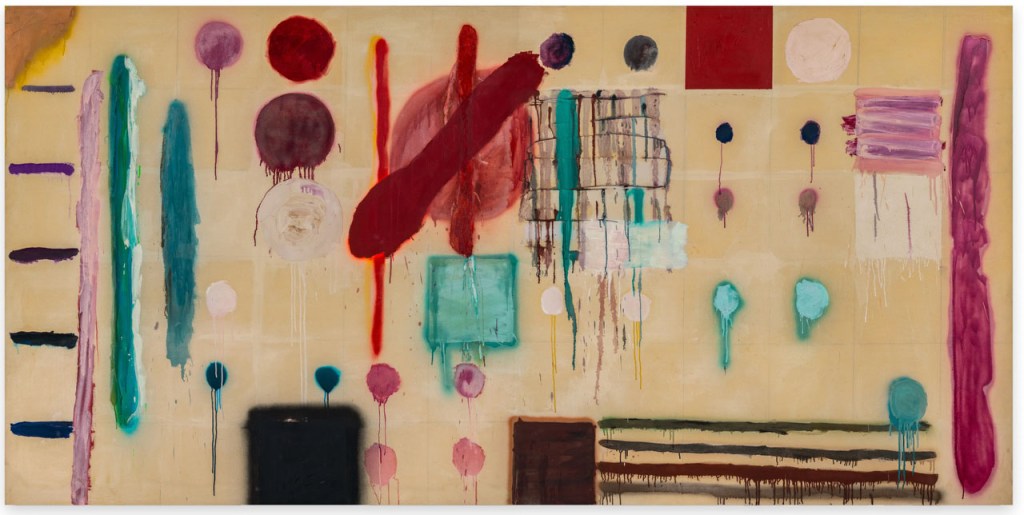
Contributed by Ken Buhler / In late summer 2023, the painter Joan Snyder opened an email from Sotheby’s. One of her early paintings was going to be offered in an upcoming auction. The email was a routine inquiry to authenticate and gather information about the work. Snyder stared with amazement at an image of a painting from 1970 titled Whole Segments. Yes, she had made the painting. What Sotheby’s didn’t know was that it had been stolen.
In the late 1960s, Snyder was breaking new ground in abstraction with what are often referred to as the “Stroke Paintings” – bold, expressionistic images that amplified the brushstroke. In the world Snyder was creating, strokes became entities in themselves, each constituting a singular presence through color, gesture, duration, and density, while together forming a loose grid-like architecture across the canvas. Instead of the cool distance often found in the Minimalist or Color Field painting of the era, these works were lush, emotional, challenging, and full of story. By 1970, the year Snyder painted Whole Segments, she had established herself as a significant young painter. With a solo show at Paley and Lowe Gallery, and participation in major group exhibitions including the Whitney Biennial, Snyder continued to gain momentum. In 1973, a charming gallerist from Chicago, John Doyle, called on her at her studio on Mulberry Street. He said he was acquiring work for two collectors from Geneva, Switzerland, and negotiated the purchase of Whole Segments directly with Snyder.
Art thefts can be carried out in the most pedestrian fashion, nothing like what is portrayed in movies like The Thomas Crown Affair or Donna Tartt’s novel The Goldfinch. Snyder’s painting, at six by twelve feet, does not exactly lend itself to furtive removal from a gallery, museum, or studio. Almost every artist has experienced a more ubiquitous kind of art theft. An artwork goes to a dealer for a show or is sold to a collector, but the artist never sees the piece again or receives an inequitable portion of sale proceeds. In this particular theft, the painting suddenly re-entered the artist’s life. There was “Whole Segments” staring back at Snyder on her computer screen.
Alerting Sotheby’s that the painting had been stolen redirected the case to their legal department, which requested any available supporting documentation from Snyder. Given the 50-year lag, this was a long shot. Snyder came up empty, and she could not recall specific details. Then Kerri Ammirata, her assistant, asked, “What about the boxes we sent to the Smithsonian?” Between 2011 and 2014, they had sent several boxes of Snyder’s archives to The Smithsonian Institution to be made available to researchers and scholars. Was it possible that somewhere in those materials were documents that could help solve an art crime perpetrated in the 1970’s?
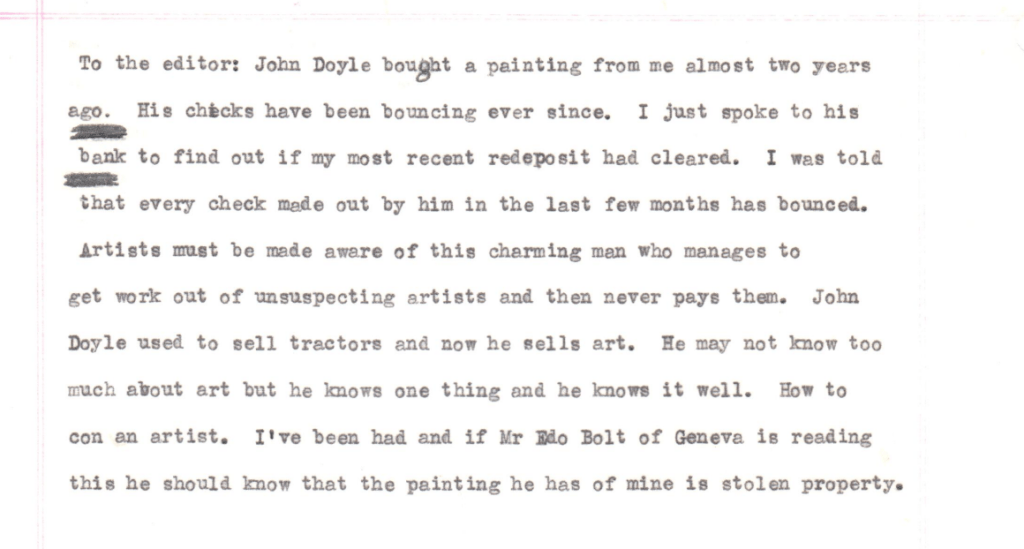
Snyder and Ammirata contacted the Smithsonian, and within 24 hours the museum had sent material that illuminated the whole fraught transaction. There were not only records of a sale but also documents showing that Snyder had hired a Chicago lawyer, sued Doyle, and won a judgment against him. The material included a letter from Snyder stating: “John Doyle bought a painting from me almost two years ago. His checks have been bouncing ever since.” At that point, the trail went cold. Doyle never responded. Upon reviewing this material, the custodian of the painting, whose name remains confidential, immediately withdrew it from the auction so that it could be restored to its rightful owner: Joan Snyder. The prospective homecoming of this stolen painting was an emotional one. Snyder asked that it be sent directly to her studio before it went for a scheduled cleaning and restoration. After over 50 years, she was loath to be parted from it one moment longer than necessary.
A looming question remains: who had the painting? It seems quite possible that Whole Segments was never in the hands of the collectors from Geneva. It may have never been more than a few miles from Snyder’s New York studio. I was able to trace the painting’s location to the loft of two very successful NYC-based art photographers – a couple whose primary clients included internationally famous artists and powerful New York galleries. They had somehow come to “own” the painting. A New York Times article dated April 16, 1973, reported that a serious fire in their Greenwich Village apartment building had resulted in the destruction or severe damage of many of the residents’ possessions. When recovered, Whole Segments showed signs of significant water damage. This suggests it could have been there in 1973 without confirming it.
One of the two photographers passed away some time ago. The other may now live in her native Ecuador. In any case, I was unable to contact her. For the most part, Whole Segments’ journey after leaving Snyder’s studio in 1973 remains a mystery. I can only speculate as to why the painting would have been in their possession. Perhaps Doyle hired them to photograph Snyder’s painting. Maybe they were holding onto it due to non-payment for their services. It’s possible the painting was in their hands until 1994, when they vacated the loft, over 20 years after the fire. Was it then moved to a client’s storage facility, overlooked for years, and only recently unearthed and offered for auction? Hard to say.
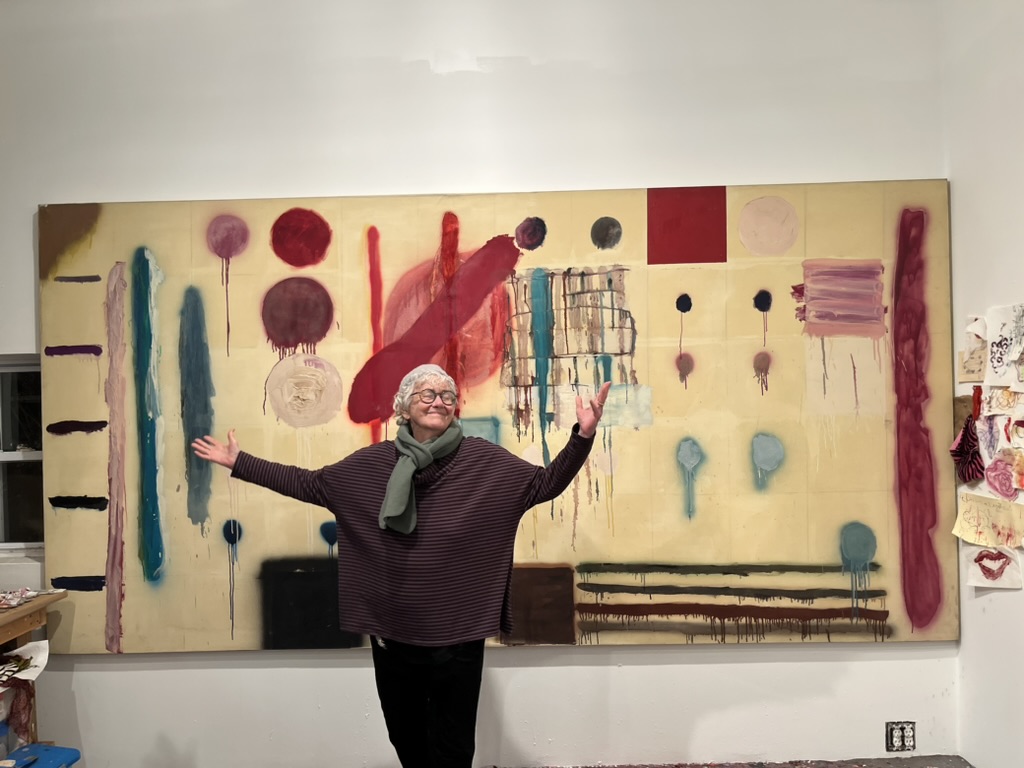
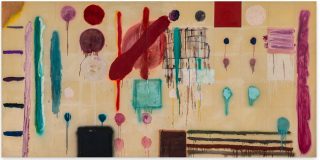
In late 2023, I walked into Snyder’s Brooklyn studio to see Whole Segments in person. The large horizontal canvas took my breath away. It truly is one of the masterpieces among her 1970’s Stroke Paintings. A varied assortment of vertical and horizontal strokes, orbs, and squares are juxtaposed across the span of the canvas. At the painting’s upper center, a large dark red diagonal stroke hovers, cohering and empowering all its elements. In form, hue, and texture, whether sprayed or brushed, every gesture resonates with sensuous and vibrant inevitability. Having emerged from a shadowed past, the painting’s provenance will now record it as a recent acquisition for The Hepworth Wakefield Museum in Wakefield, England. Whole Segments is currently on display there through March 2027, for all to see.
This story may always have gaps in it, but Snyder’s fifty-year long quest for her painting has finally come to a close.
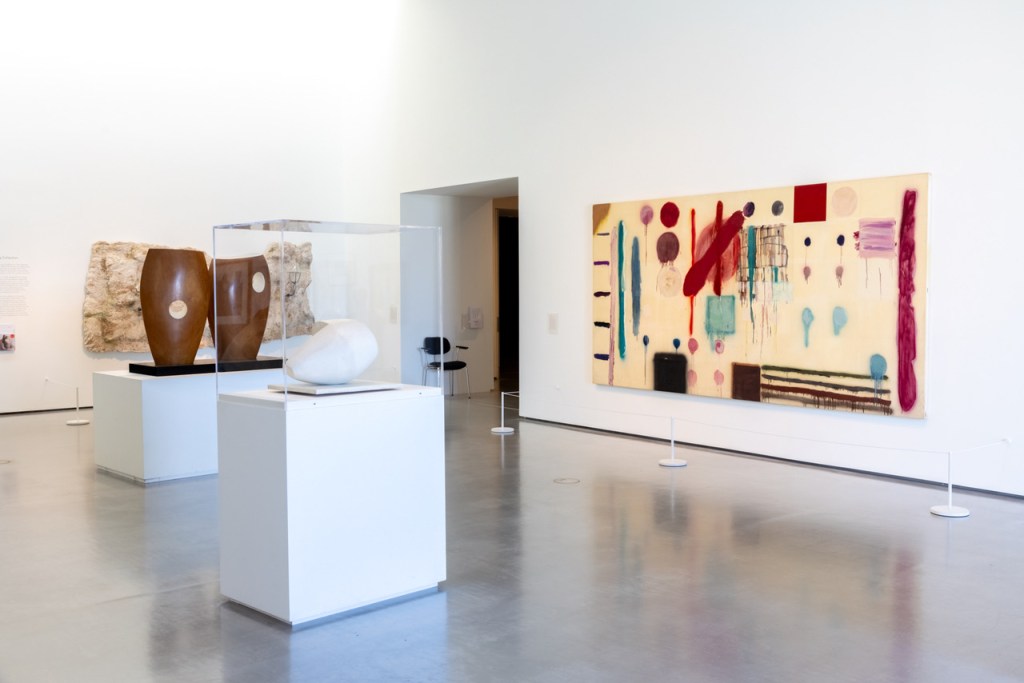
“A Living Collection,” The Hepworth Wakefield, Gallery Walk, Wakefield, West Yorkshire, England. Through March 2027.
About the author: Painter and printmaker Ken Buhler is Professor Emeritus in Studio Art at Bard College. He lives and works in Brooklyn and in Masonville, NY.









This story was a wonderful, well written read. Its so interesting to know that the painting came back home after so long.
It also brought back a very funny personal story regarding John Doyle. I just graduated from the School of the Art Institute of Chicago, 1975 (winning my second fellowship from SAIC & a national endowment Grant ) John Doyle invited me to his gallery to see a portfolio of works on paper. He asked me to put my portfolio on a pool table. He came very close and I moved away. Suddenly I was running around the table with him inches away shouting. When we see each other at openings we can have this secretly between us. I managed to grab my portfolio off the table and ran out the door.
Thank you for this interesting painting story and for reminding me of my lost memory.