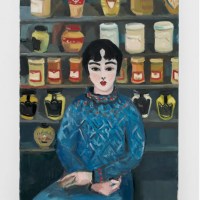
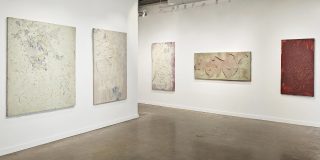
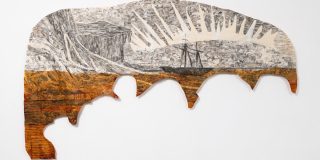
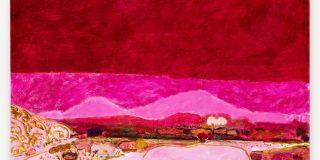
Contributed by Natasha Sweeten / Maureen Dougherty brings her paintings to life with quiet assurance. For “The Completionists,” her current exhibition at Mendes Wood DM in Germantown, she presents portraits of solitary collectors showcasing their collections in muted yet elegant tones not unlike Luc Tuymans’, with dabs of paint nestled into shadows and on tips of asparagus. Objects such as dog figurines, serving dishes, Picasso’s ceramics, skulls, and books are dutifully balanced on horizontal bands of shelving stretching across the picture plane, providing a fixed compositional framework. Perhaps Dougherty’s years of working in abstraction cultivated the acuity and freedom in her brushstroke. Nearly every one of the nine paintings on view fills the expanse of canvas as if to suggest that we’ve zoomed in on a larger presentation, singling out this particular person with this particular array of belongings while also understanding the moment as memory.
Tag: Picasso
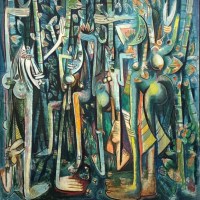
Wifredo Lam’s global reach
Contributed by Margaret McCann / “When I Don’t Sleep I Dream” at the Museum of Modern Art traces the odyssey of Afro-Asian Cuban painter Wilfredo Lam (1902–1982). His 20th-century oeuvre encompasses a prescient global combination of influences. Youthful talent afforded him portraiture study in Spain, where he remained for 15 years. But, like Goya, inclination and events pushed his art past appearances.
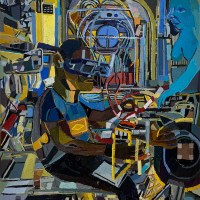
Clintel Steed’s careful daring
Contributed by Margaret McCann / In Clintel Steed’s show of paintings at Shrine Gallery, “Different Time Zones, Different Dimensions,” temporal experience is evoked through formal language as much as subject matter. In most, dynamic fragmentations of contemporaneity are fixed in static tessellations of paint. Richly varied shapes, packed in shallow space on dense surfaces, lead from abstraction to illusion.
Ben Shahn’s vigilance
Contributed by Margaret McCann / Ben Shahn’s lifelong advocacy against poverty, racism, and fascism is showcased in his solo exhibition “Ben Shahn and Nonconformity,” now up at the Jewish Museum. With engaging documentation, an array of global topics are addressed in printmaking, photography, commercial art, and calligraphy – and some excellent paintings.
Art versus politics
Contributed by Laurie Fendrich / “Modern Art and Politics in Germany 1910-1945” an exhibition of more than 70 paintings and sculptures on loan from the Neue Nationalgalerie, Berlin to the Kimbell Museum in Fort Worth, runs on three tracks. The first carries the art, two-thirds of which has never before been seen in the United States. The second, via informative and well-written wall texts, follows political developments in Germany during three-and-a-half fraught decades. The third consists of the imaginations of museumgoers who, like me, can’t help but see similarities between Weimar Germany in the years leading up to Hitler’s rule and America during Trump’s rise and authoritarian presidency.
Berthe Weill: The gallerist who loved art too well
Contributed by John Goodrich / Hindsight, of course, is 20/20. Looking back at the early decades of modernism, we may sense something inevitable about the ascent of Picasso and Matisse. Weren’t both driven, gifted artists poised to take advantage of their cultural moment? And wasn’t the time ripe for Matisse’s upending of expectations of color, and Picasso’s overturning of pictorial structures? Of course, life is not so tidy and linear for the artists operating in the moment. As the luminous exhibition “Make Way for Berthe Weill: Art Dealer of the Parisian Avant-Garde” at NYU’s Grey Art Museum demonstrates, none of the early modernists had a monopoly on talent or a singularly dominant vision of what painting had to be.
The formidable women who shaped MoMA: Untold stories
Contributed by Laurie Fendrich / I didn’t expect to particularly like MoMA’s Inventing the Modern: Untold Stories of the Women Who Shaped the Museum of Modern Art, but merely to learn from it. Turns out I loved all fourteen essays – each by a contemporary female writer, and each about a woman who worked at or for MoMA during the first decades after its founding in 1929. Many are beautifully written. While all are about formidable, pathbreaking women, none are hagiographic.
Picasso: “Unless your picture goes wrong, it will be no good”
In the NY Times Roberta Smith writes that the show of late Picasso paintings at Gagosian proves that, in the main, Picasso only got better. […]
Picassify it
In the NY Times Carol Vogel wonders what Picasso was thinking during the final years of his life, when he was living in Notre-Dame-de-Vie on […]
Process trumps product for late blooming artists
In The New Yorker, Malcom Gladwell contributes an article about late bloomers in which he looks at David Galenson‘s research comparing the careers of Picasso […]
Performance project: Face painting
Twenty years of painting practice will finally be put to good use today when I paint kids’ faces during the fall festival at my daughter’s […]
Shipping Guernica
At Looking Around, Richard Lacayo has a good summary of the situation with Picasso’s “Guernica,” and a little history lesson about the Spanish Civil War […]