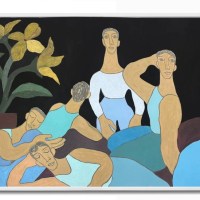
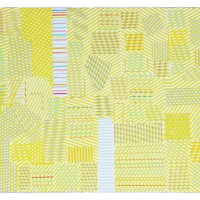
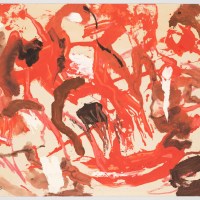
Contributed by Michael Brennan / A painter I once knew – a highly regarded abstractionist, modernist, and lover of Matisse as well as a popular professor – praised the work of a student during a critique. One of his colleagues, a postmodernist painter not so well regarded, said dismissively, “I don’t know, all I see are some colors on canvas.” The first painter replied hotly, “What the hell do you think painting is all about?” Another time, I invited a painter, now sadly sidelined, to join me at a survey of contemporary abstraction. There was a pregnant pause, “To see what exactly, Michael … shapes?” Many remain skeptical about the relevance, meaning, and remaining potential of manipulating shapes and colors. But Jane Haimes is still fruitfully exploring the possibilities. She understands that as long as there is painting, there will be shapes and colors, so we ought to make something of them.
Tag: School of Paris
Pierre Obando’s potent hybrids
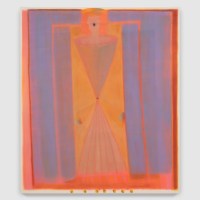
Contributed by Michael Brennan / Pierre Obando presents ten paintings, made between 2021 and 2025, in “Some Kind…,” his first exhibition at the Bushwick salon Starr Suites. While his imagery is for the most part recognizably organic, it is not easily decipherable.
Bascha Mon’s personal cosmopolis
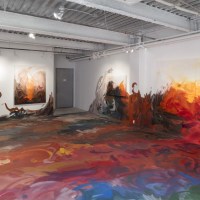
Contributed by Michael Brennan / Tappeto Volante Gallery in Gowanus is audaciously hosting a condensed retrospective spanning decades of Bascha Mon’s painting, selected and arranged by the artist herself. Her more recent work dominates the gallery’s anterior space, with paintings from the 1970s – which remain integral to her ongoing inquiry – populating the rear room….
Janice Biala’s epochal studio
Contributed by Jonathan Stevenson / A striking feature of the paintings and works on paper of Janice Biala (1903–2000), now on view at Berry Campbell in a show craftily curated by Jason Andrew, is their seamless reconciliation of civilizational clutter and spatial order. Fixing that notion is the earliest painting, The Studio (1946), arraying the artist’s active workspace and establishing her intent to embrace the world through it. (Coincidentally, Vera Iliatova’s “The Drawing Room” at Nathalie Karg gamely recaptures and updates kindred impulses.) Biala’s work here, spanning the immediate postwar period almost to the end of the Cold War and blending the New York School and the School of Paris – she lived in both cities – also bears the considerable weight of twentieth-century history, art and otherwise, with extraordinary grace and weightless cohesion, free of the strain of obvious contrivance.