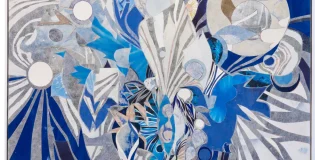
Contributed by Joe Fyfe / A large souvenir brochure accompanied Leonard Cohen’s “I’m Your Man” tour in the late 1980s. It included, among an assortment of photographs of him and reproductions of his sketches, a thousand-word essay titled “How To Speak Poetry” that has had a second life on the internet. In this singular artistic manifesto, Cohen admonishes singers that they are “among the people. Then be modest. Speak the words, convey the data, step aside.” On the next page, he tells them to “think of the words as science, not as art. They are a report.” If an audience appreciates the event, “it will be in the data and the quiet organization of your presence.” Su-Mei Tse’s current exhibition at Peter Blum Gallery seems to freshly embody Cohen’s abiding concern with presentation and how an artist must address an audience.
Tag: Caspar David Friedrich
Friedrich’s contemplative sublime
Contributed by Margaret McCann / “The Soul of Nature”at the Metropolitan Museum of Art is one of many exhibitions dedicated to German Romantic painter Caspar David Friedrich (1774–1840) on the 250th anniversary of his death. Some of his finest are absent – the epic Sea of Ice’s vision of an arctic shipwreck, The Great Enclosure’s resonant view of a Dresden field Napoleon amassed his troops on, or Ruine Eldena, one of Friedrich’s many depictions of the remnants of the powerful Catholic monastery his hometown Griefswald formed around. But there are numerous studies displaying his keen observation of nature, research he used for paintings creatively orchestrated in the studio.
Maki Na Kamura: “Caspar David Friedrich plus Hokusai minus Romanticism minus Japonisme”
Contributed by David Carrier / Born in Japan, Maki Na Kamura was trained in Germany, where she now lives and works. In that light, it’s not too surprising that she describes her work as “Caspar David Friedrich plus Hokusai minus Romanticism minus Japonisme.” Identifying herself as both a traditional painter and a contemporary artist, she notes that she might, on the same canvas, use both tempera and oil paint– two materials traditionally used separately. Her paintings and charcoal-on-paper drawings are poised between figuration and abstraction. The paintings are often centered on figures, but it’s not usually clear what’s happening in the work on view at Michael Werner. It may be hard to tell just what we are looking at, but it is obvious that her central concern is visual pleasure.