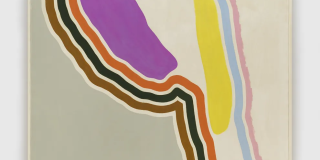
Contributed by Patrick Neal / This time of year in Norway, the sun sets around 10 o’clock at night and rises at 3 a.m., and the day shifts from misty drizzles of rain to clear, sunny skies. Whether in a city or further afield, the country’s natural topography is stunningly beautiful. Fjords, carved out by glaciers, are placid, meandering and surrounded by steep cliffs. Waterfalls cascade and zigzag down mountains, and everywhere are bright green meadows and deep, forested hills and valleys. It’s no surprise that the painter, Torild Stray mentions these climatic factors as influential to her work. As someone who has straddled dramatic atmospheric conditions, and has divided her time between North America and northern Europe, Stray has absorbed the intercontinental shifts and characteristics of different cultures.
Tag: Hokusai
Donna Moylan’s egalitarian eclecticism
Contributed by Elizabeth Johnson / “Recent Paintings,” Donna Moylan’s first exhibition at Bookstein Projects, collects works finished over the last year in her Kinderhook studio. In our email conversation, Moylan said that “sometimes paintings take years, as if they had to go off and think.” In addition to making paintings that carry time in the process of their production, she forgoes committing to a serial style, allowing her paintings to differ drastically from one to the next. “When I started doing that, in the nineteen-eighties,” she wrote, “I understood that what I wanted was to equalize, or make equivalent, many different styles of painting, and to refer to different cultures or eras with specificity but without differentiation or emphasis, without focusing on ‘styles.’” She has achieved this goal with considerable aplomb.
Sara Garden Armstrong: Immersively curved space
Contributed by Brett Levine / “A nonobjective idiom; unexpected surfaces; a synthesis of primary structures with surrealism.” That’s Lucy Lippard, in 1966, writing on the group sculpture show “Eccentric Abstraction” at the Fischbach Gallery in New York. Robert Pincus-Witten wouldn’t coin the term post-Minimalism until five years later, but that idea tracked with Lippard’s description and is arguably the strongest conceptual foundation for Sara Garden Armstrong’s “Environment: Structure/Sound III.” First exhibited in 1979, this 2024 incarnation at the Alabama Center for Architecture is a poignant reanimation and re-imagination of post-Minimalism as a practice. Accompanying the work are contextualizing process sketches, the original score, and new risograph prints.
David Rhodes: Reconfiguring the authorship of a painting
Contributed by Adam Simon / One could be forgiven for mistaking the paintings of David Rhodes at High Noon Gallery for samples of high-end décor, with black fabric punctuated by parallel diagonal stripes stretched over variously sized frames. Whether or not Rhodes anticipates that his work might elicit this response, for me it provided a hurdle, a momentary deflection, suspending my usual mode of engaging with art. I’m glad I had this moment of puzzlement, wondering what in fact I was looking at, before the significance of Rhodes’ achievement sank in.
Maki Na Kamura: “Caspar David Friedrich plus Hokusai minus Romanticism minus Japonisme”
Contributed by David Carrier / Born in Japan, Maki Na Kamura was trained in Germany, where she now lives and works. In that light, it’s not too surprising that she describes her work as “Caspar David Friedrich plus Hokusai minus Romanticism minus Japonisme.” Identifying herself as both a traditional painter and a contemporary artist, she notes that she might, on the same canvas, use both tempera and oil paint– two materials traditionally used separately. Her paintings and charcoal-on-paper drawings are poised between figuration and abstraction. The paintings are often centered on figures, but it’s not usually clear what’s happening in the work on view at Michael Werner. It may be hard to tell just what we are looking at, but it is obvious that her central concern is visual pleasure.