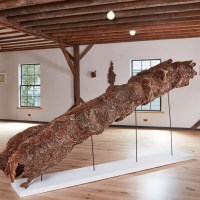
Contributed by Bill Arning / Ascending the stairs in Geary’s new space in Salisbury, Connecticut – a tastefully renovated suburban house – one anticipates modestly scaled artworks in small, semi-domestic rooms, perhaps featuring prints of duck hunts. Yet at the top of the stairs is a cavernous exhibition chamber, with rough-hewn columns of dark wood better suited to a pioneer cabin. While heavy structural beams that look hacked from timber with an axe are surprising, they seem a logical complement to Henry Klimowicz’s new work in “Methods of Proceeding.” They actually hold the roof up. Klimowicz’s monumental sculptures are all illusion, made from lightweight recycled cardboard, sliced into thin strips, and laboriously rejoined with hot glue and obsessive perseverance. Though they are dark and brooding, we can see through them. Daylight appears through gaps, as if to illustrate a fundamental principle of atomic theory: matter is largely space and only appears solid.