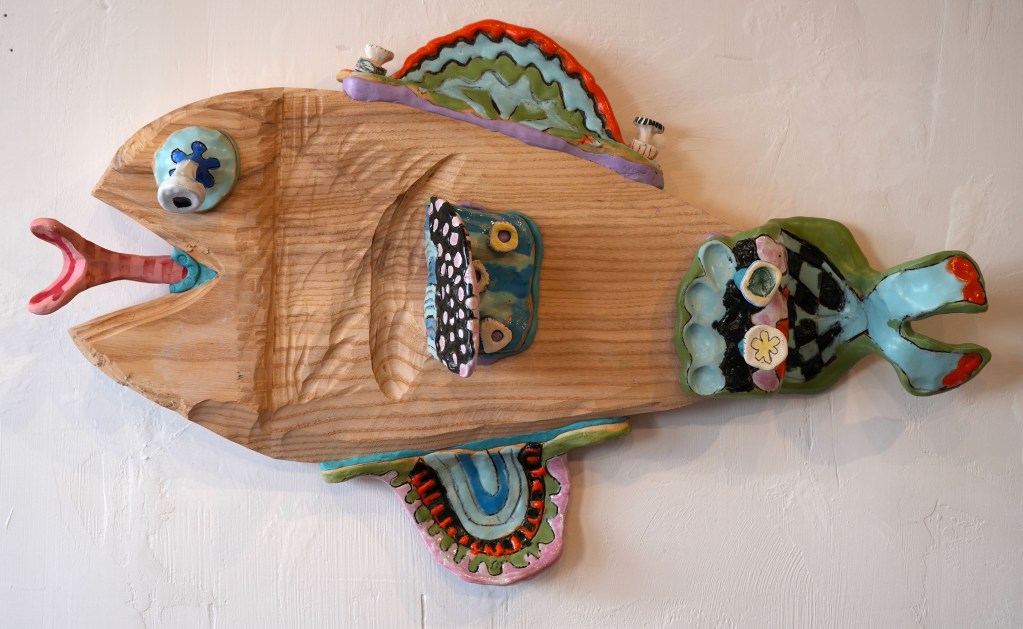
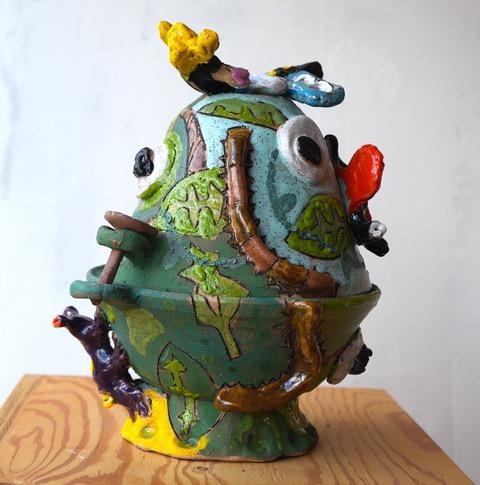
Contributed by Bill Arning / An effusively punky-queer sensibility infuses all 14 ceramic objects populating Luka Carter’s first show at Fireplace Project’s Warren Street storefront. Their image world has a phantasmagoric fantasy feel, something like a 2026 version of Pee-wee’s Playhouse. As in that environment, everything in Carter’s world is animate, everything potentially has a face, and any blank area seems destined to be covered with pop flowers and all manner of critters, every one of which could, in theory, engage us in conversation as Chairy, the friendly plush armchair with big eyes on its back and a mouth between its seat cushions, could. Take Carter’s dinner tray, crafted just slightly larger than life and seemingly meant to sit on one of those folding TV tables your folks would set up so you never had to stop watching My Favorite Martian or Green Acres. Its center handle is both a face and another dinner setting, with a ceremonial plate, cup, and bowl.
An adjacent piece, standing on a plinth made of stacked cinder blocks, has a handle in the form of an old-time airplane with multicolored wings. Dice occupy the compartment where the apple compote should be in a TV dinner, while the green-bean compartment sprouts an overscale yellow flower. The remaining corner contains a three-dimensional skateboarder leaning back, but even his T-shirt bears a curlicue and his skateboard deck could squeeze in one more flower. Carter is nothing if not an over-the-top maximalist. Surprisingly for an artist in his mid-thirties, though, Carter aesthetically predates Pee-wee Herman, harkening back to Rowan & Martin’s Laugh-In, where daisies, Day-Glo colors, cartoons, and bodies competed fiercely for visual territory. In Carter’s work too, no surface larger than three inches remains unadorned. Horror vacui is not an anxiety but a worldview, empty space another opportunity for something to come alive.

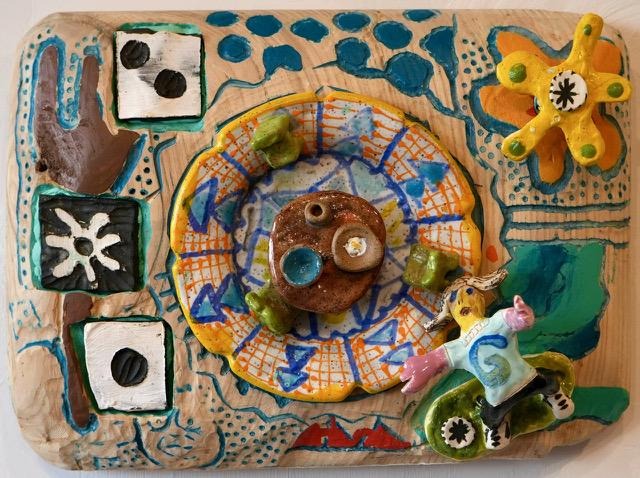
Luka Carter, Dinner Tray, 2026 ceramic, 8 x 13 x 9 inches
Carter makes a fetish of awkwardness in a very appealing folk-art mode. While over half the pieces lean toward decorative functionality – their interiors are glazed and could theoretically be used as vessels – their handles most often depict heads, flowers, or hands, causing those of us wary of damaging art objects to second-guess ourselves before manually engaging them. But engage them we must, since some of the most memorable elements are hidden inside. A pile of dirty laundry rendered in clay stood out among these interior plants. A self-portrait as a skateboard-riding hipster tucked inside a soup tureen provoked another guffaw. Even the unique percussive symphony of two ceramic surfaces rubbing together helped animate the room.
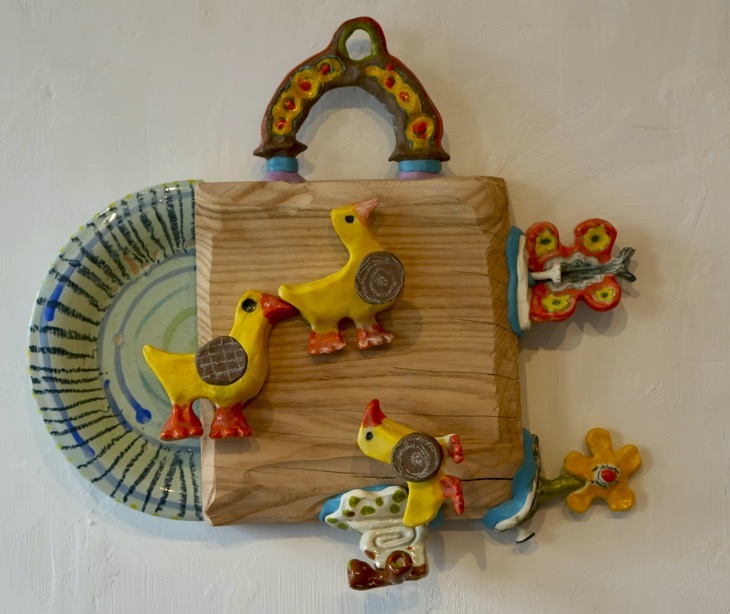
Though Carter frequently mimics Toys ‘R’ Us plastic materials designed to survive children’s natural tendency to destroy, the artist seems drawn to baked clay, which is notably durable, the oldest surviving ceramic objects dating back to the Ice Age. There is something pointedly contrary about rendering the disposable, childish, and ridiculous in a material capable of astonishing longevity. And casting a world of frivolity, surrealism, and laugh-out-loud humor in clay gives it a certain gravitas. From this perspective, the apparent declaration “I will include everything I see in my image catalog” acquires a degree of philosophical profundity. Carter is granting skateboarders, TV dinners, dice, dirty laundry, and cartoon flowers the material possibility of outliving us. And like ancient fertility goddesses and other ceramic figures whose original meanings have become mysterious, Carter’s creatures take on a shape-shifting interior mythology. One work features a three-faced duck shaking a die. Is this an animal god rolling dice to divine our futures, or just another absurd character passing through Carter’s universe? Like traditional Southern face jugs, with their grotesque or demonic masks sometimes understood as protective or spiritually charged, Carter’s mythologies remain ambiguous yet compelling.

The jokes are immediate, but their meanings refuse to settle down. Curriculum Vitae, is straightforward resembles one of those unliftable, oversized Bavarian beer steins, its surface covered with items drawn from the artist’s résumé and previous occupations, including “line cook” and, in the largest hand, “Art.” The hierarchy is funny but also poignant: all the jobs, identities, and practical necessities orbit the giant, unruly thing called art. In the sheer overabundance of images, words, and associations that characterize Carter’s work, I’d choose another phrase, hidden inside Bug’s Life, as the exhibition’s unofficial motto: “Bless this Mess.” It’s a sentiment I believe all of us would share.
“Luka Carter: Desire Lines,” Fireplace Project, 435 Warren Street, Hudson, NY. Through October 11, 2026.
About the author: Bill Arning is a curator, critic, advisor, writer, and itinerant maker of pop-up shows based in Old Chatham, New York.