
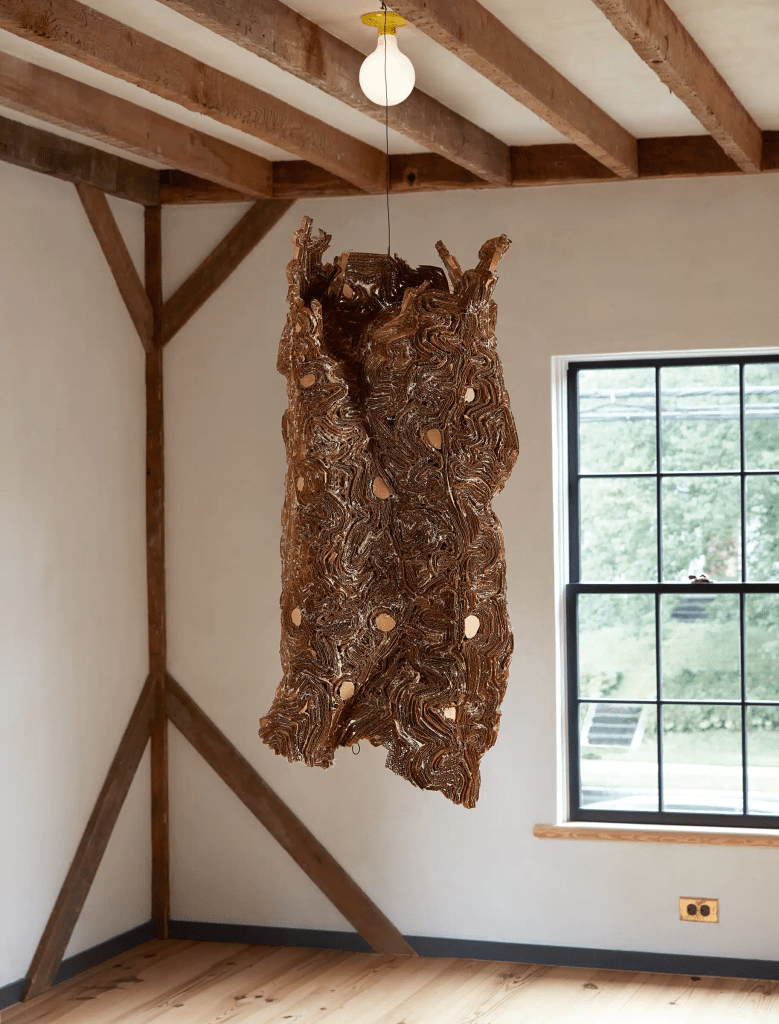
69 x 15 x 11 inches
Contributed by Bill Arning / Ascending the stairs in Geary’s new space in Salisbury, Connecticut – a tastefully renovated suburban house – one anticipates modestly scaled artworks in small, semi-domestic rooms, perhaps featuring prints of duck hunts. Yet at the top of the stairs is a cavernous exhibition chamber, with rough-hewn columns of dark wood better suited to a pioneer cabin. While heavy structural beams that look hacked from timber with an axe are surprising, they seem a logical complement to Henry Klimowicz’s new work in “Methods of Proceeding.” They actually hold the roof up. Klimowicz’s monumental sculptures are all illusion, made from lightweight recycled cardboard, sliced into thin strips, and laboriously rejoined with hot glue and obsessive perseverance. Though they are dark and brooding, we can see through them. Daylight appears through gaps, as if to illustrate a fundamental principle of atomic theory: matter is largely space and only appears solid.
We are accustomed to slicing up bulky cardboard boxes to fit them into our always-too-small recycling bins. Klimowicz, however, manages to remove the printed logos that would identify his material’s commercial origins. Repurposing cheap, ubiquitous cardboard for anti-precious art is a long tradition, the pioneers of the practice range from Schwitters to Rauschenberg. Museum conservators have spent thousands to de-acidify artworks made from 1960s cereal boxes. Klimowicz himself is a haunted master of his material, and each sculpture is treated in several ways to make it both archival and fresh.

11.5 x 9 inches / Framed 15 x 12 inches
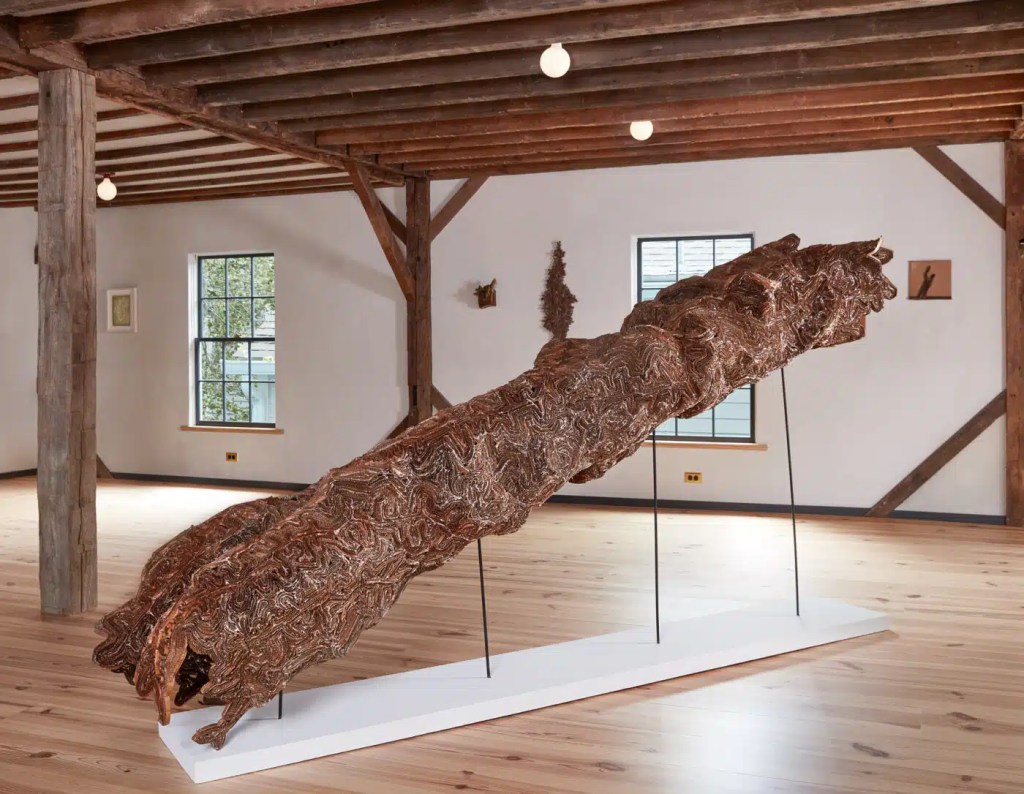
cardboard and hot glue, 62 x 24 x 112 inches
Most of his pieces hang vertically, but the largest and most intricate is angled on a mount suggesting a natural-history museum display of, say, a recently unearthed canoe, fossilized in a bog. Titled Between Salt and Society, 33,898 Days, the work memorializes Klimowicz’s relationship with his recently deceased father; 33,898 is the number of days he lived. The elder Klimowicz was deeply religious, and, as the two rebuilt their relationship, Klimowicz drew images from his father’s idiosyncratic retelling of the life of Jesus, which he was publishing online. This content is never explicit, but sustained engagement unearths a great deal. Both ends are left open, inviting us to peer inside. Klimowicz fills a structure of cardboard ribs with his favored tiny strips. He adds layer after layer to a minute blip in the interior lattice until a millimeter’s deviation becomes a seismic wave through sheer repetition.
The gallery’s description of Klimowicz’s technique employs the metaphors of the bee and the swimmer. Darwin famously marveled at honeybees’ instinctive ability to construct geometrically efficient hexagonal cells, seeing the hive as an extraordinary product of natural selection. Earlier theologians, of course, saw such apparent perfection as reflecting the purposeful design of a divine watchmaker. Klimowicz’s own studio practice can likewise seem marvelous and nearly impossible. Or, like a swimmer, the artist loses himself in a hand-based zone of creation and keeps going until his giant, mysterious forms achieve their faux solidity.
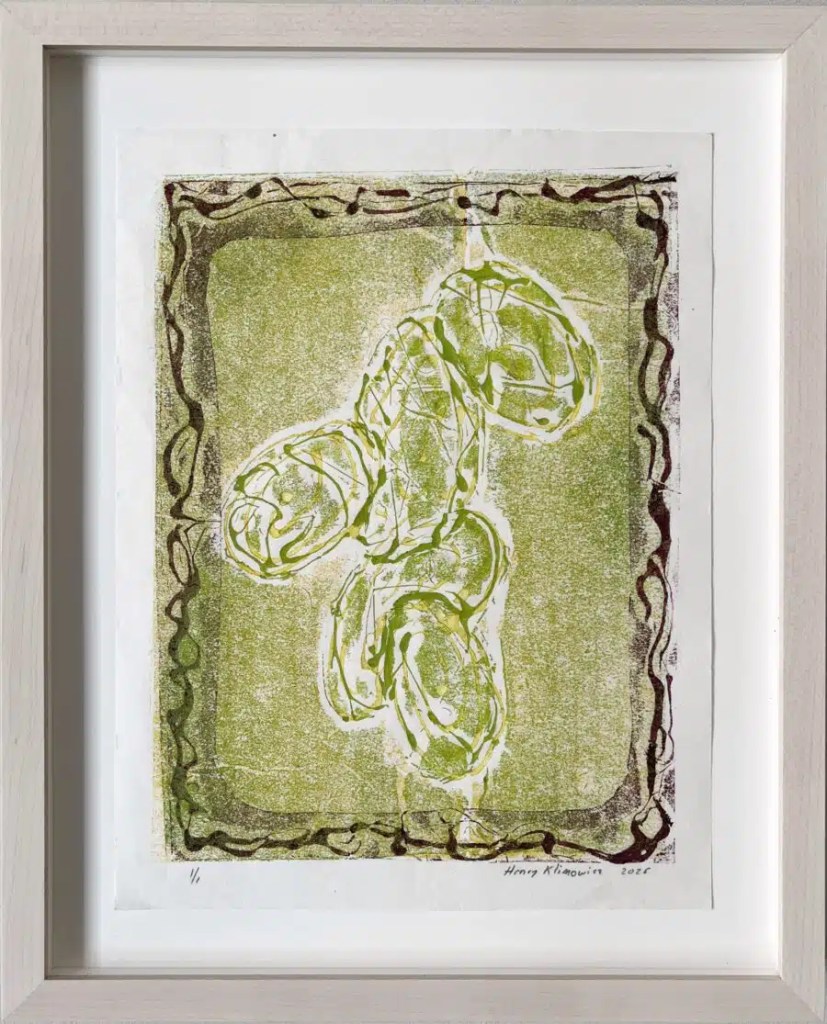
English etching ink monoprint on acid free paper, 11.5 x 9 inches
Framed 15 x 12 inches
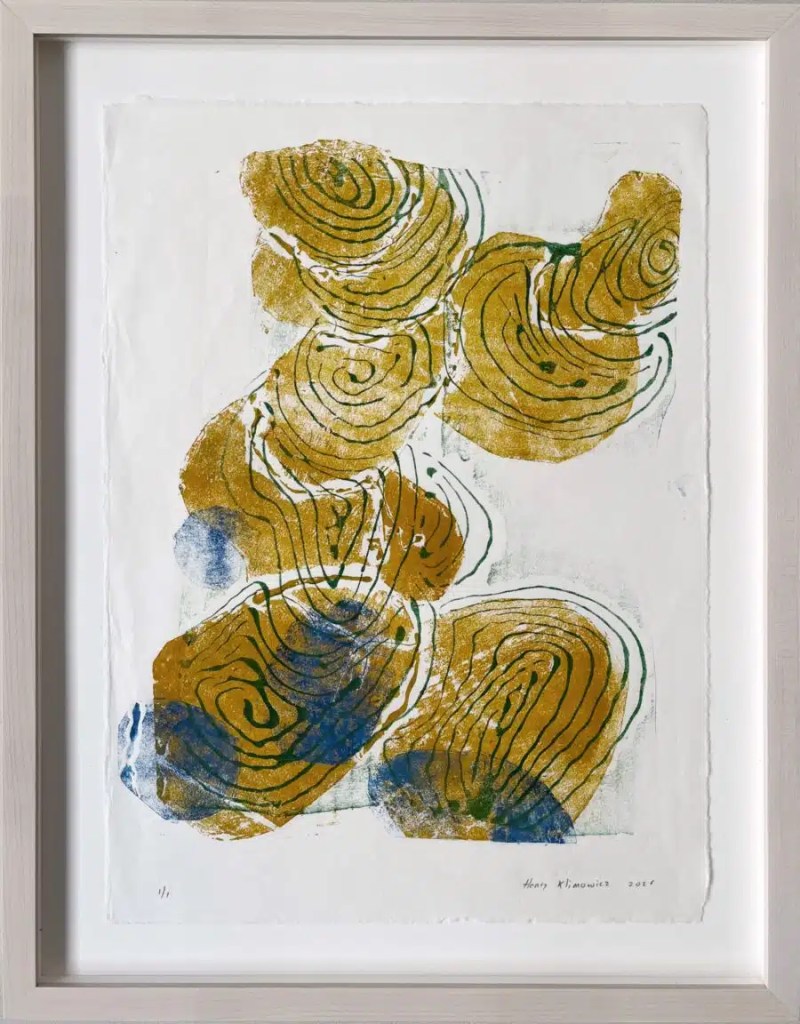
15.5 x 11.5 inches
Framed 19 x 15 inches
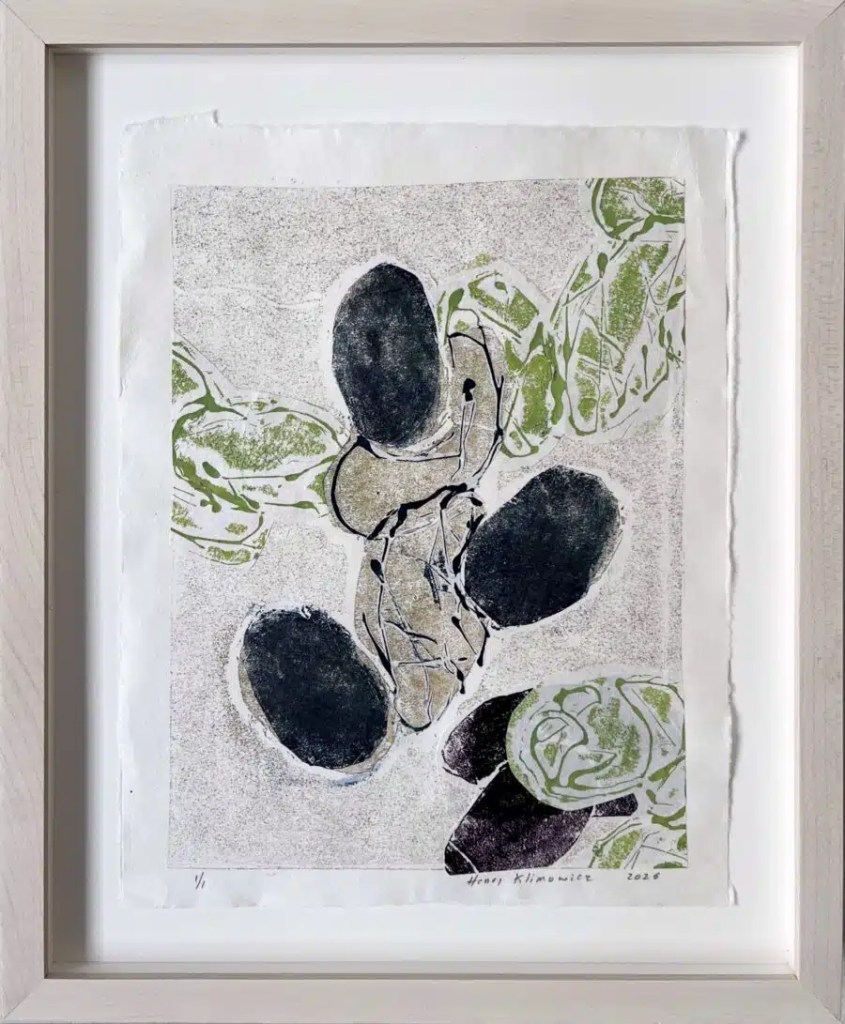
collaged monoprint on mulberry paper, 11.5 x 9 inches
Framed 15 x 12 inches
Klimowicz has begun making process-based monoprints that further reveal how the sculptures come into being. Hot glue released from a gun is a familiar craft material, and moving your eyes across the sculptures’ busy skins, you see the ooze of repeated gluing frozen in time, alternately sensuous and gross, like the yield of an explosive sneeze. Each glue string terminates in a small visual incident, twirly and almost cute. In the prints, that endpoint – the moment the artist’s finger releases the stream of glue – becomes a crucial surface event within a repetitive rhythm. Return to the sculptures after considering the prints, and their glue-drawn surfaces suddenly appear far more deliberate.
Klimowicz’s cardboard sculptures are not always this enigmatic, sometimes taking recognizable forms such as thrones or balconies. Smaller works encircling the room hint at the breadth of his image world. He is also a celebrated local arts-community hero, running the beloved Re Institute from his studio barn in nearby Millerton, New York, and creating incisive curatorial contexts for fellow travelers. But here Klimowicz shines most intensely as something simpler and even rarer: a truly singular maker of captivating three-dimensional art.
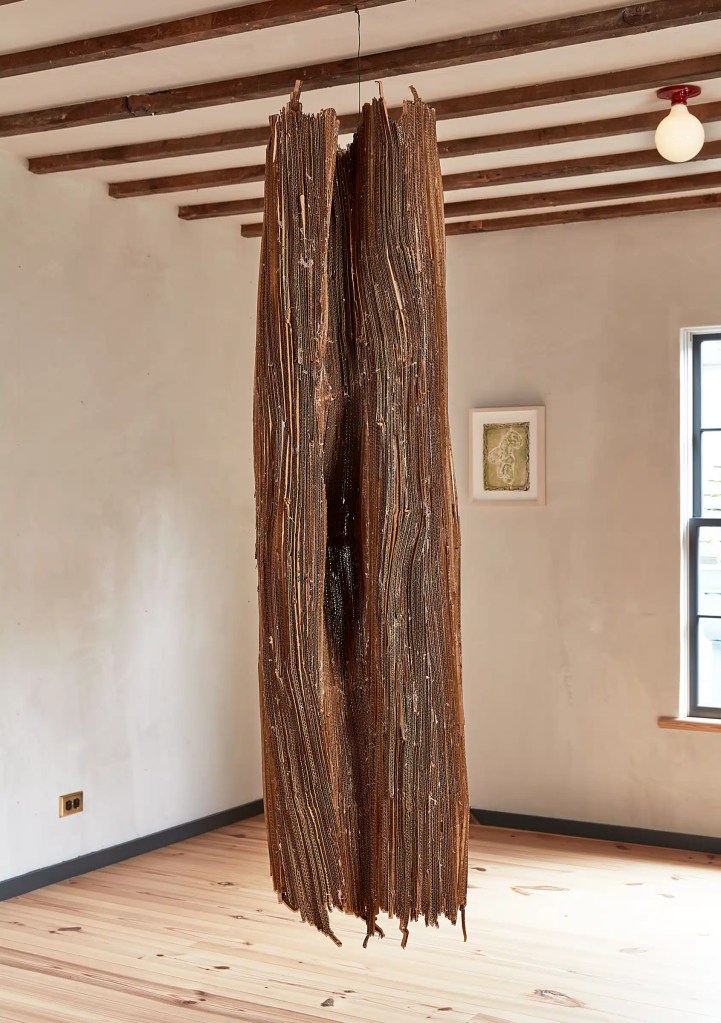
69 x 15 x 11 inches
“Henry Klimowicz: Methods of Proceeding,” Geary, 14 Main Street, Salisbury, CT. Through September 27, 2026.
About the author: Bill Arning is a curator, critic, advisor, writer, and itinerant maker of pop-up shows based in Old Chatham, New York.










I know Henry! I was amazed when I came upon his work on view at the Re-Institute while I was visiting the exhibit of my friends, the dual painters Jane Fine and James Esber (seriously wonderful).
From afar, I thought Henry’s sculpture were laborious carvings in wood, but was amazed and surprised to find that they were simply shards of cardboard! And no pretense to disguise the glue, inherently present. They looked to weighty and secure, it brought a smile to my face. Fabulously Fantastic. Bravo!
Henry Kilmowicks work and his Art Space at the Re Institute is a breath of fresh air. So nice to see work that is not simply decorative. My husband Leonard Titzer and I moved fulltime to Hillsdale from Brooklyn in 2019 and are both still actively making Art. We sometimes miss some of the Grittiness of the lower east side. Well done!
Congratulations Henry! Amazing work. Keep up the good work.