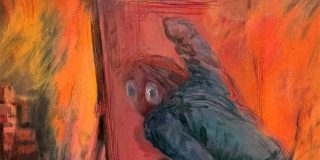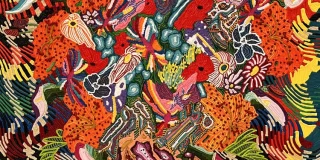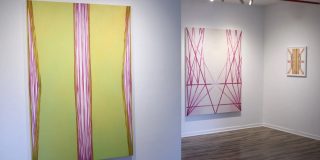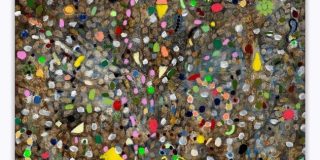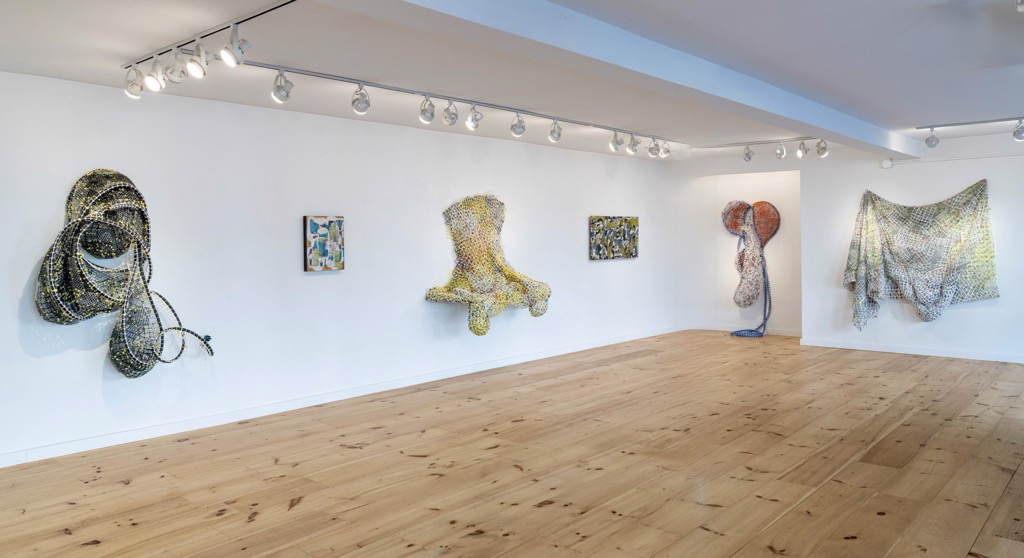
Contributed by Richard Klein / The ellipsis in the title of Joseph Fucigna’s current show “In Process …” at G-Town Arts signifies a story unfolding. Known for abstract, biomorphic sculpture made with everyday plastic materials, he has given up sculpture for painting. He had, to be sure, ventured into painting earlier with pieces like Indian Yellow_Green Gold_Black Wash Drip, importing onto canvas gravity-induced sags and drips that occurred in his sculpture. But in newer paintings such as Untitled 2_22, which incorporates scraped and sanded acrylic, he reveled immersively in what materials and labor could produce strictly on a two-dimensional surface. In creating the Pressed and Squeezed series from 2024, he employed monoprinting techniques and controlled accidents, applying acrylic paint to homemade clay board panels and then manipulating them to leave an irregular skin of paint that he then pressed onto the painting’s surface, causing wet paint to ooze through the gaps and tears.
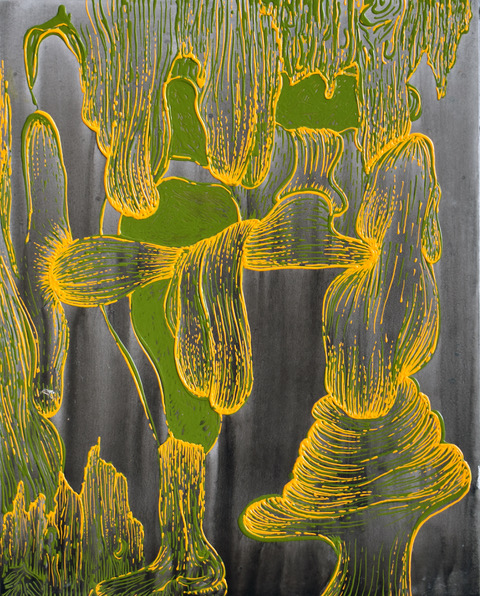
acrylic on panel, 20 x 16 x 2 inches
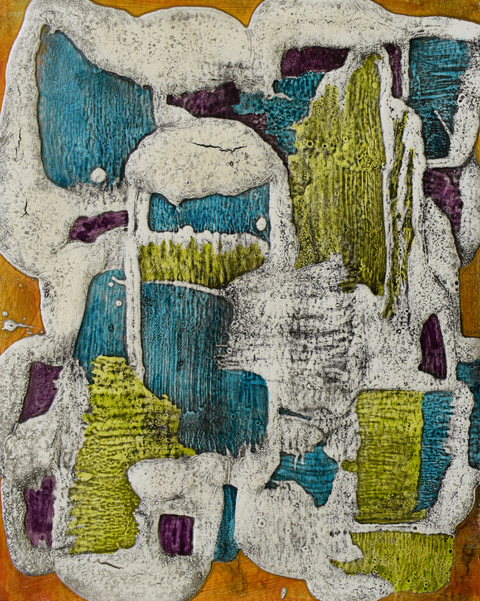
20 x 16 x 2 inches
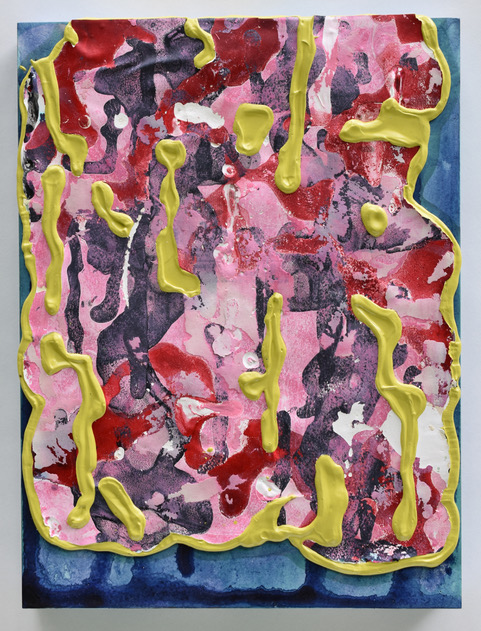
acrylic on panel, 16 x 12 x 2 inches
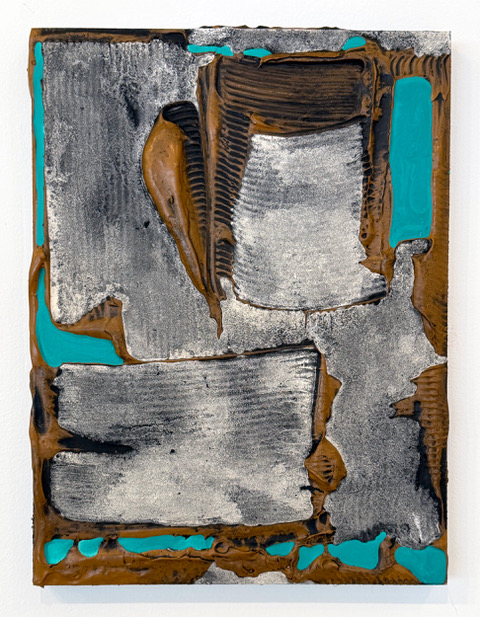
acrylic on panel, 16 x 12 x 1 inches
He began the newest paintings by pouring on a clay slurry that he rolled around on the surface to produce a textured image. Acrylic washes were then applied and wiped off to amplify the nascent texture. Then he rubbed down the surfaces with steel wool, erasing old contingencies and creating new ones. Next, he spread acrylic paint on the surface and, while it was still wet, animated it in various ways, including decalcomania, whereby a sheet of foamcore is pressed onto and pulled off a surface to yield unpredictable patterns. Once the recessed areas were dry, he filled them with more paint. Gently nodding to his sculptural roots, the artist has tried sprinkling salt on the slurry, which creates an organic texture resembling weathered cement. Excavated Fields 3_26 is a particularly successful example of this technique.
While personal and political factors have played a role in Fucigna’s transformation, its primary source was simply an innate urge to defeat ingrained habits and chart a future with no designated endpoint. The small scale of the paintings has encouraged rapid experimentation, putting Fucigna in the company of artists as diverse as Jack Whitten, Gerhard Richter, Lynda Benglis, and Stephen Maine. The artist has described the move into two dimensions as “going to graduate school again,” reflecting his belief that he is returning to a state of relative innocence. This mindset might be expected to produce works that are tentative or unresolved, but, in this case, the opposite seems to be true.
“Joe Fucigna: In Process…,” Georgetown Arts & Cultural Center (G-Town Arts), 5 Main Street, Georgetown, CT. Through October 3, 2026.
About the author: Richard Klein is a Connecticut-based artist, independent curator, and writer. His essays on art and culture have appeared in Cabinet magazine and in numerous books.